
Collage [match, found & vintage paper] acrylic
on Rives BFK
8.5 x 5 in.
Monica Church
Monica Church works between painting and collage, building mixed-media pieces from handmade papers, family ephemera, and protest paste-ups pulled from the street. She thinks of collage as a product of wartime and rebuilding — a medium where glue and paper outlast scarcity. With Andrea Burgay, she co-founded Transforming Collage, whose 2026 symposium at the Vassar Institute for the liberal arts gathers artists, historians, and curators around the medium's expanding field.
In the Words of the Artist
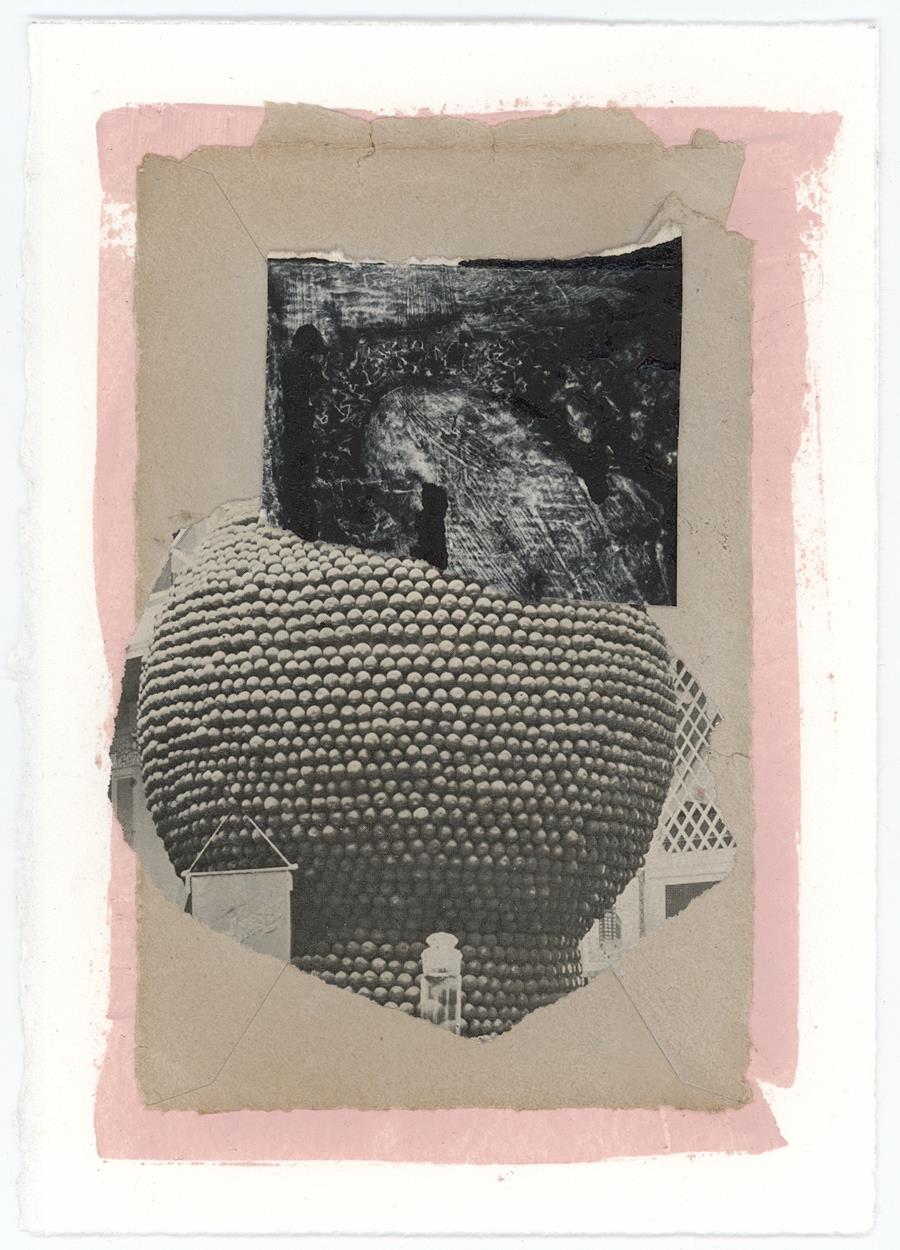
Collage, acrylic on Rives BFK
5 x 7 in.
On the most basic level, collage is a juxtaposition between two disparate elements that become one by using an adhesive. In many ways, Andrea Burgay & I are disparate elements, and our collective, Transforming Collage, is how we merge our ideas and hopes for what collage can do for us individually and for the broader arts community. Collage steps outside of formal rules and often upends our expectations. How do these strange paper elements and materials transcend their differences and become unified?
In a finished collage, my family ephemera becomes something new, part of a larger story. However, each element also holds memories or connections to people or places. I can tell you where I collected each element and/or what family member it is from. There is something powerful in giving archival materials a new life and story. The risk is ruining the original object- I rarely, if ever, use fabrications or copies, I rely on the risk factor of potentially destroying something important to my history in hopes of providing it with a new context.

Collage [Polaroid transfer, found paper] acrylic
on Rives BFK
6 x 4 in.
A blank canvas or piece of paper is a unified support that is interrupted when paint or paper fragments are introduced. I incorporate collage elements onto my surfaces, knowing that my goal is to reunite disparate elements to formally read once again as a unified surface and not individual elements. My training as a painter, and relying on painterly considerations, helps me create collages that do this. When a viewer looks at my paintings, they will often see non-paint elements like pieces of music, handmade papers, or eggshells, integrated onto the picture plane.
Looking at my collage works, there is a continuum of material selections. I use paint, Caran d’Ache crayons, or colored pencils to add areas of color. I eagerly explore this middle space that exists between painting and collage. Even in my purely paper collages, the way I read them is from a painter’s perspective- in the same way that I grew up in Vermont, that perspective is embedded inside me. A painted element is often my first gesture or approach to a collage. It sets the stage for the paper elements.
I have a love for handmade papers and paper that has been held and embedded with DNA. Both mediums support each other, and the surface qualities are unique to each. I move back and forth between paint and paper seamlessly, however I am unable to give up the painted surface quality. Materially, it holds power in the way light passes through it rather than off it.

Collage [papers sourced from the streets of Berlin Germany & Vietnam], acrylic
on Stonehenge
6.75 x 5 in.
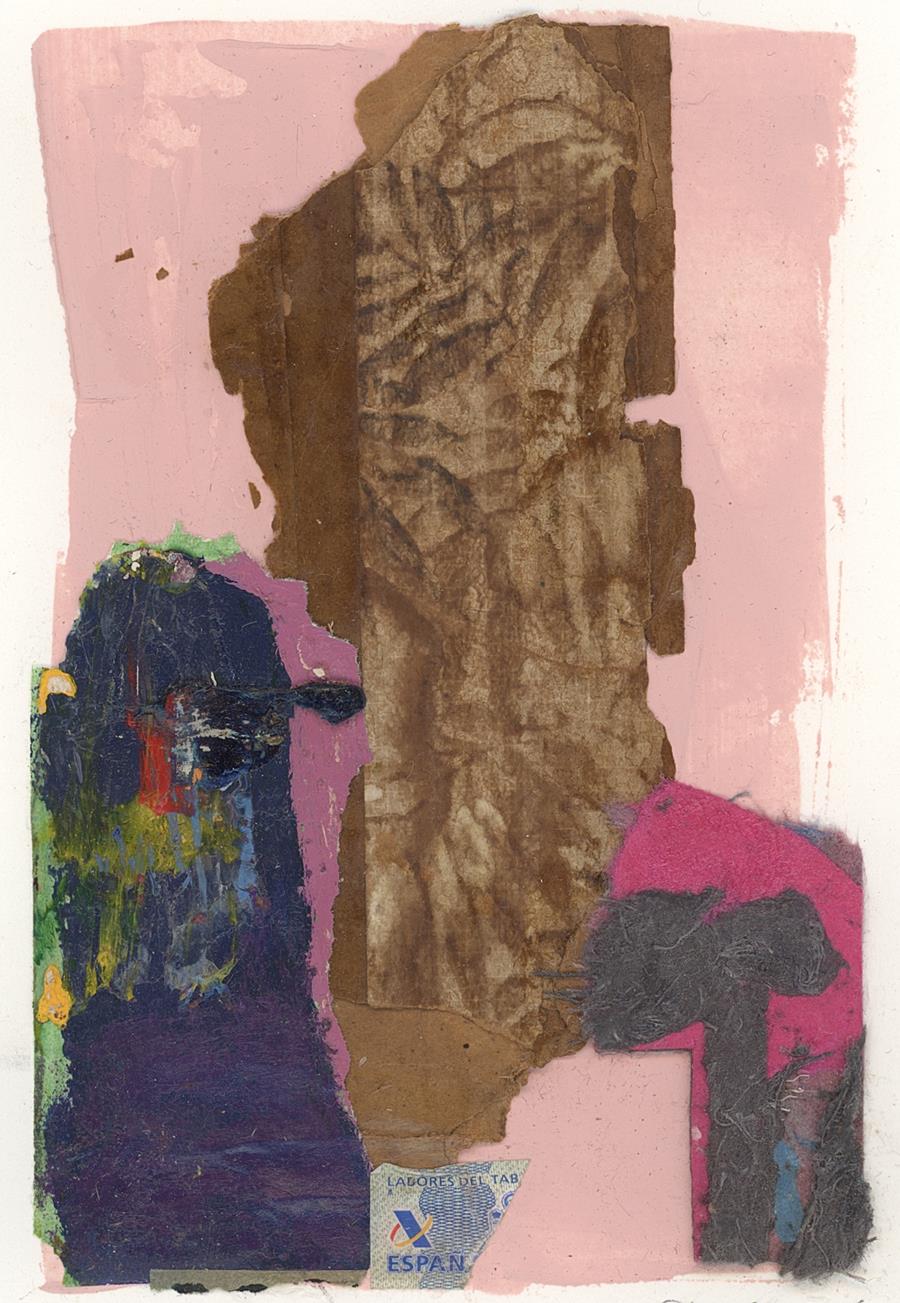
Collage [handmade & vintage paper, cigarette tax stamp]
acrylic on Rives BFK
7 x 5 in.
I respond to political, historical, and cultural events by using the production and distribution of agitprop that appears on walls, street signs, and surrounds these charged moments. Sourcing protest stickers, political posters, protest paste-ups as materials allows me to change the context and elevate both my voice and the original protester’s message and offer my critique.
I think collage emerges during economic hard times, conflict, and post-war rebuilding. I am aware of this charged history when traveling and making work. While on a research trip to Hanoi, Vietnam in 1992, my first series of collages was made from what little paper I could find. This was before the US lifted sanctions against Vietnam, so Hanoi had fallen on hard times. Everything was used or recycled, leaving little waste or litter. Toilet paper, receipts, pages from Russian books used for wrapping vegetables, and lottery tickets served as the basis for a series of 30 small collages, From the Streets of Hanoi. Since then, I have worked in other post-conflict spaces, among them Myanmar, Ireland, South Africa and Berlin. In post-war countries, where traditional art materials are scarce, glue and paper are more easily found.
Artists can use the political language and imagery of the opposition and recast the message to mean something completely different. Through litter and posters, one learns a great deal about a place’s political and economic health. I also have a large archive of family materials—photos, souvenir postcards, letters, sheet music, bible, napkins—because my father was a World War II vet and my parents lived through the Great Depression. Everything was saved.
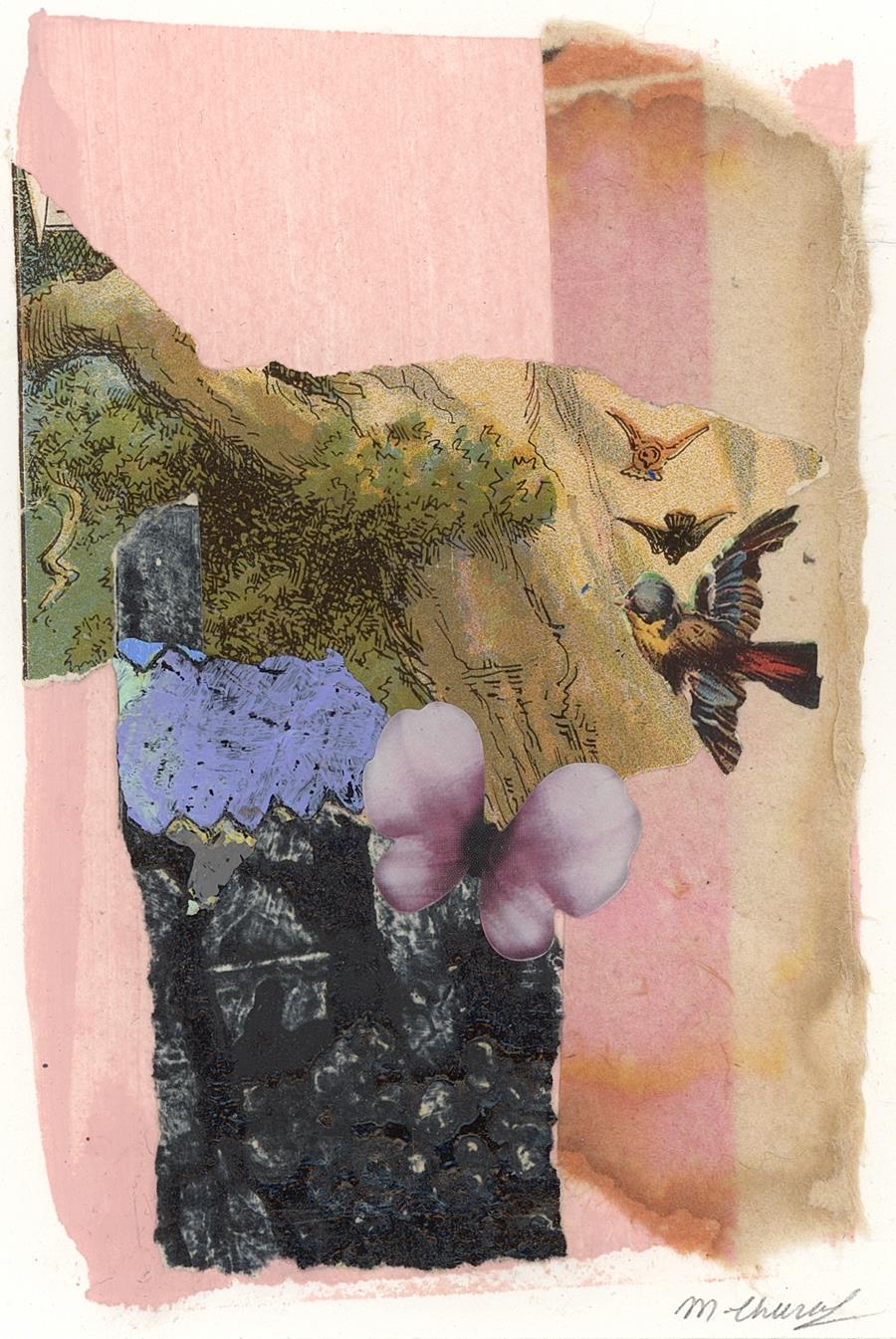
Collage [collagraph, handmade paper, vintage paper]
acrylic on Rives BFK
7 x 5 in.
It’s not that there wasn’t anything being said, it’s that there is so very much being said! I am interested in the ever-expanding field of collage and how it is classified. The practice itself is an underpinning for many other art fields. There are digital spaces and in-person gatherings that support the creation of new works, and there are forums focusing on the presentation and intersections of the study of collage.
Making Meaning: A Collage Symposium is happening in the midst of one of the most artist-dense regions in the world, New York’s Hudson Valley. It is bringing together artists, historians, publishers, and curators in one space—The Vassar Institute for the Liberal Arts— that was created for such gatherings. The symposium will serve as a think tank for many who want to discuss collage’s role in today’s world. Transforming Collage—Hudson Valley, ten collage exhibitions each focusing on a different approach to the medium, will serve as a springboard for continuing the conversations begun during the symposium. c
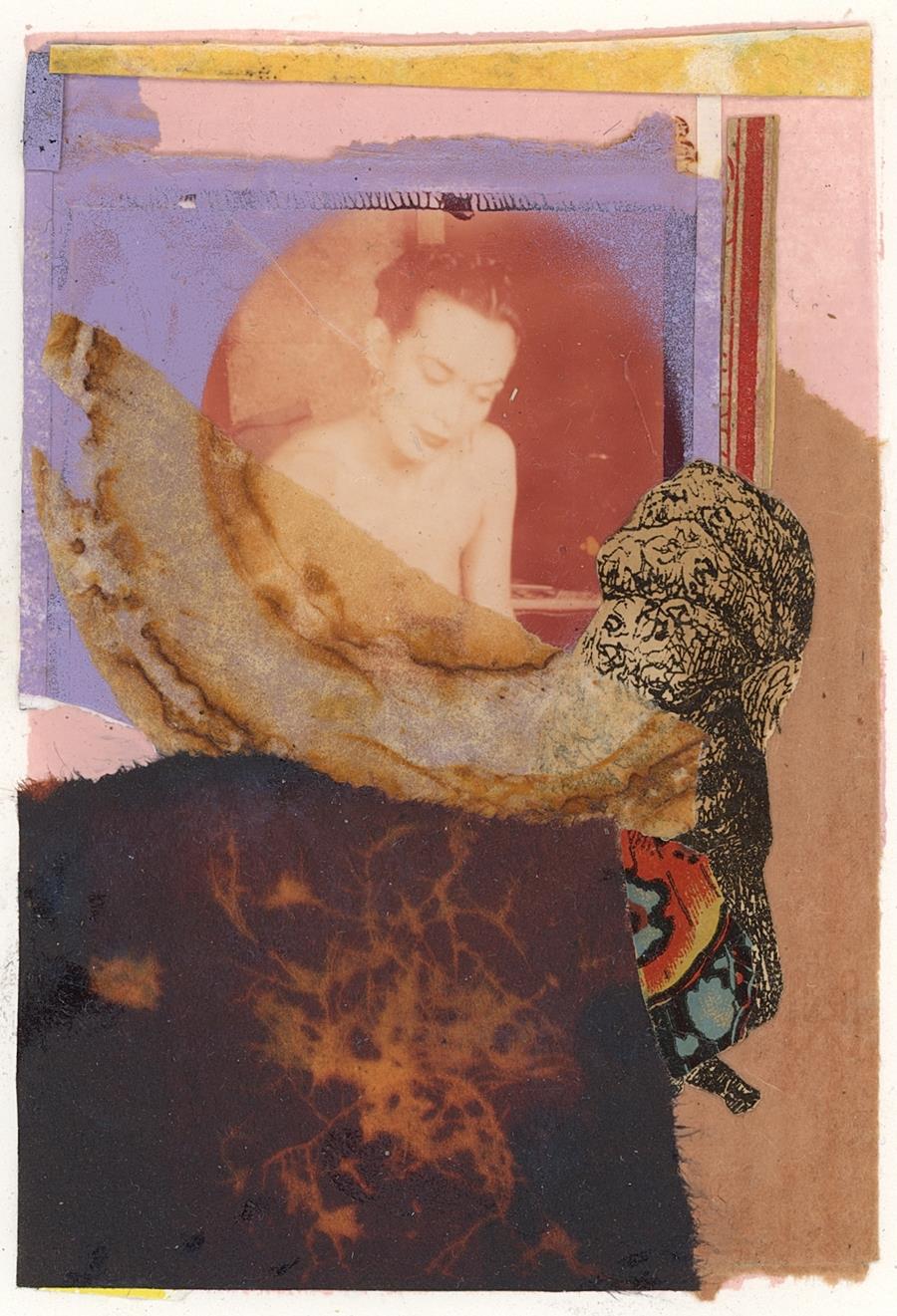
Collage [Polaroid, vintage & handmade paper] rust,
spray paint, acrylic on Rives BFK
7 X 5 in.
About the Artist
Monica Church is a visual artist and curator. She studied printmaking at Rhode Island School of Design, has a B.A. in visual arts from Bennington College, and an M.F.A. in painting from The University of Kentucky. Monica focusses on the continuum between collage and painting. Her work combines passages of color and delineated shapes with physical materials like found papers, sail material, and ephemera from her family archive. In some pieces, she emphasizes structural materials and in others surface activity and color space.
Along with artist Andrea Burgay she founded Transforming Collage, an artist-led collective. The collective supports projects that explore collage as a transformative practice—conceptually, materially, and socially. Their 2026 projects are Making Meaning: A Collage Symposium and an accompanying exhibition series Transforming Collage: Hudson Valley.
For Your Viewing Pleasure
What to watch, read, and experience, as curated by the Collé team.

ALLISON ANNE is an interdisciplinary artist based in Minneapolis with their two cats. allison works in a variety of mediums including collage, zinemaking, publishing and graphic design.

CRAIG AUGE is a multidisciplinary artist and curator whose art toggles abstract collage and ephemeral salvage assemblage. Works are improvisational, intuitive, and responsive, emphasizing process over product, regenerating materials and entire artworks.

TODD BARTEL received a BFA from Rhode Island School of Design in 1985 concluding his studies at RISD’s European Honors Program in Rome. His work assumes the forms of painting, drawing, and sculpture in a collage and assemblage format. His work investigates the interconnected histories of collage and landscape and the roles of nature and natural resources in Western culture.

PALOMA TRECKA was born in Xalapa, Veracruz in 1964, raised by artists and anthropologists between Mexico and Europe before settling in Montreal to study Studio Art and Design for the Theater at Concordia. She grew up surrounded by music, folklore, and performance, and works under the artist name Paloma Shaloma.

ANDREA BURGAY is a visual artist, publisher, and curator based in Brooklyn, NY, originally from Syracuse, NY. In her work, paper and print media undergo processes of accumulation and deconstruction, with the resulting works bearing the markings of these visceral transformations.
Out and About
What to watch, read, and experience, as curated by the Collé team.

▼ VISIT
Raymond Saunders: Flowers from a Black Garden, Jun 26 – Jan 3, 2027
Flowers from a Black Garden at Orange County Museum of Art, moves freely across the artist’s career. Through more than thirty works, it investigates his multifaceted and nonlinear process of picture making.

▼ VISIT
Putting it Together: Transforming Collage on view until July 12th
A wide-ranging exhibition designed to explore and expand our understanding of collage. Through historic approaches or contemporary art processes, this exhibit is a deep-dive into the practices and concepts of collage, as we define, redefine, reimagine, reinvent, and sometimes break rules.

▼ LISTEN
Gnawing At The Chord by Ovven
Owen Burton's debut sits openly inside the Asheville fuzz-guitar lineage, Lenderman, Wednesday, Fust, produced by Alex Farrar at Drop of Sun. Made to be played loud.
