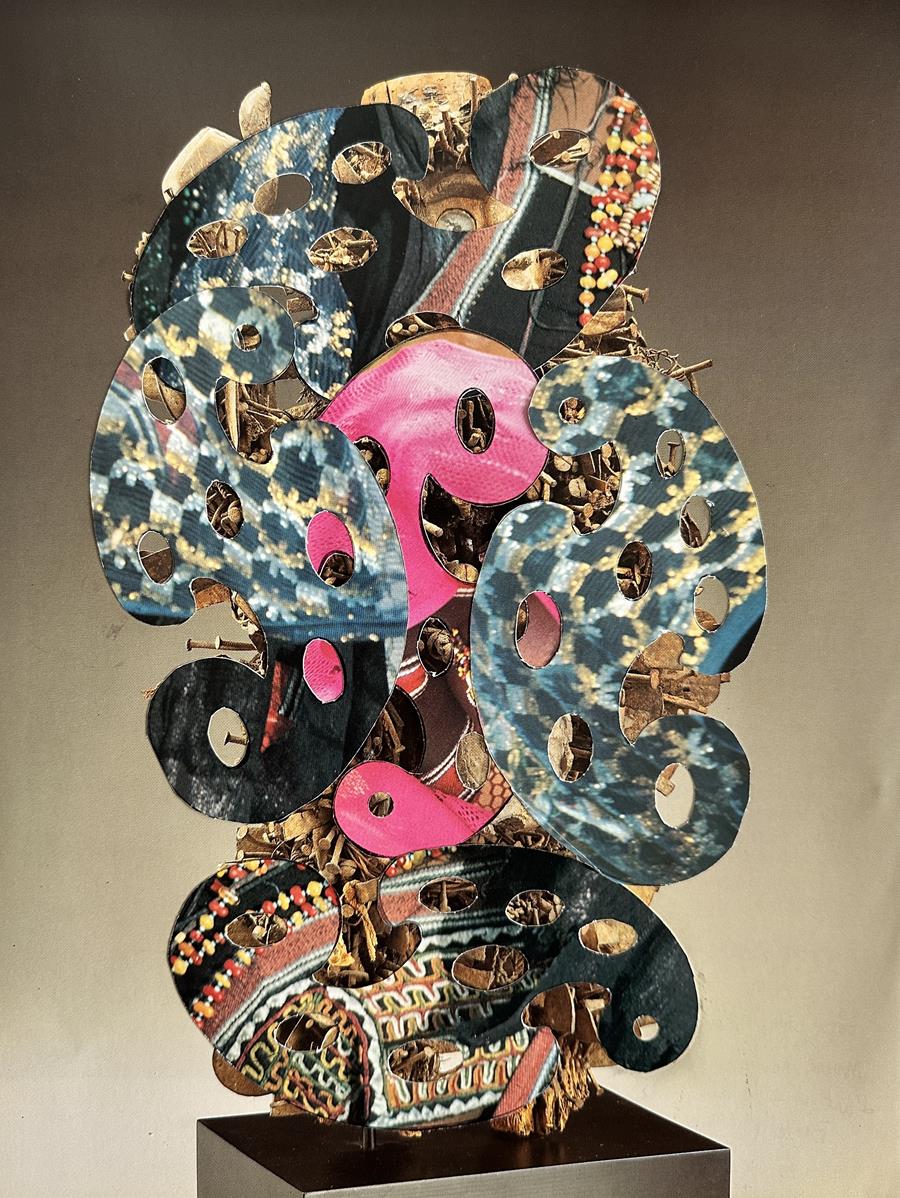
cut and stenciled calendar image
on museum catalog page
9 x 12 in.
Helen Kauder
New Haven collagist Helen Kauder cuts into images of museum objects with a French curve, the drafting tool used to plan ships and buildings. Her portholes and channels reopen histories of status and power that institutions present as settled.
In the Words of the Artist
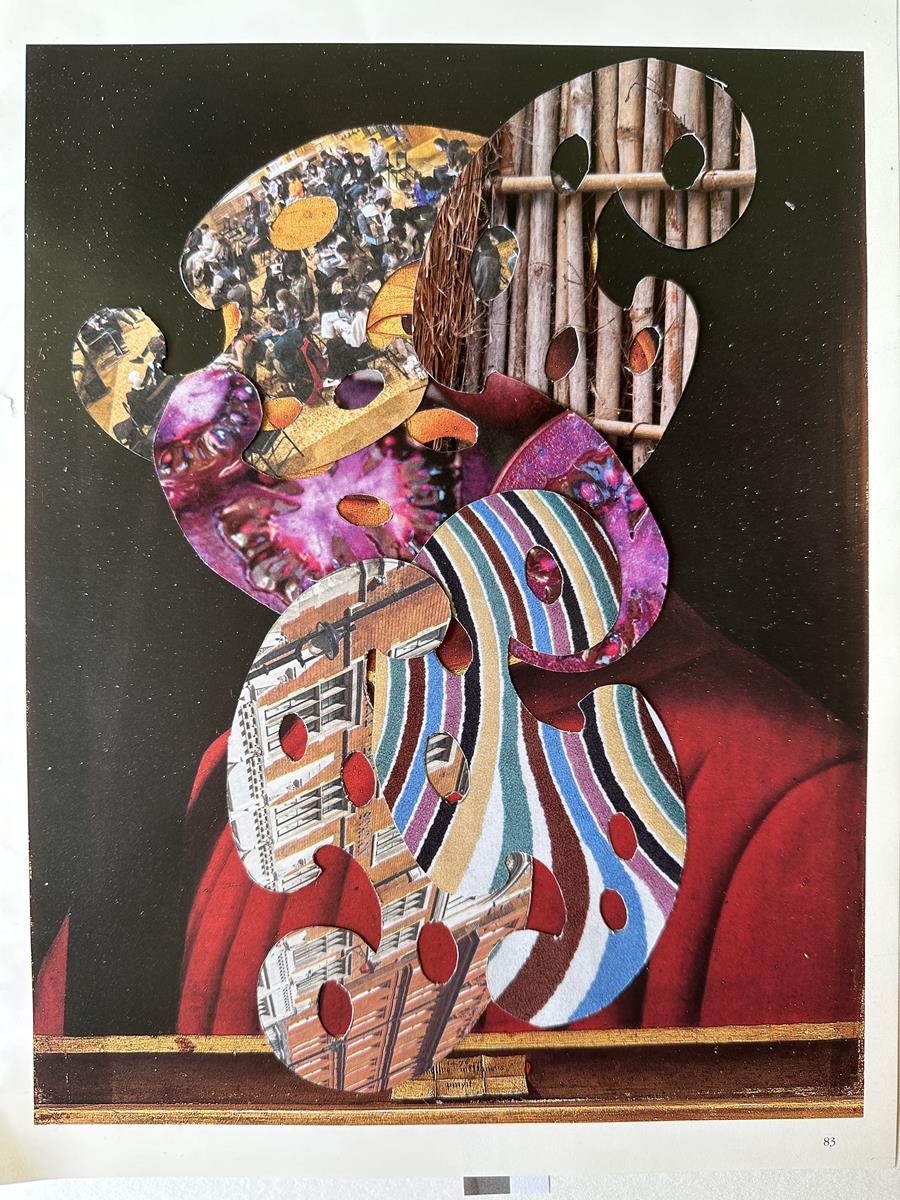
Cut and stenciled magazine pages
on museum catalog page
9 x 12 in.
I often start my studio time picking up yesterday’s offcuts from which I construct a flat, abstract assemblage on a small piece of black cardstock. It brings to mind the sly, humorous installations of Jessica Stockholder and the teetering, ethereal collage structures of Janice McDonald. I am striving for a nonsensical arrangement that conveys a simultaneous sense of harmony and dissonance.
I follow the principles of Ikebana, a very formal and intentional Japanese flower arranging technique that I studied years ago that strives for interplay between carefully positioned floral stems and the negative space between them–alternating tension and release. After this first exercise, I might spend some time drawing with my left hand (I’m right handed) and make some somatic loopy forms that I re-trace, enlarge, and map onto some subway billboard paper from my stash, and then carve and try to smoosh together––work that has an artistic kinship with Elizabeth Murray’s shape-based paintings. Finally, fully warmed up, I’ll turn to the French Curve, also known as the isometric helix. Mentally and physically, this is the most demanding of the avenues I pursue.
It’s a lot of trial and error, searching and tentative layering, rarely fast and loose. Whatever I have made, I usually end the day by documenting what I have laid out, but I wait for the next day to glue the pieces down, after a morning reassessment. Besides Elizabeth Murray, my other go-to artistic influence is Mikalene Thomas; each day usually includes some time admiring her compositions, halftones, and color choices.

Cut and stenciled magazine pages
on museum catalog page
8.5 x 11 in.
I stumbled on the plastic forms at the art supply store early in my collage journey–they happened to be displayed next to the glue section! Since I grew up figure skating, having to make figure eights on ice with my inside and outside edges, I was curious about the precise lines that I could make in tracing the curves with my knife. It took off for me as a meaning-making shape when I realized that so much of the built environment is created to signal ambition, aspiration, permanence, and power.
As I experimented, I discovered that these clear plastic forms were like a shaped lens, allowing me to hone in on enigmatic moments within ready-made images, and on historic objects, buildings, and figures that were depicted or collected to convey status and power. The interior ellipses in the helix tools become invitations to carve out portholes, portals, or channels to accentuate specific substrate imagery, and thus offer ways to tell a story across time and contexts. I am hoping to expand both the conceptual and the expressive possibilities of the French Curve.
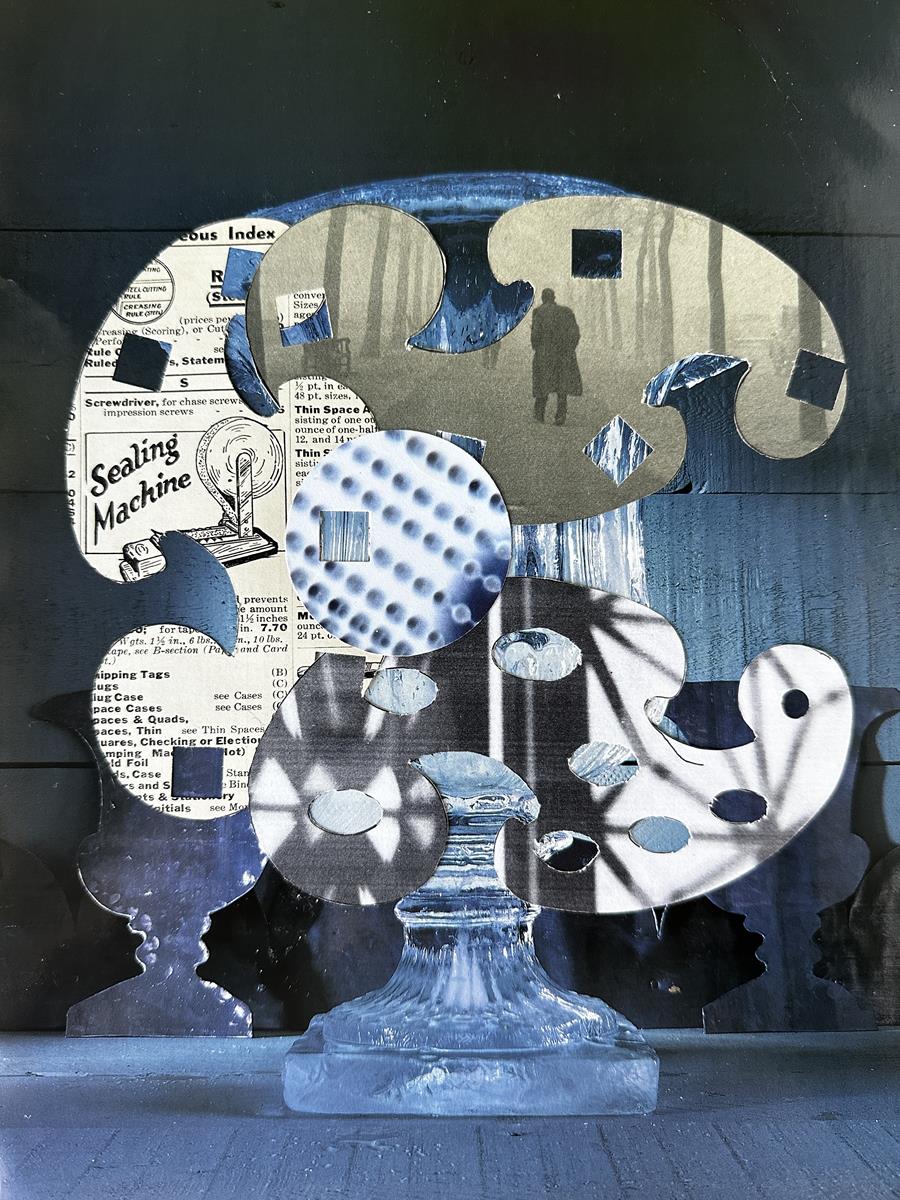
Cut and stenciled tissue paper and magazine pages
on museum catalog page
8.5 x 11 in.
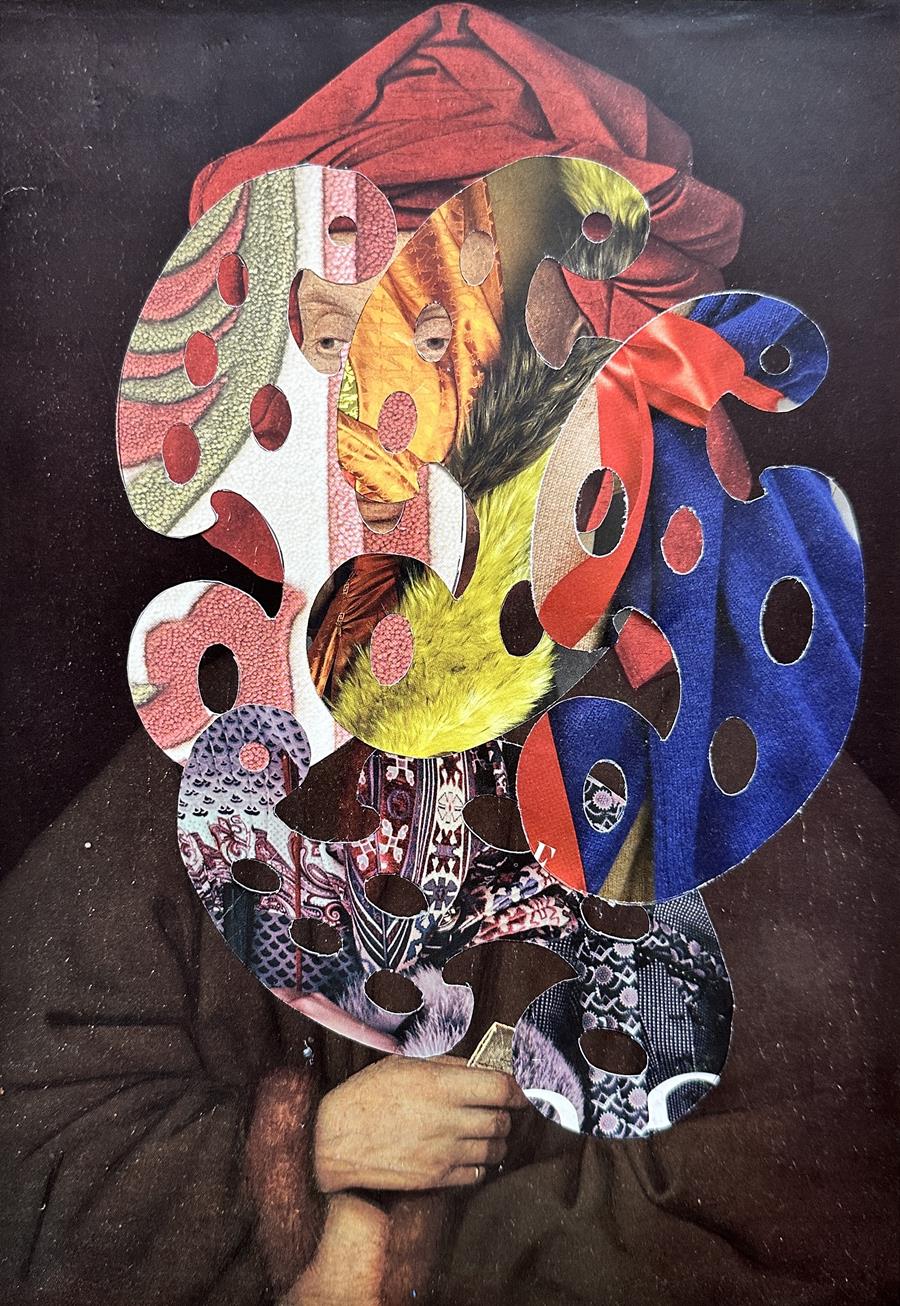
Cut and stenciled magazine images
on museum catalog page
9 x 12 in.
The objects I am generally drawn to are bodies on some kind of pedestal or base. Formally, the body’s curves form a harmonious dialogue with the helix, so there is an underlying family of geometries and proportions that are related and whose images generate energy when juxtaposed. I have built an archive of images of textiles and garments that I have already stenciled and pre-cut. I’ll rifle through the stash, looking for dramatic curves, assertive draping and folds, and generally for ways to harness the dynamism of curvilinear forms.
The narrative potential emerges in a trial-and-error process, obscuring and revealing story elements by placing and rotating the cut paper until a connection–formally or narratively– appears. The stories might contemplate an imagined dialogue between past and present, underscore past failures, or offer a speculation on a possible future. Within that proposition, there can be repair, critique, allegory, or even satire. Of course, at the moment, there are many museum objects that have contested origins or are the subject of repatriation or restitution discussions. In the most basic sense, I am conveying that the objects held in institutions have histories that are still being written and are worthy of our attention. I aim to keep those objects alive in the collective imagination.
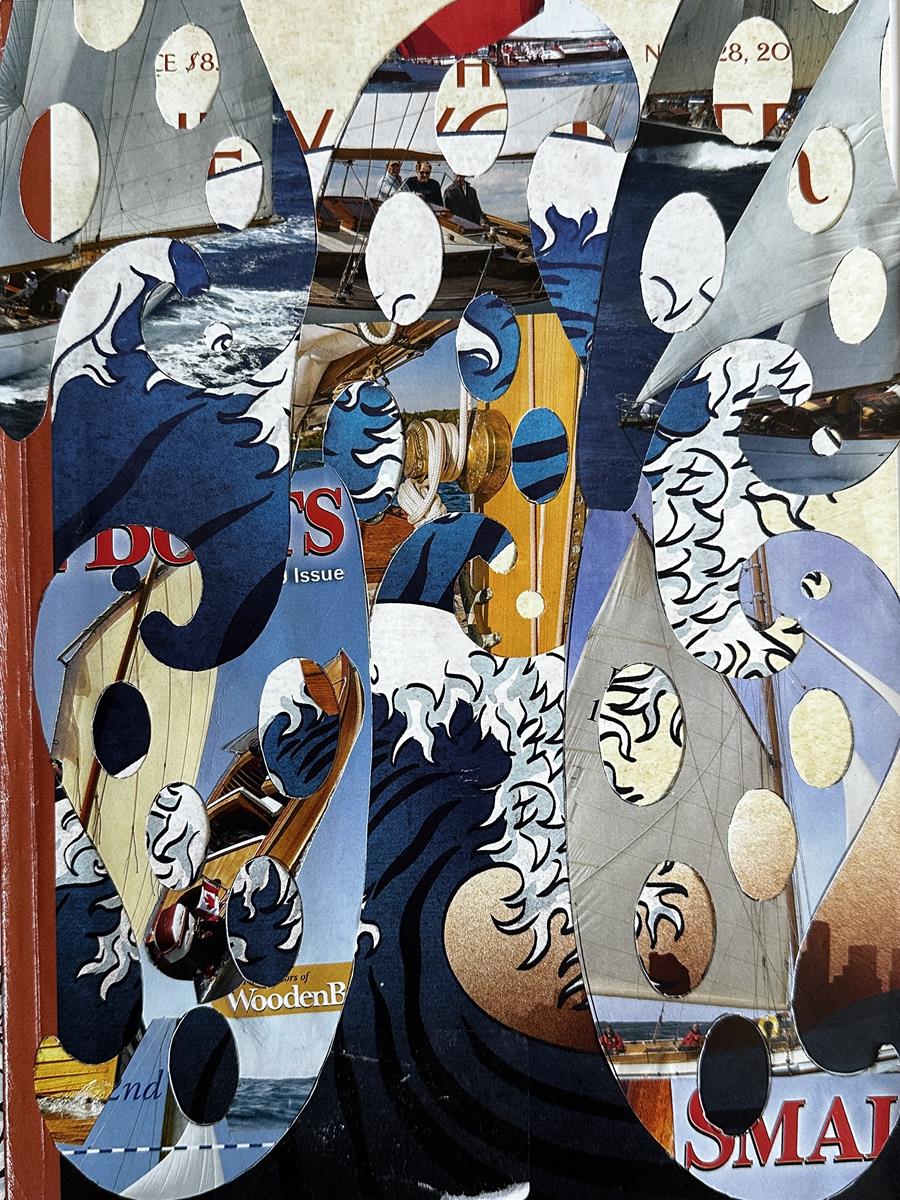
Cut and stenciled elements from Small Wooden Boat Magazine
on New Yorker Magazine cover
8.5 x 11 in.
Collage is how I try to tame the chaos in my head and represent the turbulence in the world. It’s how I conjure structure, building blocks, logic, and associative juxtapositions, aiming to make something surprising for myself in the process. Collage–whether my own or the output of fellow collagists–provides a jolt of electricity and a strong sense of community. I am endlessly inspired by the collagists in my feed.
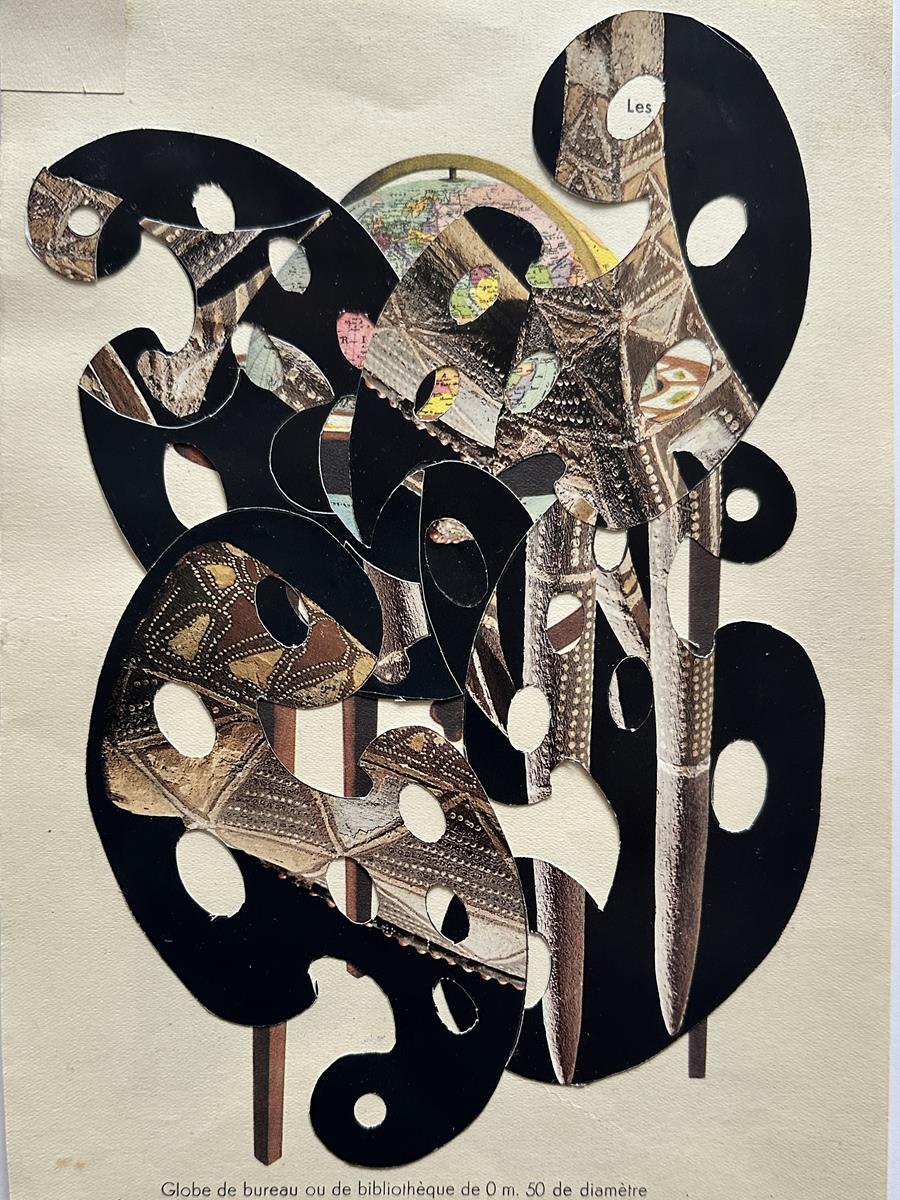
Cut and stenciled museum catalog page
on vintage magazine insert
8 x 10 in.

About the Artist
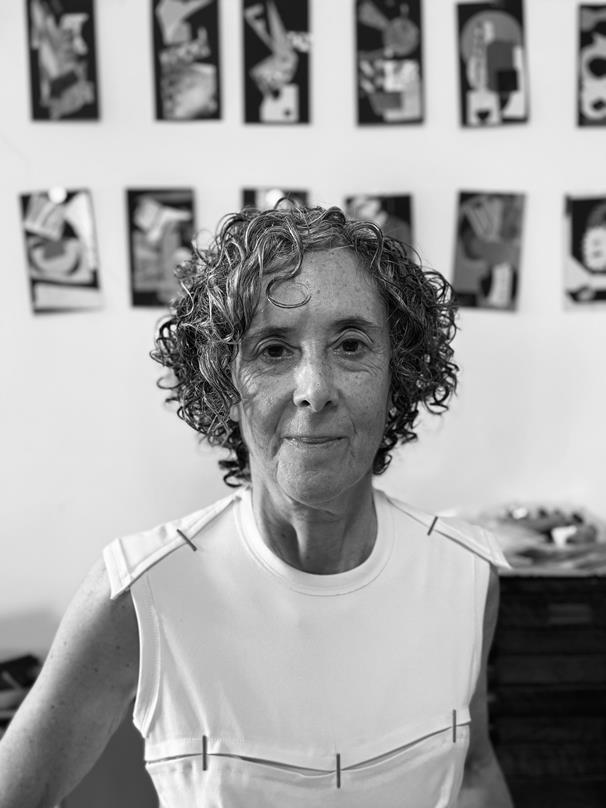
Helen Kauder is a collage artist based in New Haven, CT. For 20 years, she served as Executive Director of the alternative space Artspace, New Haven, and also did a stint as Deputy Director of The Aldrich Contemporary Art Museum in Ridgefield, CT, and consulted for the Hammer Museum at UCLA.
Her collage work has been included in group shows at Field Projects, NYC, Craft Alliance, St. Louis, MO, Hartford Artspace, CT, and in numerous community arts shows across Connecticut, most recently a 3-person collage exhibition (with Lesley Finn & Matthew Shelley) at Keyes Gallery at the Willoughby Wallace Memorial Library. Her work is included in recent Cut Me Up Magazines (issues curated by Craig Auge and Allen Bealy). First Prize Winner at CT Women Artists Exhibition, Slater Memorial Museum, Sharon Butler, Juror. Recent experiences and projects: 2025 Collagist in Residence at Openbach in Vincennes, France; Curated Parallel Cosmologies, an exhibition of 60+ Connecticut collage artists at Ursa Gallery, Bridgeport, CT, and forthcoming, in collaboration with Rosanne Walsh and others, Anatomy of an Exquisite Community; Some Assembly Required, a series of gatherings of collagists playing the Exquisite Corpse game in collage, for a 2027 exhibition.
For Your Viewing Pleasure
What to watch, read, and experience, as curated by the Collé team.

ADDISON BALE is a painter whose gestural work draws on the worn surfaces of New York: aging infrastructure, weathered signage, and the detritus that collects at street level. The paintings find form and color in what the city discards.

MATTHEW ZAREMBA (b. 1983) is a Boston-based artist whose spare, minimalist drawings take on the heart, the mind, and the strange mechanics of how people connect. He works in collage, mixed media, painting, and public murals.

SARA ZINELLI is an Italian-born collage artist and photographer who learned to print black-and-white photographs in London darkrooms in the 1990s. Her analogue collages combine her own and family photographs, hand-painted papers, and pressed flowers, exploring memory and vulnerability.

MARIETTA MAVROKORDATOU (b. 1996, Cyprus) lives and works in Athens. Recent exhibitions include Emmelines, New York (2026); Camera Austria, Graz (2025); Benaki Museum, Athens (2025); Radio Athènes, Athens (2025); and Brunette Coleman, London (2025).

HELEN O' LEARY earned an MFA at the School of the Art Institute of Chicago, IL. She has been honored with the Rome Prize American Academy in Rome, Citavella Ranieri Fellowship, Italy, Hennessy Purchase Award, IMMA, Dublin, John Simon Guggenheim Fellowship; two Pollock-Krasner awards; the Joan Mitchell Award for painting and sculpture; and several grants from the Arts Council.
Out and About
What to watch, read, and experience, as curated by the Collé team.

▼ VISIT
Erin Shirreff: New Work at Sikkema Malloy Jenkins, New York
Shirreff’s new work continues her thinking on object-image translation and how materiality, our experience of an object, is lost or gained through image. These cyanotypes and print collages inspire and rework her sculptural practice. Her collaged prints reimagine past sculptures as intangible forms, dissected and rebuilt, while the cyanotypes inspire new steel sculptures. On view through December 19, 2026.

▼ READ
Lorna Simpson Cuts Across Time by Zoë Hopkins on FRIEZE
With new shows in Venice and London, Lorna Simpson talks with Zoë Hopkins about Ebony magazine clippings, a 1957 album of two people staging themselves for the camera, images she sat with for years before knowing how to use, and collaging photographs so the people in them outlast their moment.

▼ LISTEN
U.F.O. by Jim Sullivan
This is the debut album by psychedelic folk singer-songwriter Jim Sullivan, released in 1969. The album was unpopular upon release, but has gained a cult following in part due to the mysterious disappearance of Sullivan.
