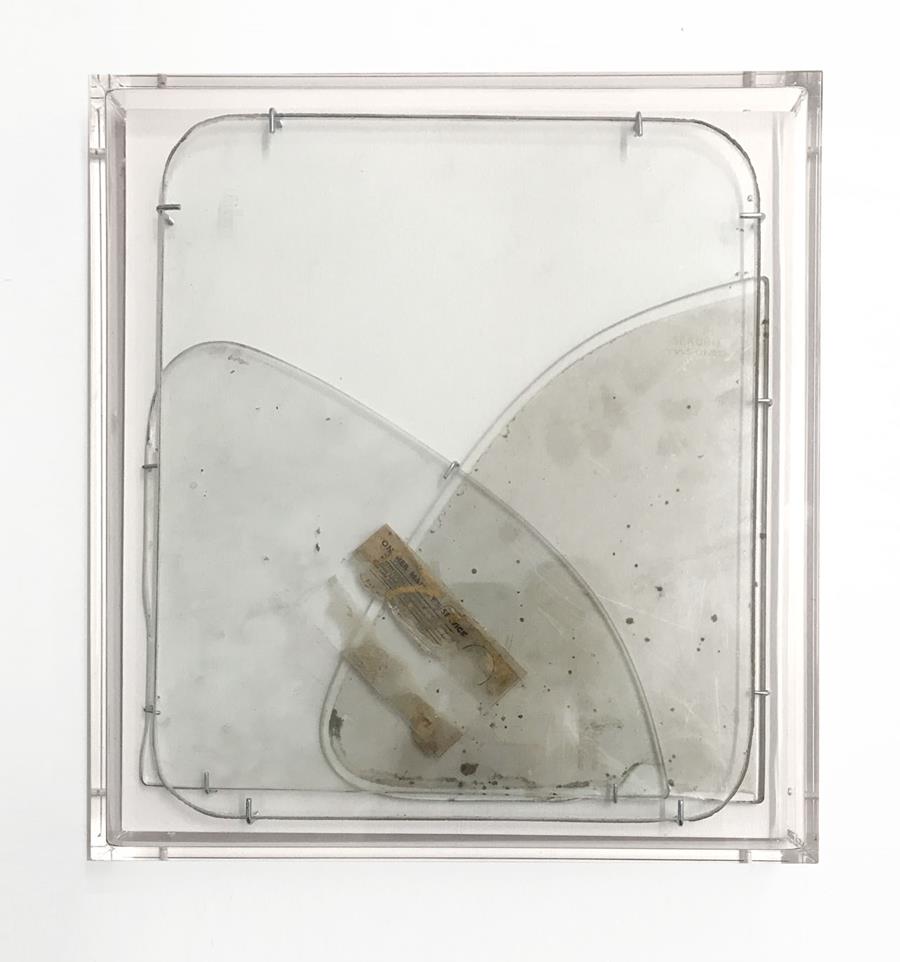
TIme-stained car panes, hooks, plexiglass frame
37 x 40 cm
Anneke Eussen
Anneke Eussen creates compositions from found glass and industrial remnants, arranging them with a minimalist approach that still allows the history of the materials to be visible. She keeps each element in its original framework, then uses overlap, fracture, and repetition to generate new color, depth, and rhythm while letting the material’s previous life remain legible. She reflects on how materials hold time and shifting value, and why collage, for her, is a way of seeing that never fully resolves.
In the Words of the Artist
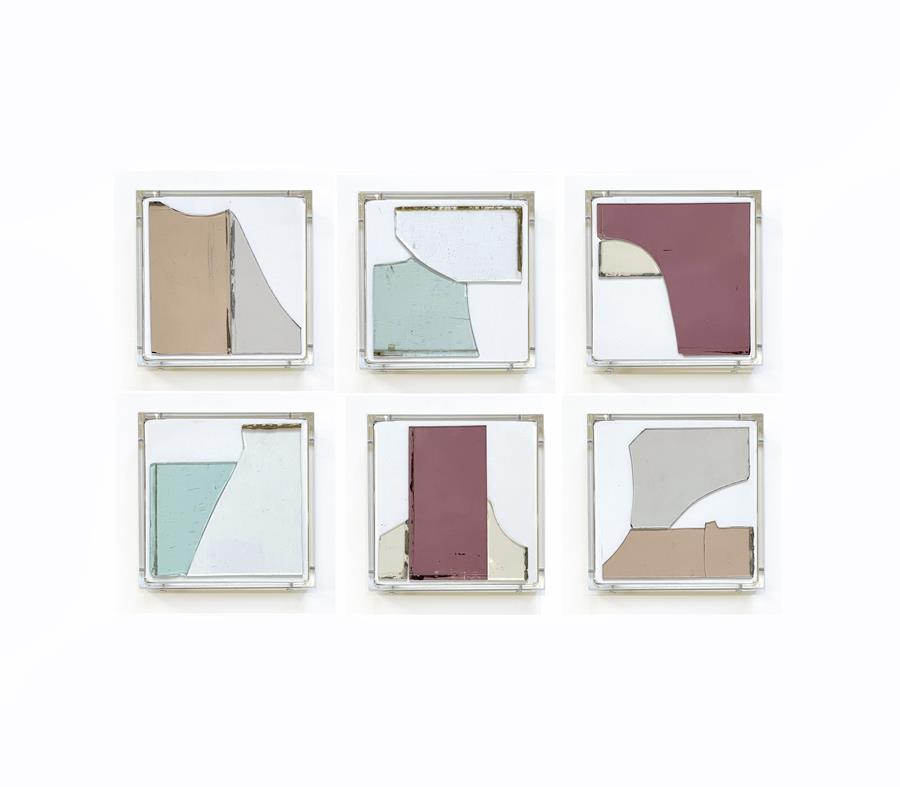
Recycled glass, nails, plexiglass frame
12 x 12 cm each
I've always been drawn to abandoned places and discarded objects. The question of why something has value for someone and how that value changes or disappears completely remains the common thread in my research. I've never really sought out a specific material. It's more about the presence of everything in our constructed environment and how we interact with it. About 10 years ago, I first walked through my father's and grandfather's abandoned business premises. The halls were deserted, and in a small space, I found racks full of glass. They were windows from post-war vehicles. For over 60 years, they lay there untouched, forgotten. I created my first glass works using these windows. The time-worn plates became a symbol of how the past, present, and future are captured in our environment.
After that, glass became a material I consciously seek, find, and buy. By working with it, I discovered a material that, for me, connects the living and the inanimate. The glassmaking process is an ancient craft that has been adopted by industry. It is infinitely recyclable. The breaking of glass is uncontrolled and leads to a unique shape created by the circumstances of the break. Thus, for me, glass is a material that can transform from an industrial form into a natural one. It thus embraces the two aspects of our environment: constructed reality and natural reality.
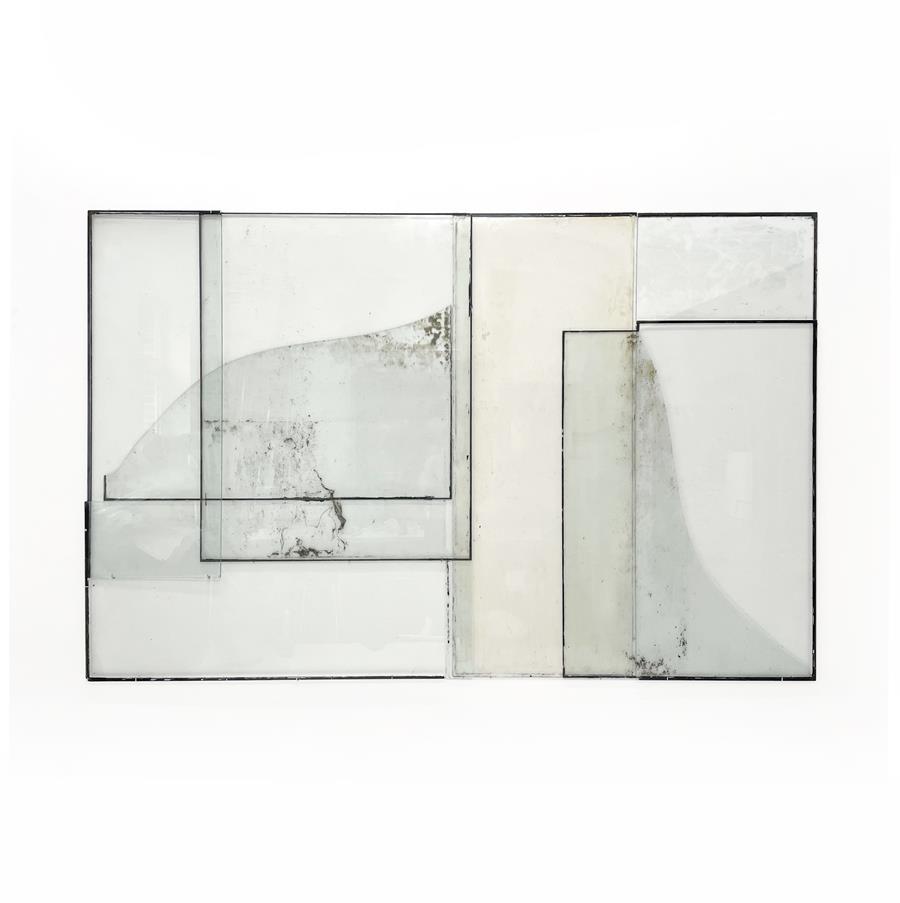
Recycled glass, hooks
160 x 250 cm
By incorporating used glass, bits of history are incorporated into my work. Sometimes the origin of the material is known, but often it has already been moved and can no longer be traced back to its original location. I still go out and search for materials myself, but now items also come to me as gifts. The way the materials reach me isn't so important. What matters is that an energy is captured and that I sense time, value, and transformation within them.
I believe assemblage is the joining of existing forms or products without altering them. For me, collage is the merging of forms, creating forms that weren't there before. The layering of my work creates a third dimension. Even if the glass is thin, this third dimension is highly influential; the transparency of the glass ensures that overlapping is not obscured. Deeper shades of color emerge at the points where the panels overlap; these are also the areas of the work where new forms emerge. Creating the compositions often follows these new forms; the artistic process of placing the panels sometimes feels like painting. The layers create depth and allow colors to merge. Often, geometric, straight shapes converge with organic fractures.
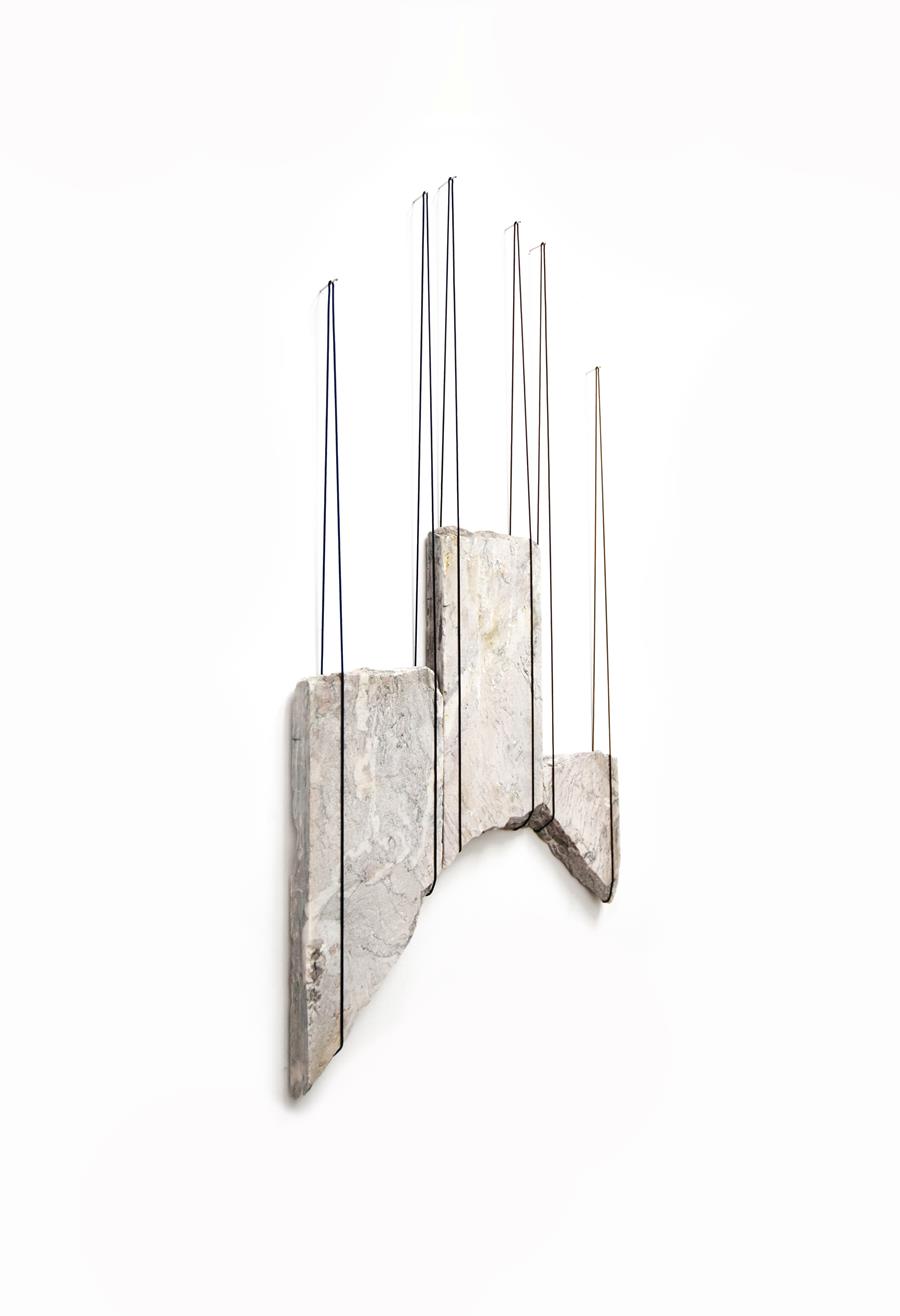
Recycled marble, black thin rope, nails
75 x 39 cm
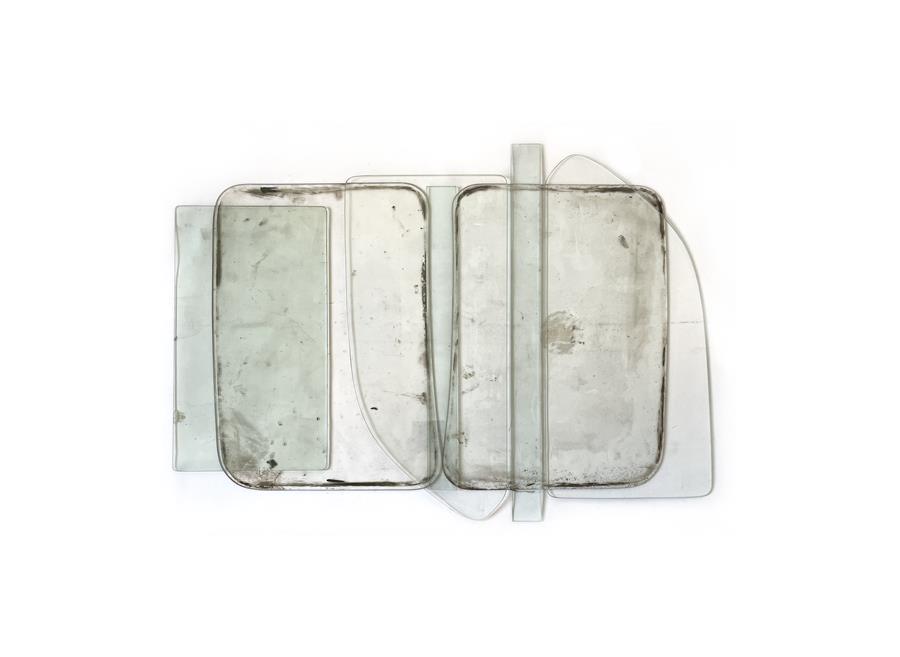
Time-stained car panes and recycled glass, hooks
90 x 127 cm
Collage is an arrangement of separate parts, permanently or temporarily combined. For me, collage symbolizes how we function as human beings. Our vision isn't fixed. It's a process, a collection of experiences, lessons, thoughts, memories, feelings, and dreams. The truth of where you stand in life is always a mixture of elements, a collage that is never finished.
Repetition refers to a rhythm, a perception of time. Counting, copying, and repeating are systems for grasping the fleeting nature of time. The element we cannot capture, manipulate, or exclude. The irregularity embodies stories, traces, and stains. They are part of the work because it is strange to me to not embrace the past. Trying to erase it or pretending to start with a clean slate, just doesn’t make sense.
Finding peace and balance in a composition is an act that comes very naturally to me. A broken piece of glass transforms when its break connects to the break in another piece. Suddenly, the break doesn't cut off anything but becomes the line that flows through. This continuity refers to time, the constant movement in our environment that has the greatest influence on our personal collage: life itself.
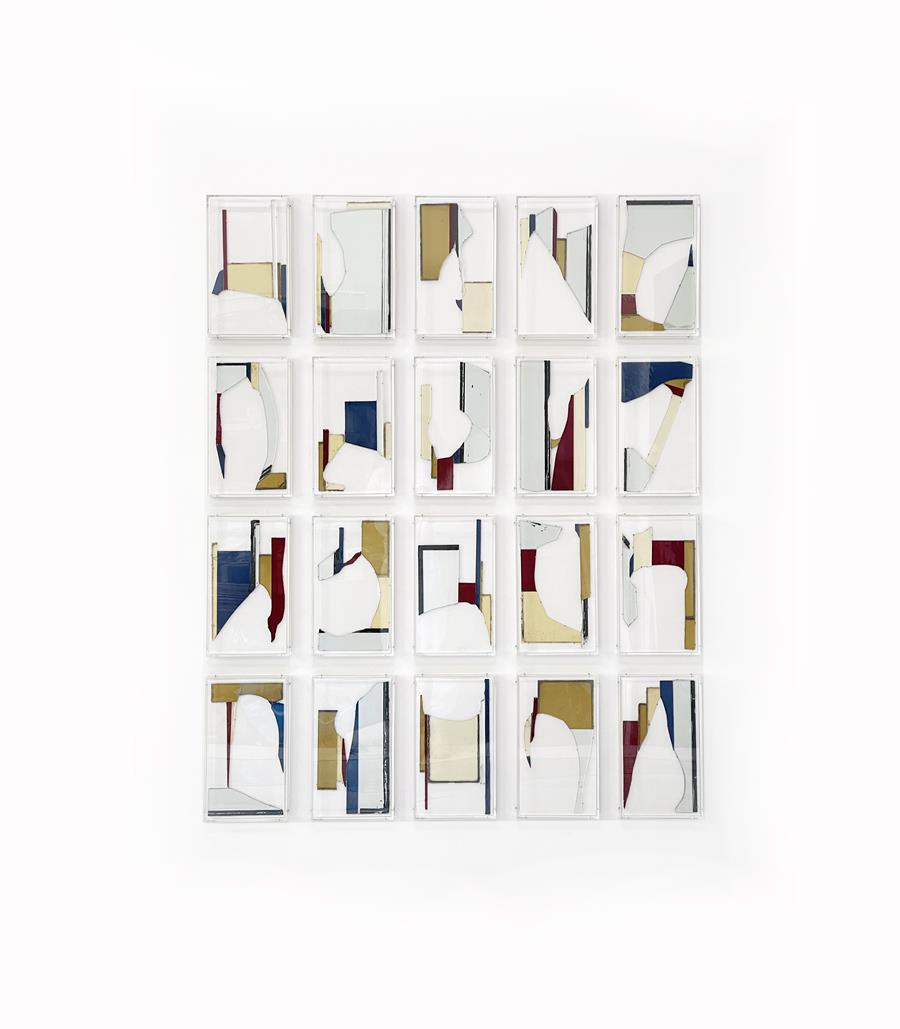
Recycled glass, colored glass, nails, hooks, plexiglass frames
155 x 120 cm

124 x 397 cm
Recycled glass and hooks

About the Artist
Anneke Eussen (born 1978, Netherlands) lives and works in Vaals, Netherlands.
She studied at the Academy of Maastricht, Netherlands, followed by post-graduate studies at the Higher Institute of Fine Arts, Antwerp, BE. Solo exhibitions include: Tatjana Pieters, Ghent, BE; Kunstverein Schwerin, DE; DOCUMENT, Chicago, IL; Marinaro, New York, NY; Reset-home, Borgloon, BE; Circle lines Cruise and Callas, Berlin, DE; Park Platform for Visual Arts, Tilburg, NL; Bildmuseet, Umeå, SE; Cc De Bond, Brugge, BE; Suermondt Ludwig Museum, Aachen, DE.
She has participated in group exhibitions including; Project 36: Form follows function, OV projects, Brussels, BE; Gist triennale, Brussels, BE; Space as a duty of care, Galleria studio G7, Bologna, I; L’artiste et les commissaires, Lage Egal, Berlin, DE; Horizonverticaal, Haarlem, NL; Rites de passage, Schunck*, Heerlen, NL; 'What’s in an artwork?', HISK, Brussels, BE; and Re-cyclage sur-cyclage, Fondation Villa Datris, L’Isle-sur-la-Sorgue, F.
Anneke Eussen is represented by Document, Chicago, Marinaro, New York, and Tatjana Pieters, Ghent.
For Your Viewing Pleasure
What to watch, read, and experience, as curated by the Collé team.
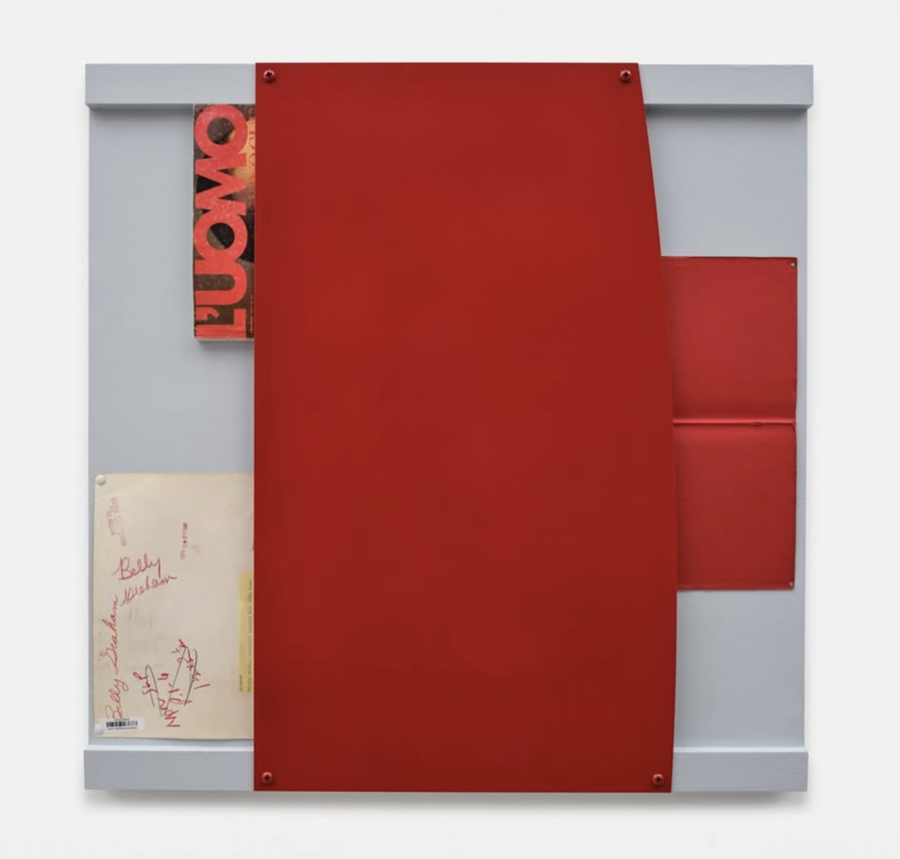
TOM BURR (b. 1963 in New Haven, Connecticut) is a conceptual artist who lives and works in New York and Connecticut. He attended the School of Visual Arts and the Whitney Independent Study Program in New York. Burr's work revisits the formal vocabulary of minimalism and post-minimalism, and explores the themes of homosexuality, public versus private spaces, and architecture.
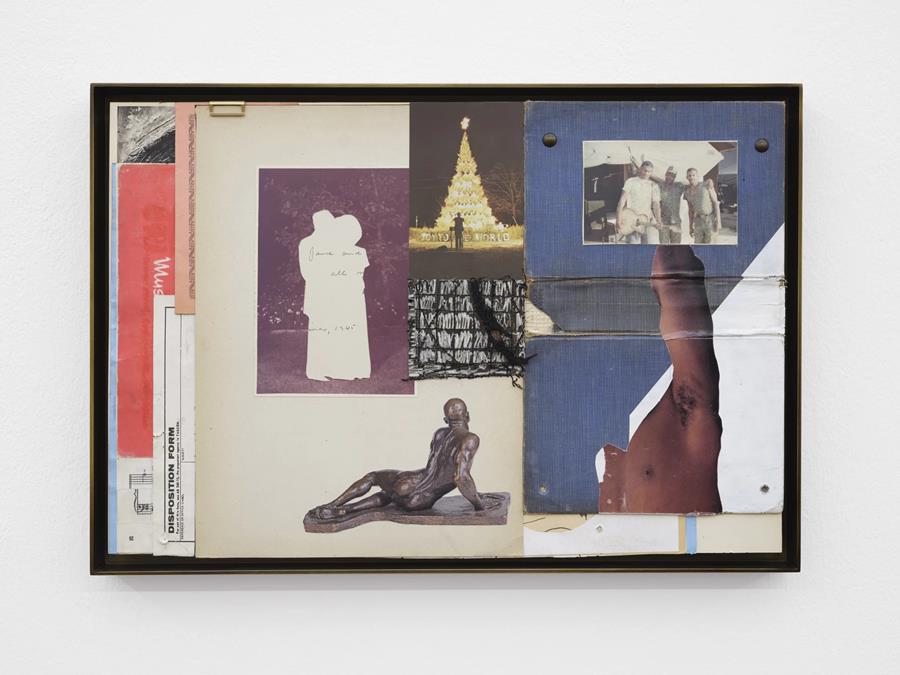
TROY MONTES MICHIE is an interdisciplinary painter and educator. Using collage as his methodology, Montes Michie engages with archives to reveal the complexity of the gaze and trouble the representation of powerful groups targeted for oppression. Employing an array of materials, Montes Michie investigates the influence of print media in mass culture, disrupting modes of consumption that historically erase and fetishize specific communities.
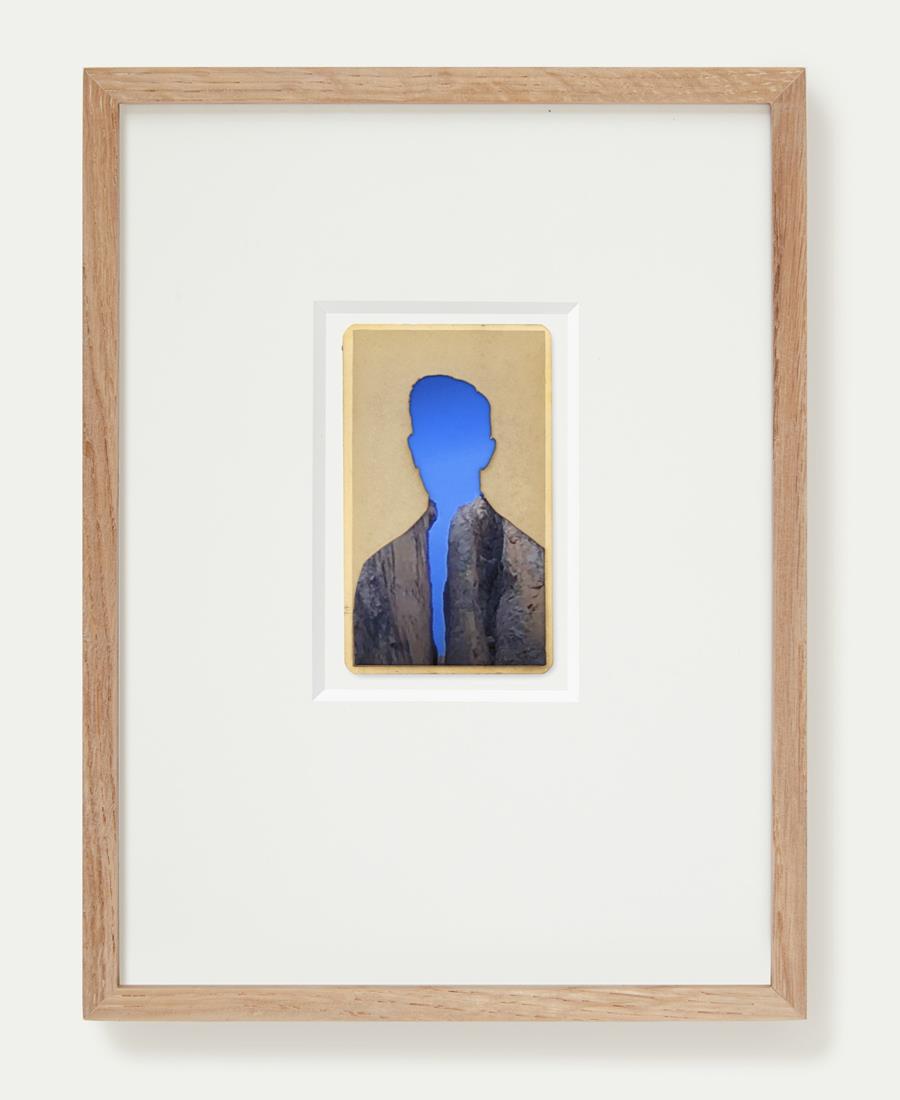
JAVIER HIRSCHFELD MORENO [b.1979, Málaga] is a Spanish artist and curator currently living in London. Moreno is interested in the role and responsibility of photography in the representation of the self and also collective identities.
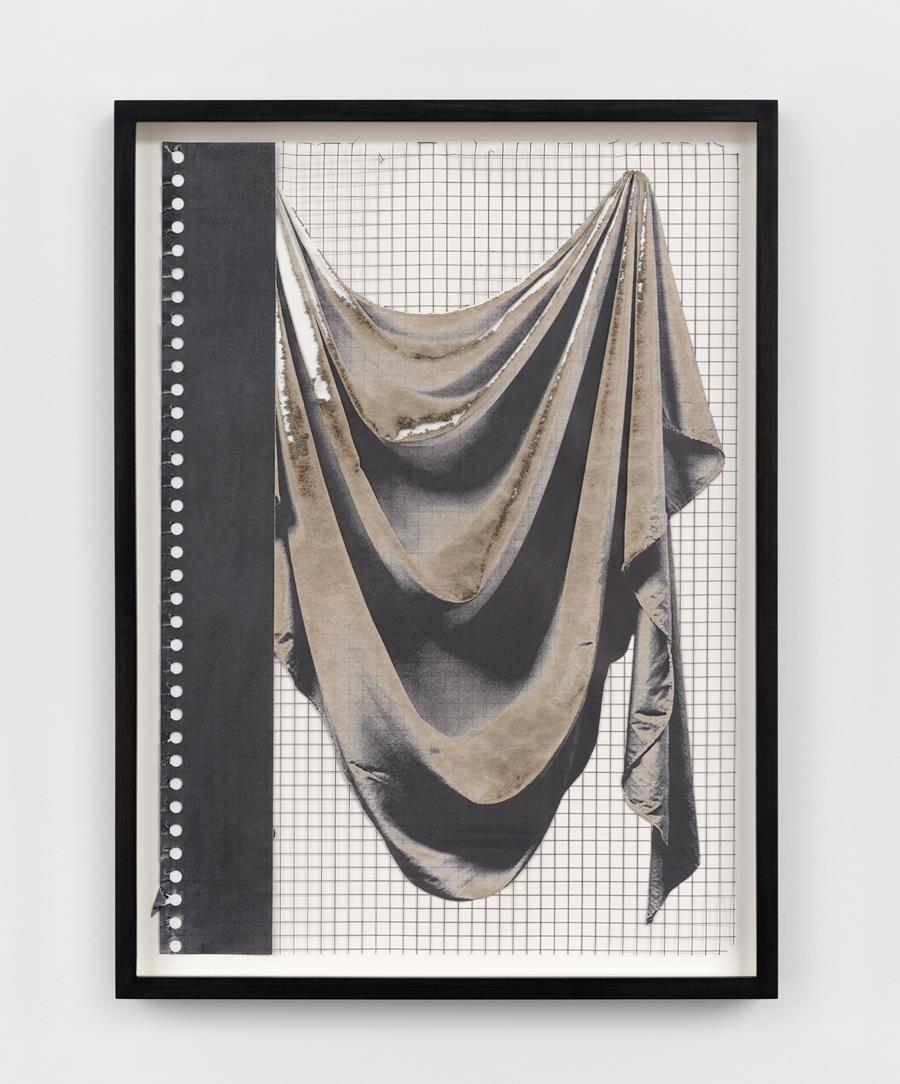
ANALIA SABAN rethinks painting by treating paint as both image and material, blurring the line between painting and sculpture through process-driven experiments and art-historical play. Using methods like unweaving canvases, laser-burning surfaces, molding acrylic paint, and weaving paint through linen, she foregrounds fragility, balance, and the charged presence of everyday objects.
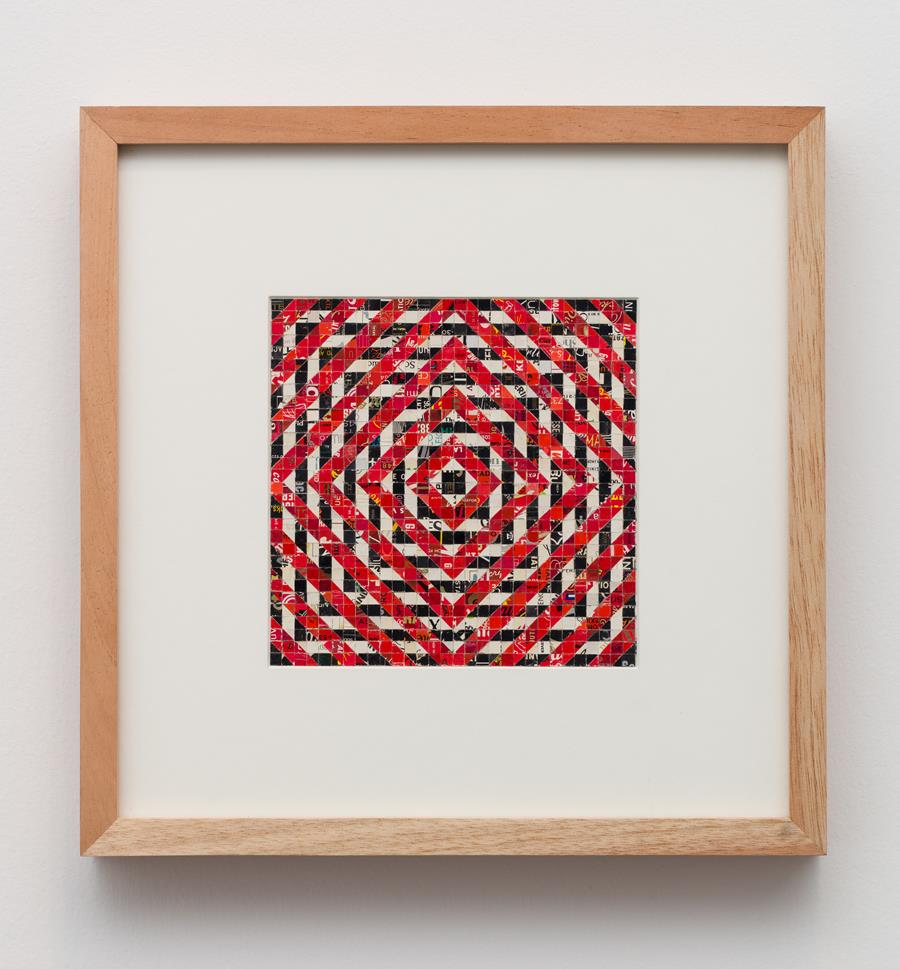
ALFREDO GALLEGOS MENA'S practice is developed through scenarios and everyday experiences where he introduces materials that are foreign to the traditional practices of painting, sculpture, and drawing. His exercise is based on the creation of works through elements that have been transmuted, such as clay, wood, medicine packaging, organic matter, wax, old matchboxes, and various restoration components, and where each material is considered a source of information.
Out and About
What to watch, read, and experience, as curated by the Collé team.
▼ READ
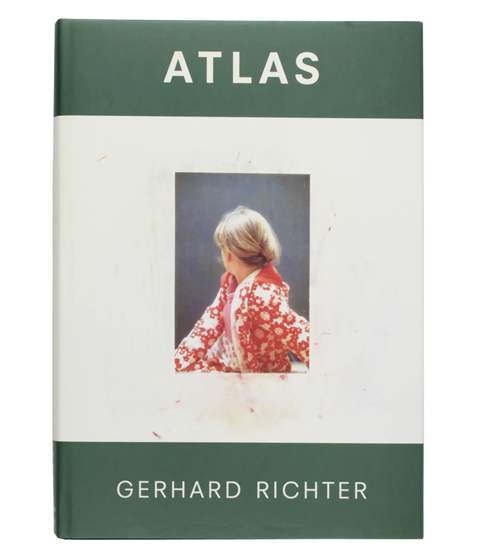
Gerhard Richter: Atlas of the Photographs, Collages and Sketches
An impressive representation of the contents of Gerhard Richter's Atlas, a repository of photographs, newspaper cuttings, and sketches that the artist has been collecting since the mid 1960s. Reproduced in color, with an index of descriptions at the rear. Introductory text from editor Helmut Friedel.
▼ LISTEN
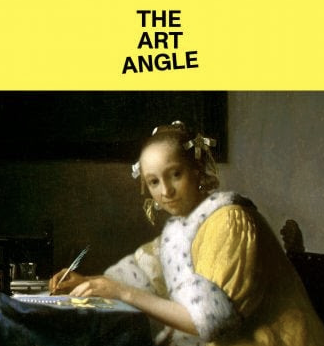
The Magic of ‘The Artist’s Way’ on The Art Angle
Millions of people know The Artist’s Way. First published in 1992, the book began as notes for a class that its author, Julia Cameron, taught on creative self-discovery or, as she sometimes prefers to call it, “creative recovery.” It found a huge audience, and today you can find Artist’s Way groups all over the world.
▼ LISTEN
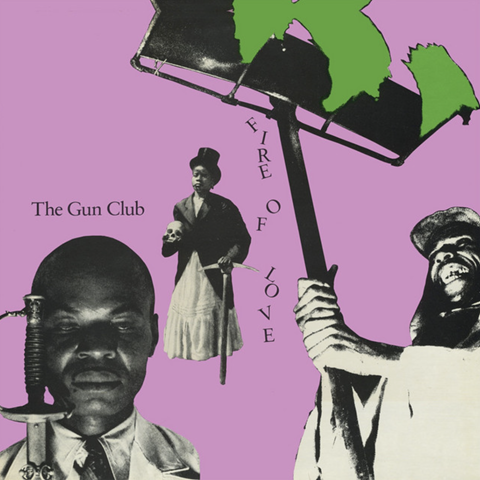
Fire of Love (Remastered 2020) by The Gun Club
Fire of Love is the 1981 debut by The Gun Club, where blues tradition is pulled into punk velocity without ever becoming reverent. It moves by collision: gospel heat and streetlight glare, desire and dread, romance threaded with menace. The 2020 remaster sharpens the details while keeping every abrasion intact.
