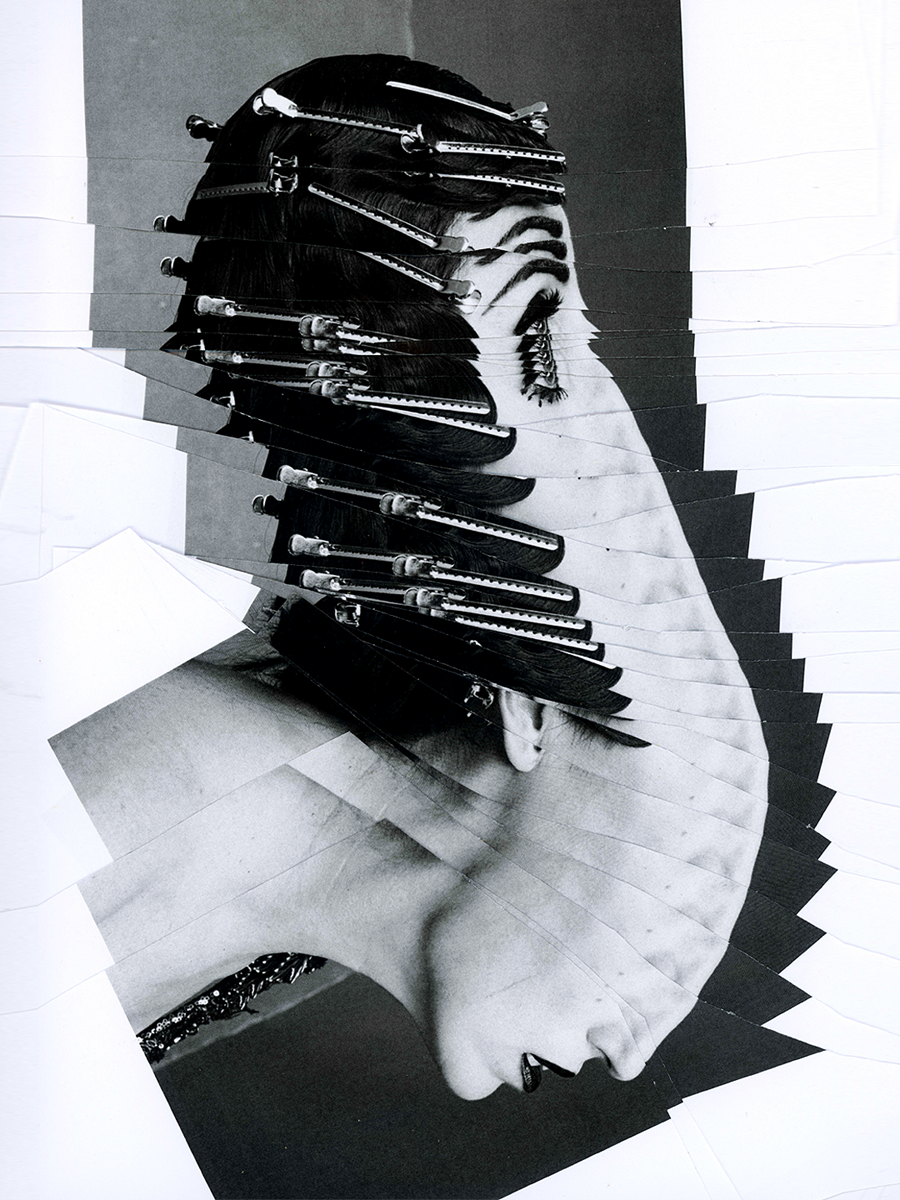
Collage on paper, A3
Juan Romero
Juan Romero is an artist whose practice spans graphic design and sound, rooted in underground culture with a punk sensibility. Drawing from a countercultural lineage of queer cinema, horror aesthetics, and post-punk music, his work deconstructs portraiture to interrogate beauty standards and celebrate imperfection. Through collage, Romero constructs what he calls "benevolent monsters": hybrid figures that reveal the poetic potential of the grotesque.
In the Words of the Artist

Collage on paper, A4
I have always made collages since I was very young. In graphic design school, it was a way to work around my weaknesses in drawing. This deepened during COVID — while everything slowed down, diving back into collage felt deeply salvaging. It is a burlesque way of diverting reality, of creating your own world and language.
What I love most are the details. The detail that catches your eye, slightly disturbs you, and makes you want to reveal it, give it space. The detail many people find ugly, but that I want to sublimate and make even more beautiful and visible. For me, collage is about bringing out the singularity of an image in an XXL version. It is hypnotic, punk, and raw. It reflects an entire underground culture: that of fanzines, of a "poor," instinctive, intuitive art.
These collages become a kind of monster. But my monsters are not monsters. They are benevolent. Encountered through paths as wild as they are varied, emerging from B-movies, cinema classics, or a queer universe, they reflect a culture that is deeply precious to me.

Collage on paper, A4
I am part of Musique d'Apéritif, an artistic collective through which we organize concerts, DJ sets, and exhibitions, and run both a studio and a label. What's funny is that I think about music the same way I think about collage, cutting a track, a song, placing it onto another sound. Whether performing DJ sets with the collective or composing with my solo project Jaters Whon, the instinct is the same.
I like it analog and imperfect. Mistakes, textures, glitches. These practices naturally come together; my collages often become flyers, concert visuals, or album covers. And collage, to me, is deeply connected to the DNA of punk and underground culture. So it feels natural that these worlds respond to one another. The loop is complete.

Collage on paper, A5
I am always searching for images that resonate with me, ones that immediately catch my eye and trigger something, even in a subtle or unconscious way. I work a lot with instinct. If an image slightly disturbs me, fascinates me, or makes me uncomfortable, I know there is something there.
I am drawn to details that break surface-level harmony and make faces deeply human, therefore beautiful and unique. Gap teeth, overly intense gazes, asymmetrical eyes, frozen grimaces, wrinkles, imperfections. All the details that some people try to erase are treasures to me. They tell a story. They make an image alive.
My goal is to highlight them in a fun, strange, sometimes absurd, and often humorous way, to amplify what stands out, to exaggerate what feels uncomfortable. There is always a sense of play: with the viewer's gaze, with beauty standards, with the very idea of normality.
My approach is intentionally quite random. I like repetition to the point of obsession, repeating an eye, a mouth, a tooth until the detail becomes overwhelming, almost destabilizing. But I can just as easily let go and follow the fragments: test, move, cut, layer, remove. There is something very intuitive, almost meditative, about this process.
I mostly work from a single image that I deconstruct in order to recreate, less a technique than a natural reflex. I also enjoy face swaps, merging two identities to create a third: more distorted, stranger, more unique. Not monsters, but hybrid figures that seem to emerge from a slightly unbalanced dream.
What I find powerful about collage is precisely the absence of fixed rules. It lets me move between structure and chaos, twist and break aesthetic codes, without ever feeling limited. It is a space of total freedom, raw and instinctive.

Collage on paper, A4
My sources vary depending on the project and the mood. I collect images from magazines, books, the internet, and social media, and I like mixing old printed materials with digital images. There is something special about cutting into paper that has already lived, that carries time within it.
Sometimes I search very intentionally for a specific face or expression. Other times I let myself scroll, wander, and wait for an image to catch me. The discovery phase is already part of the creative act.
I grew up with hippy-punk parents, carrying a dense imagination shaped by punk, rock, post-punk culture, and underground cinema. My mother also introduced me to a lot of queer references and inspiration: John Waters, Divine, Rocky Horror Picture Show. At home, references moved freely and without hierarchy. From John Waters to Tarantino, from The Cure to Joy Division, from Russ Meyer to Rocky Horror, through an entire collection of bad-taste horror films. Rough, excessive, sometimes ridiculous, yet always intensely alive.
This environment deeply shaped the way I see. Very early on, I was drawn to what overflows, what disturbs, what is not perfectly controlled. Strange details, poorly made effects, exaggerated acting, unapologetic madness. Everything that escapes dominant good taste became a space of fascination. This aesthetic of imperfection and excess taught me that beauty can emerge from the grotesque, that intensity often lives in what feels fragile or outside the norm.
This fascination has never left me. It flows through my collages, my way of looking at faces and images. It feeds a desire to transform the strange into something precious, the awkward into something poetic, the monster into a benevolent presence. I continue along this line, inspired by punk heroes of the past and contemporary figures who carry the same spirit of freedom and experimentation.

Collage on paper, A4
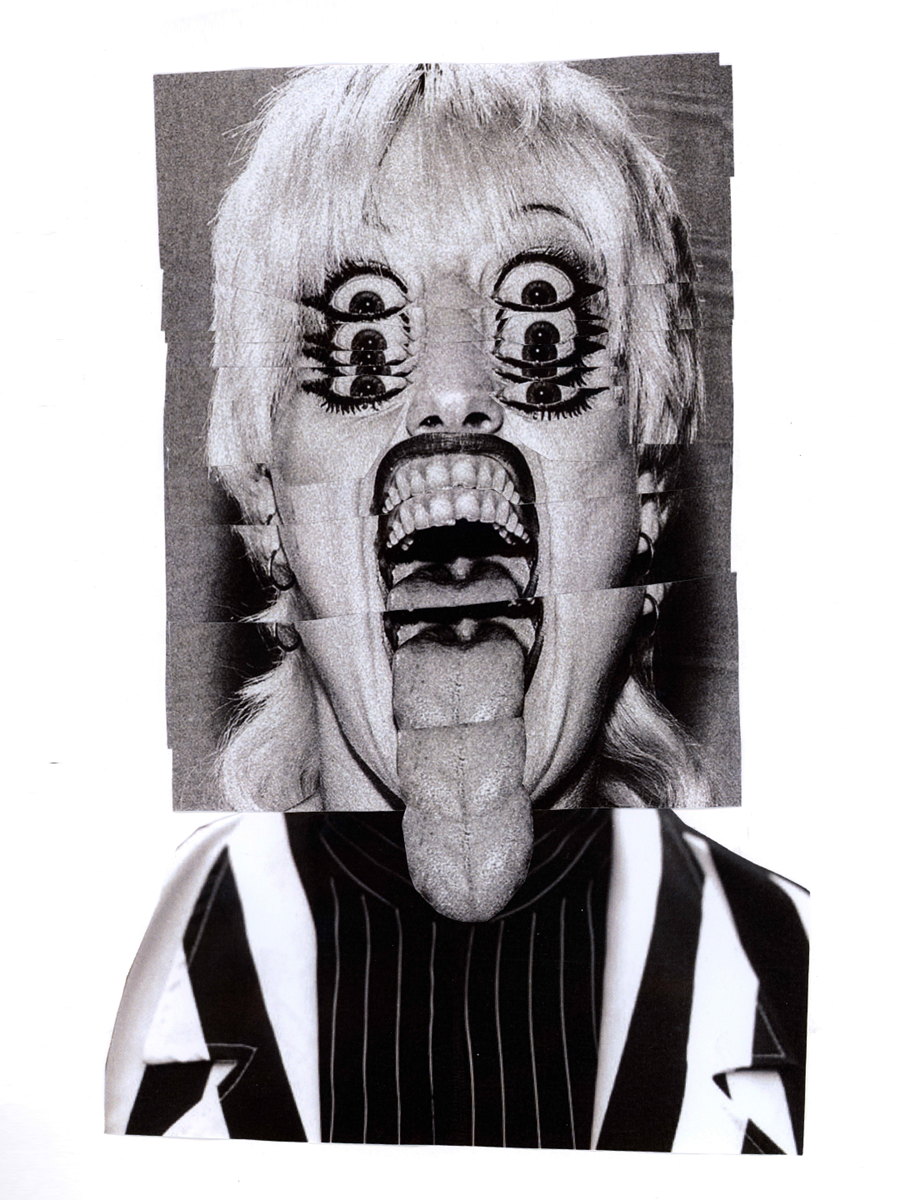
Collage on paper, A4

About the Artist
Oscillating between visual arts, graphic design, and music — whether solo or within the collectives Musique d'Apéritif and Bow Down Studio, which he co-founded — Juan Romero is a hyperactive designer passionate about visual and sonic collages, driven by underground culture. He approaches creation by emphasizing the details and visual stakes that matter to him: the personal, the intimate, or the reflective. For him, what matters isn't what we see, but how we love to see.
He currently works at Atabal, a music venue, after spending several years in the surfing industry. The shift feels natural — like moving from one form of rhythm to another. The ocean, its movement, and the culture surrounding surfing all shaped his sensibility in particular ways. Today, that energy continues in a different space: sound, concerts, encounters, and collective moments.
At the same time, he keeps creating slightly chaotic and joyful projects with his art collective, Musique d'Apéritif. Together, they organize events, concerts, DJ sets, and exhibitions — always with the same desire to mix disciplines, blur boundaries, and keep a sense of freedom and experimentation alive. Alongside this, Juan continues making musical and paper collages for fun. These personal explorations remain essential to his balance: spaces without pressure, where intuition leads, mistakes are welcome, and imagination can stay raw, playful, and alive.
For Your Viewing Pleasure
What to watch, read, and experience, as curated by the Collé team.

SUZIE SHIN is a Korean-American collage artist, illustrator, and graphic designer based in Chicago. Her collage practice consists of abstract compositions made with magazine scraps that play with color, shape, and rhythm. The original artworks are either framed, printed on greeting cards, or adapted for tapestry throw blankets.

MATT BORUSSO is a San Francisco-based artist holding a BFA from the San Francisco Art Institute and an MFA from Yale University School of Art. He has exhibited widely, with solo shows at Cloaca Projects, Steven Wolf Fine Arts, and 2nd Floor Projects in San Francisco, Black Ball Projects in Brooklyn, and group exhibitions in New York, Los Angeles, Mexico City, and Berlin.

JEFFERSON FOUQUET is a Paris-based floral set designer whose practice deconstructs classical composition, submerging flowers in urban environments, distorting them with paint and synthetic textures, and pushing arrangements toward sculpture and installation.

AGOSTO MACHADO is a Chinese-Spanish-Filipino-American performance artist, activist, archivist, and muse who has been a vital participant in New York's cultural and creative life since the early 1960s, spanning art, theater, performance, film, and the dawn of the gay liberation movement.

B. INGRID OLSON is a Chicago-based artist working across photography, sculpture, and architecture to explore the boundaries between body and space. Fragmenting and cropping her own body within the studio, her photographic works create tensions between interior experience and exterior, mirrored existence, while her sculptural reliefs invoke corporeal form through concave curves and molded recesses.
Out and About
What to watch, read, and experience, as curated by the Collé team.

▼ COLLECT
Assemblage, Environments & Happenings, Allan Kaprow, 1st Edition
A foundational text in postwar avant-garde practice, this book documents Kaprow's pioneering work, collapsing the boundary between art and everyday life — from room-sized environments to unscripted participatory events that made the audience the medium itself.

▼ COLLECT
Femme/Object by Linder, Paris Musées, 2013, 1st Edition
Collects Linder Sterling's iconic photomontages spanning her Buzzcocks' Spiral Scratch period, her portraits of Morrissey, and her confrontational collisions with erotic imagery. Designed in a faux-magazine format.

▼ LISTEN
Ege Bamyasi by CAN (Remastered Version)
Widely considered CAN's most focused record and a krautrock cornerstone, this 1972 album locks into hypnotic grooves and rhythmic precision. Remastered by Spoon Records in 2004 with new liner notes and unreleased photos, its influence stretches from Brian Eno to Sonic Youth to Pavement
