
Paper collage
Lucy Sante
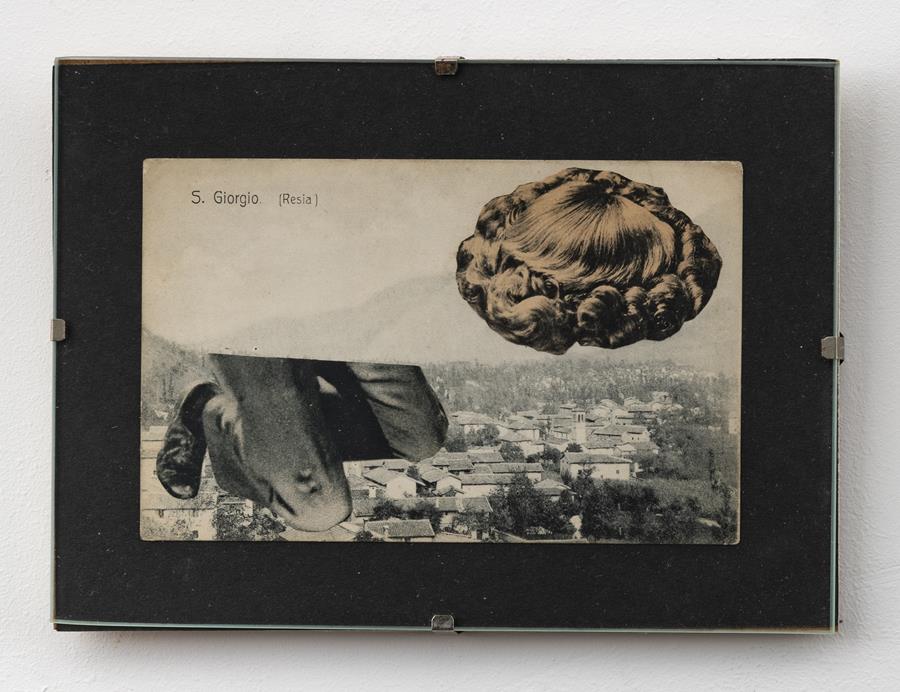
Lucy Sante has been making collages for nearly sixty years, working almost entirely from paper that shows its age—faded, creased, torn. A clean image, she says, has been stripped of its history; a broken corner carries the full century of a thing's existence. Her collages build from that accumulated wreckage, recognizing that images keep their former lives, and that public lies can be turned to tell the truth.
In the Words of the Artist
Paper collage
Collage is the arrangement and adhesion of flat materials on a flat plane. (Non-flat is assemblage.) Collage allows you to hijack others' images and styles and repurpose them; it is all about quotation. Like its cousins, assemblage and sampling, collage builds its own world from the wreckage of the one we inhabit. Collage realizes that the future is an accumulation of the past, that images retain their former lives, that public lies can be turned around to tell the truth.

Paper collage
Clean images are stripped of their history, at least in part. When I collected old photographs, I always went for the ones with broken corners, with writing on them, maybe even with creases, because there I was getting their full century-plus of existence, whereas if they looked factory-fresh, they might as well have been laser-printed that morning.
I think it comes from the way my mind is structured: intensely visual, related to mnemonics. I was learning two languages at once when I was a child, and I kept things on track by linking words with images--that weren't necessarily mere illustrations. And then, over the years, looking at a lot of images led me to imagining images I'd like to see, which led me to making my own images.

Paper collage

Paper collage
No, I don't think collage is a form of language. Collage, after all, is many different things depending on the artist (and the viewer). Collage doesn't have to look anything like mine. It can use fabric samples, or celluloid, or scotch tape. It doesn't have to nod to the picture plane or allude to other styles of visual presentation. I like to use as few elements as possible; some people feel the opposite way. Collage is a site of language, rather than an example of one.

Paper collage

Paper collage

About the Artist
Lucy Sante has been making collages for nearly sixty years. What began in adolescence—with scissors, Elmer’s glue, and stacks of magazines—became a lifelong, parallel practice: what she calls her violon d’Ingres, an outlet that answered a permanent need to make images when drawing could not.
After relocating to New York and working at the Strand Bookstore, Sante found herself immersed in a flood of discarded printed matter—paperbacks, maps, technical manuals, propaganda, and magazines—much of which she preserved and continues to use decades later. In the late 1970s, she created collaged gig flyers for downtown bands, wheat-pasting them across the city. Though the practice paused for years, she never relinquished the materials. In recent years, she has returned to collage with renewed focus, drawing from an archive that spans the nineteenth century through the mid-twentieth, favoring matte surfaces marked by foxing, fading, stains, and tears.
For Your Viewing Pleasure
What to watch, read, and experience, as curated by the Collé team.

ROMARE BEARDEN is recognized as one of the most creative and original visual artists of the twentieth century and had a prolific career that spanned nearly fifty years. He was also a writer, social worker, and an active arts organizer: he was the first art director of the Harlem Cultural Council, a prominent African American advocacy group, and was involved in the founding of The Studio Museum in Harlem.

JOE BRAINARD (1941–1994) was an American artist and writer associated with the second-generation New York School. Working across collage, assemblage, painting, and drawing, he produced thousands of small works, including his Nancy series. His 1970 book I Remember, became a landmark of American autobiographical writing.

HOWARDENA PINDELL (b. 1943) is an American artist, curator, and educator. Her process-based practice, hole-punched paper, numbered grids, sewn and reconstructed canvases, extends collage into painting.

MAY WILSON (1905–1986) was an American artist who began exhibiting in her sixties after moving from rural Maryland to New York's Chelsea Hotel. Associated with Ray Johnson's correspondence network, she produced photo-collage "Ridiculous Portraits," assemblages, and mail art throughout the 1970s downtown scene.

AL HANSEN (1927–1995) was an American artist and a founding member of Fluxus. Known for happenings, performance, and collage, he made extensive use of Hershey bar wrappers and cigarette butts as material. He taught, published, and collaborated widely, and was the grandfather of musician Beck.
Out and About
What to watch, read, and experience, as curated by the Collé team.

▼ VISIT
LoVid: Hotter than the Sun
The NY-based duo LoVid (Tali Hinkis and Kyle Lapidus), working together since 2001, open a new show at Picture Theory NYC, treating the image as unstable material, stretched, translated, and reconstituted across media. The exhibition draws on the duo's personal collection alongside work from an extended circle including Cory Arcangel, Casey Reas, Lauren Lee McCarthy, Electronic Arts Intermix, and Triple Canopy. On view through May 30.
▼ VISIT
Making Meaning: A Collage Symposium
Making Meaning: A Collage Symposium is a three-day convening exploring how collage constructs, disrupts, and reimagines meaning across time, media, and community. Featuring presentations, workshops, exhibitions, and a book fair, the symposium takes place July 22–24, 2026 at the Vassar Institute for the Liberal Arts in Poughkeepsie, NY.

▼ LISTEN
Cat by Hiroshi Suzuki
This 1976 album is a cult Japanese jazz record led by trombonist Hiroshi Suzuki, moving between spiritual jazz, post-bop, and loose jazz-funk across five tracks. Long out of print, it was reissued by We Release Jazz in 2020.
