
Roofing screws, rubber washer, keyring, calling card, metal glue,
mounting hook, metal sheet, and metal clips on frame
20.5 x 15 cm
Eva Dixon
Eva Dixon's recent assemblages take the found image as their unstable raw material, embedding it within armatures of industrial salvage—aluminium, leather straps, darkroom filters, lads'-mag cutouts—that shelter and withhold in equal measure. The image here is apprehended rather than composed, wrenched from its source and held in a state of arrest. What emerges is less a resolved object than a record of its own difficulty, with failure operating as method rather than accident.
In the Words of the Artist
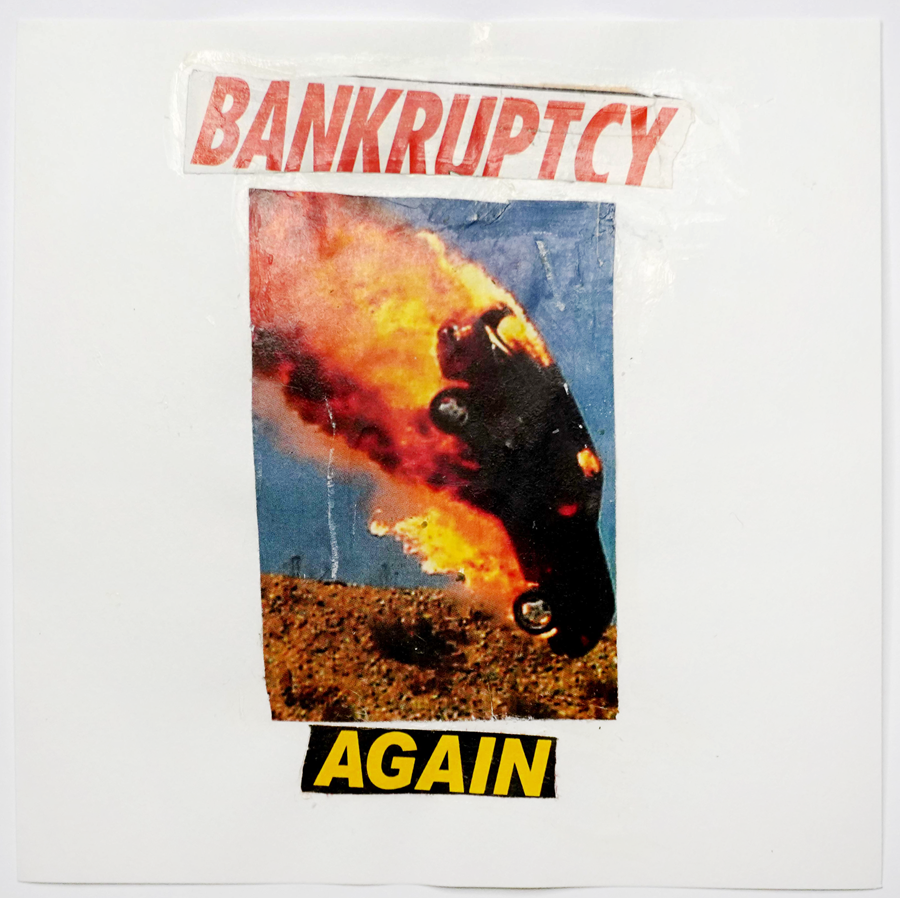
Magazine cutouts, and glue on paper
15 x 15 cm
Collage is something between painting and sculpture, assemblage made with scavenged materials. My work is a process of cumulative failure. I am interested in things being difficult; I like the struggle of resolving work. I make work to learn, to understand an idea I’ve had or something I’ve seen on a worksite. My studio is something between a gardenshed, workshop, and laboratory.
Often by chance, if I’m composing a work on the floor, I won’t get to know the dimensions, and the stretcher comes afterwards - however, if I’m setting out to build a specific kind of support, then the surface comes after. This process is rarely linear; often, I am unhappy with work and will cut it from its frame. much of my work has traces of its earlier iterations, bits of fabric and material poking out underneath. Just this week, I’ve been working on 2 conjoined stretchers I have had for 4 years, I must have pulled 10 works off each of them till now!
It has taken me a few years to understand why I chose the materials I do. I am certainly interested in low-brow culture in artwork; that is how some of the materials are chosen. My solo show at Incubator titled ‘Crash’ however, is about J.G. Ballard’s novel by the same name and the movie adaptation by Cronenberg… so when I made work for this show, I was thinking a lot about the automobile, fluffy dice, air-fresheners, bumper stickers, polishing compounds, metal, collision… I have a studio in Camden and went on a walk recently, and came back with a shattered bit of discarded bumper, as silly as it sounds, sometimes I think the objects find me.

Ilford safelight glass, Advocate clipping, metal glue and pin,
roofing screws, and bulldog clips
on metal frame
13 x 18 cm
I wouldn't have used the word collage to talk about my work until recently. Many years ago, I used to make photographs - I was very frustrated with the lack of objecthood printed images receive. Much like Roland Barthes speaks on in ‘Camera Lucida’, I was frustrated that people had a tendency to identify with the subject “that is my sister/brother” as opposed to the physical object of the photograph, so I started making surfaces for the images to be printed onto- translucent fabrics. I realised after a while that the surface without the image was more interesting. In the last 12-24 months, I have begun to re-incorporate the image.
When I was graduating in 2023 from CSM, the image was only in found pins and patches; now collage serves to communicate ideas I cannot otherwise express… An image of a wrestler, taken out of context, becomes something else entirely: a lone figure, flexing in an empty space, a homoerotic symbol, a sex symbol… for example. By using found images in the work, there is a material directness I cannot replicate; there is nothing more immediate than the source material- it excites me to find images I can only use once and may never find again, the temporary encounter forces me to be highly selective.
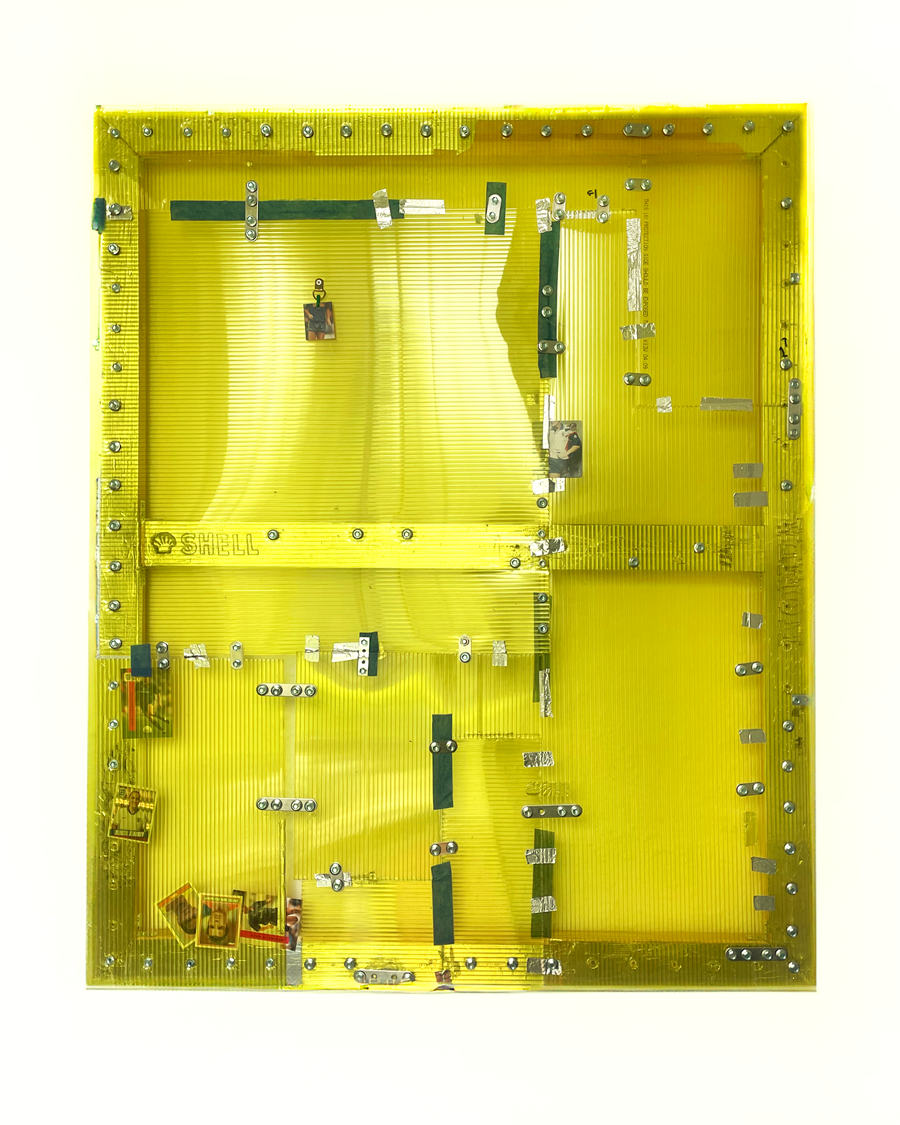
Polycarbonate Panelling, Screws, Stickers, Cards, Brackets,
Metallic Insulation Tape,
Fabric Tape, and Engraving on Stretcher
140 x 100 cm
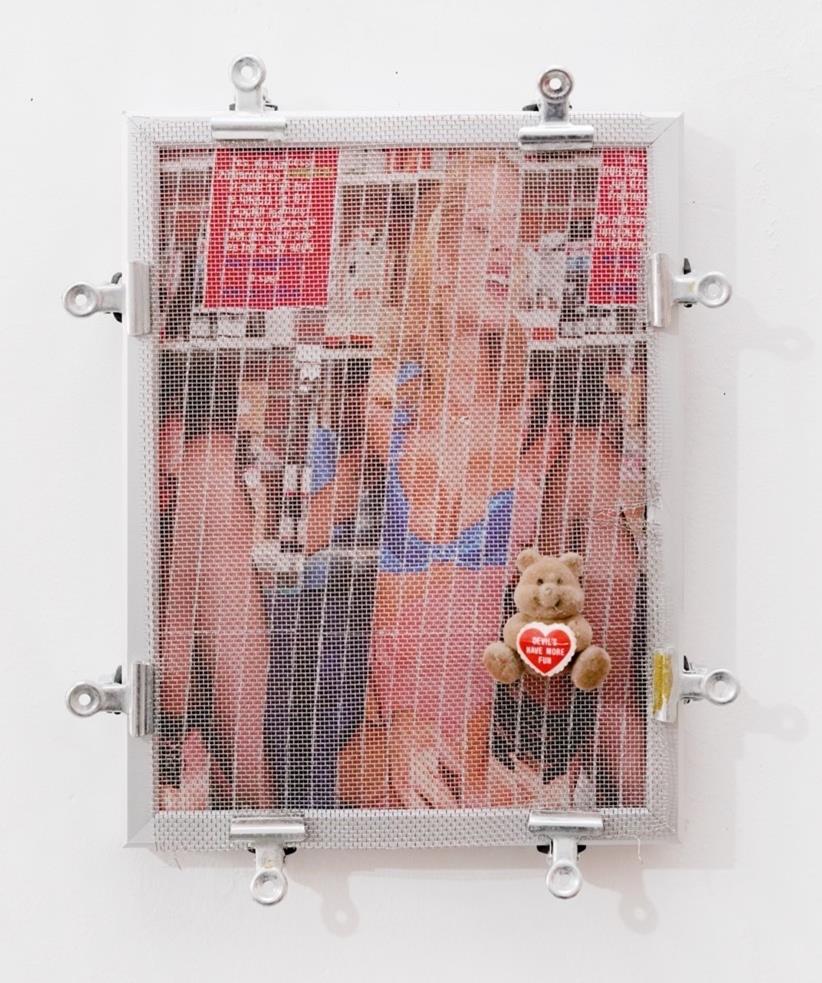
Bulldog clips, found pin, magazine, roofing screws, and mesh
on metal frame
19.5 x 24 cm
When I am between projects, it is quite normal for me to work at home for some time - the collages came out of this period. I had just finished my solo at WIP Space Studios with Particular Ideas in London (Mercury 13) and wasn’t sure what the next step was. I had spent years researching Mercury 13 and knew I wanted to put it down for a while. My sister-in-law had given me an Anne Summers magazine she found when moving into her home (the best part about my working at home is that my materials are so limited), and I started playing around with the images inside.
My childhood was punctuated by visits to my Aunt and Uncle’s homes and hanging out in man-caves/sheds - several of my uncles have images of half-dressed women pinned to the ceiling, women on flags holding beers, flags as a symbol of country, cultural identity… of a woman holding a can of ‘XXXX’… I am fascinated by the multiplicity of these women; they hang in 1000s of sheds across the country, smiling, seemingly looking to pass the beer onto the viewer. I was confused by these images; they didn’t look like the women in my life. They painted a portrait in my mind of the mechanisation of sex, magazines like ‘Custom Cars’ (a mag featuring women laying across and inside ‘sexy’ cars).
I don’t think it is the role of the artist to decide what a viewer does with their work, nor do I think I know enough about my own work to know- if I were even to take a guess, I think I’d cut off so many wonderful interpretations and discussions about the work. I think that is part of why I love showing work so much, it allows me to understand it outside of my role as the artist.
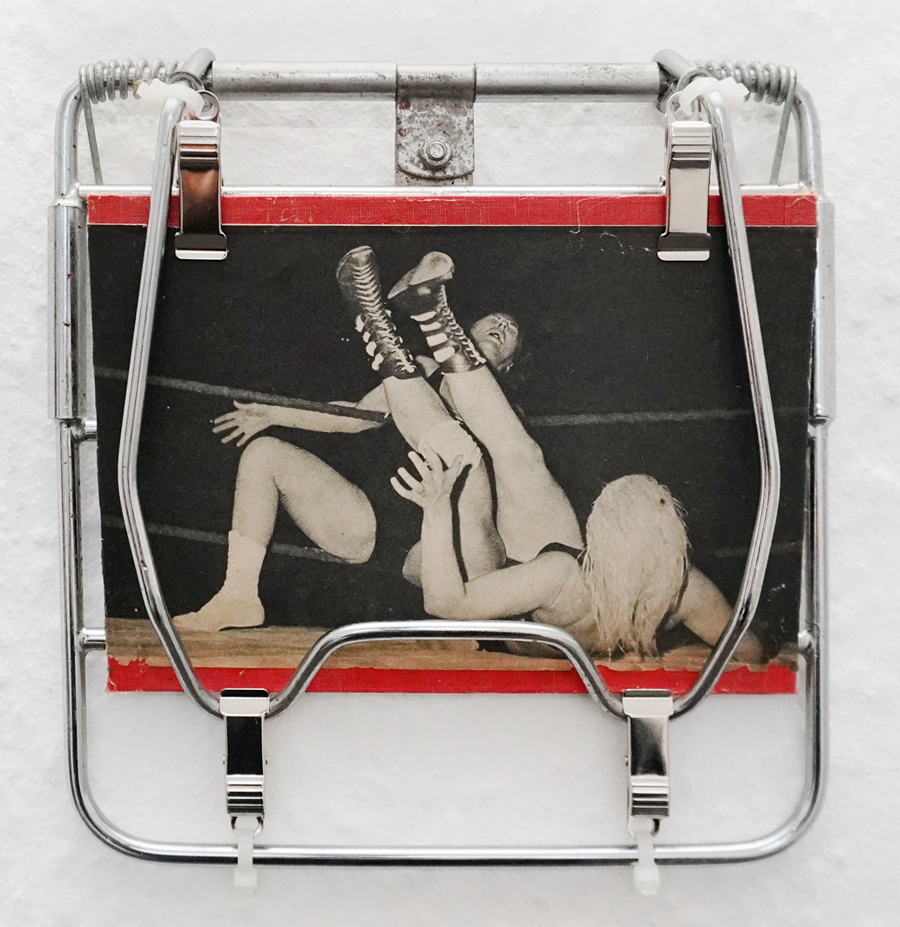
Bike rack, magazine cut out, glue, darkroom filter, clips, and cable ties
21 x 20.5 cm
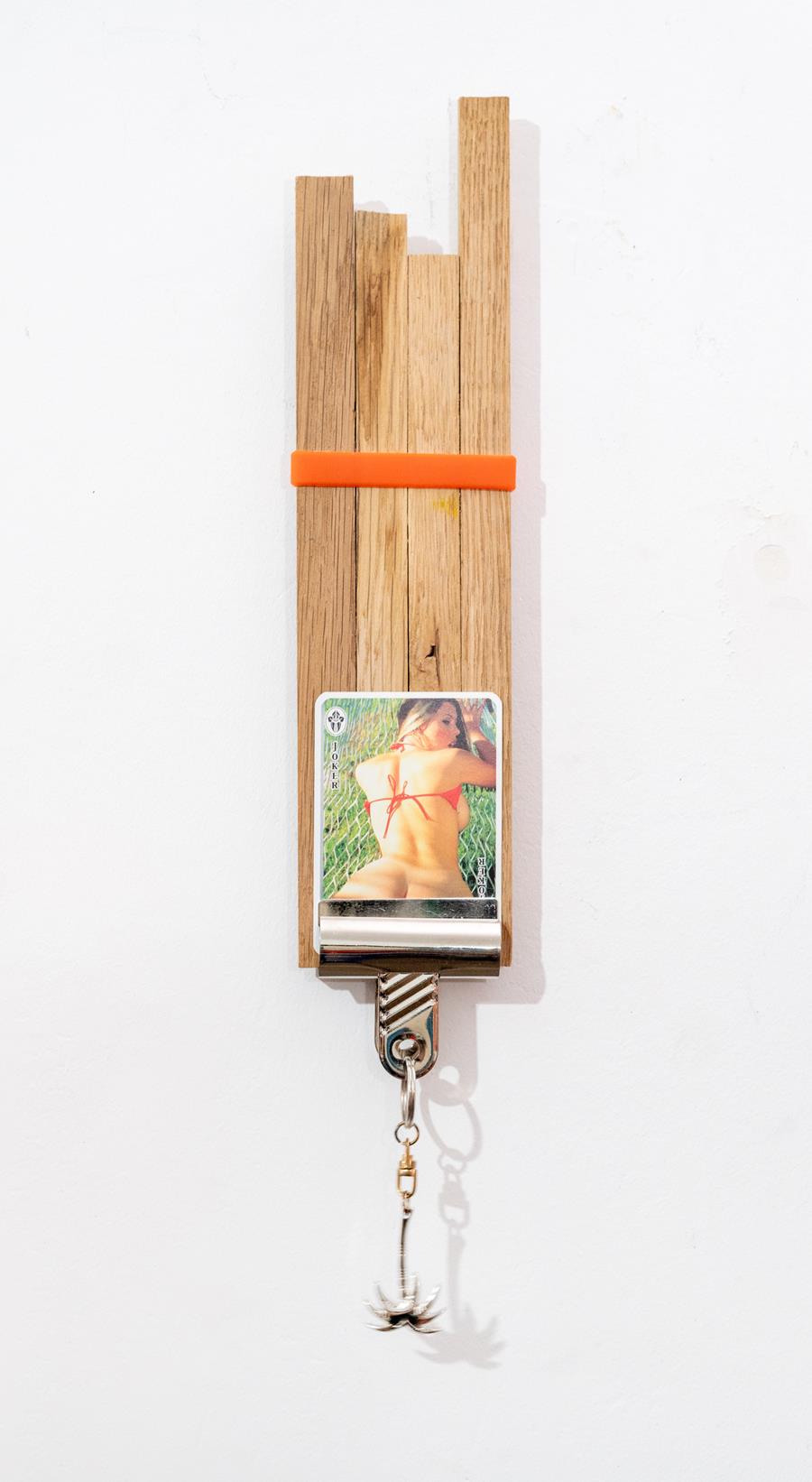
Found oak offcuts, staples, rubber band, playing card,
bulldog clip, glue, and keyring
42 x 7.5 cm

About the Artist
Eva Dixon (b. 2000) is an Australian artist living in London. Dixon’s practice, spanning assemblage, sculpture, and painting, explores homo-eroticism in sport and porn, the space race, lesbianism, and industry. Horny reimaginings of goal celebrations and tackles play against seductive or kinky materials; aluminium sheets, walnut frames, darkroom filters, buckles, clips, and leather straps. Rockets built from stolen street signs and gifted electrical spools.
As a collector of things; disused industrial materials, old football and boy-mags, pins and play cards, the material is a key-research point to Dixon. Manipulating each component to spin wild and sometimes racy narratives. Advertisements seeking discreet and specific kinds of sex inform the next stages of Dixon’s practice and speak to the loss of historical artefacts in the wider LGBTQ+ community, where fictioning is a prevalent tool passed down through generations.
Text by Olivia Rumsey
For Your Viewing Pleasure
What to watch, read, and experience, as curated by the Collé team.

PAOLO ARAO is a Filipino-American artist who fuses textiles with painting to explore the elastic nature of queerness. His work is rooted in geometric abstraction; created by stitching pieces of second-hand clothing, hand-dyed fabrics, and weathered canvas.

JAMES LOMAX (b. 1991, UK) previously studied at the Ruskin School of Art. He is drawn to objects that act as barriers and containers and uses these to investigate the physical and material language of a place.

VINCENT LA SCALA, a self-taught New York City collage artist of roughly thirty years, exhibited in group shows at Adam Baumgold Fine Art in the late nineties, culminating in a 1998 solo show praised by The New York Times' Grace Glueck.

ZARA JUNE WILLIAMS is an artist working between collage and painting. Drawing from a personal archive of both found and made materials, her practice explores memory, time, and the cyclical nature of matter through the repurposing of accumulated fragments.

JUSTIN GUTHRIE is a photographer and sculptor based in the American Southwest. His latest body of work, titled “New World Rites”, explores the forced acclimation of ancient indigenous rituals of the”Old World” to the foreign environment of the “New World”.
Out and About
What to watch, read, and experience, as curated by the Collé team.

▼ LISTEN
Arthur Jafa's Radical Theory of Readymade Art - The Art Angle
Jafa—arguably the most revered artist of the past decade—built his reputation on difficult video work assembled from found and borrowed footage. This podcast traces his radical theory of the readymade, reframing appropriation and the cut as tools for making meaning from existing images.
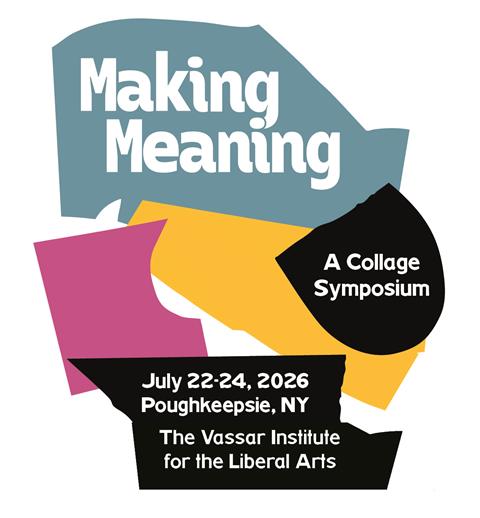
▼ VISIT
Making Meaning: A Collage Symposium
Making Meaning: A Collage Symposium is a three-day convening exploring how collage constructs, disrupts, and reimagines meaning across time, media, and community. Featuring presentations, workshops, exhibitions, and a book fair, the symposium takes place July 22–24, 2026 at the Vassar Institute for the Liberal Arts in Poughkeepsie, NY.

▼ LISTEN
Train on the Island by Aldous Harding
Harding's fifth album, Train on the Island, is her career best, an oblique self-portrait that never quite resolves. Across psychedelic folk arrangements, she slips between voices and personas, singing cryptic, shape-shifting lyrics that lodge in your subconscious while keeping her own identity tantalizingly out of focus.
