
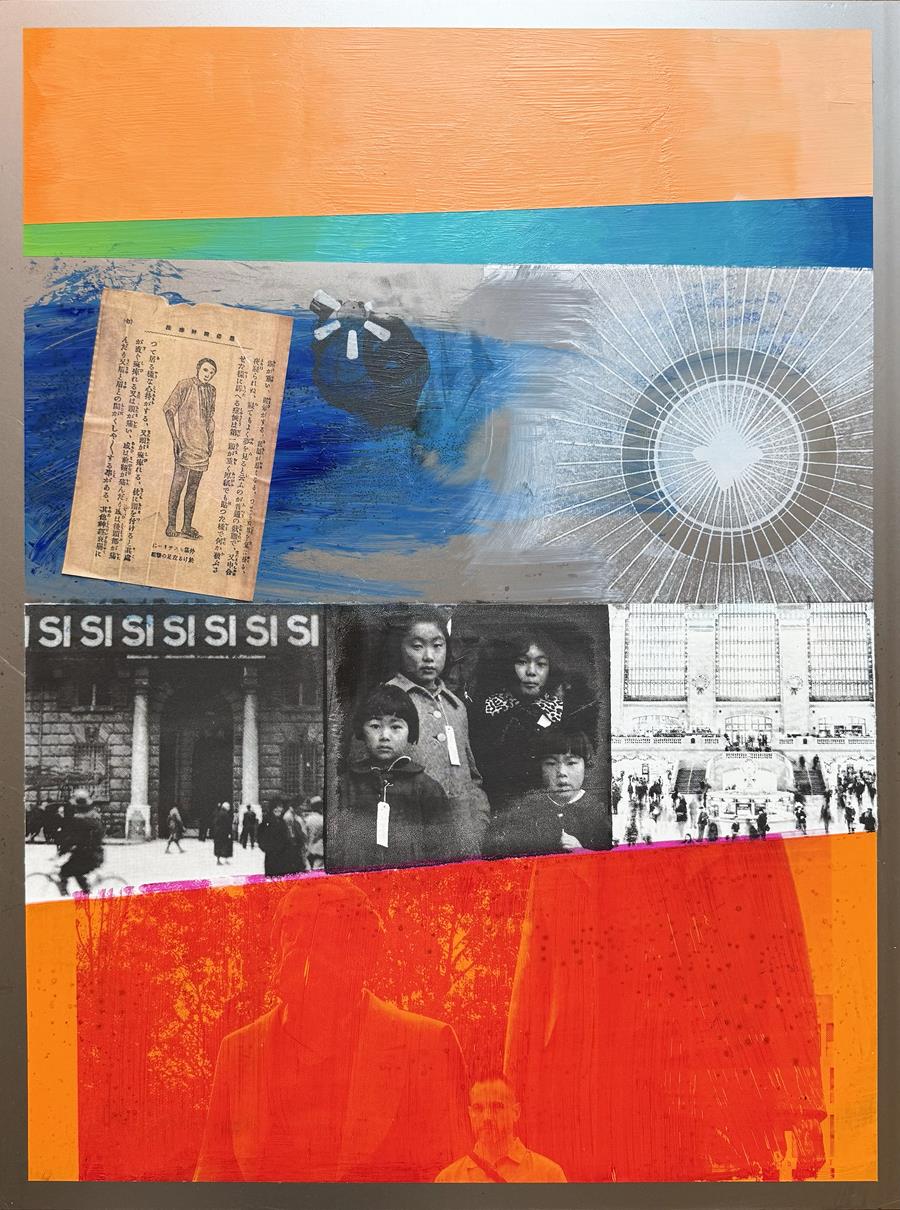
Acrylic and serigraphy on wood
36 x 48 in.
Gabriel Allred
Gabriel Allred is a multidisciplinary artist whose silkscreen-based collages layer personal photographs with found imagery. Drawing on a Ph.D. in cognitive psychology and a childhood spent in his father's sculpture studio, his work holds grief, commerce, and transit in open conversation, tracking the drift of attention and what gets caught along the way.
In the Words of the Artist

Acrylic, serigraphy, and paper on steel
24 x 36 in.
I think of collage as a form of visual language, an artistic technique that broadens the potential thematic scope of a work. Whereas a portrait or landscape can convey a particular person, place, or event, collage can encompass as much or as little as you like in a composition, without being bound by a single concept or thread. There’s a Rauschenberg interview where he discusses wanting to make works that were as responsive to as many things as humanly possible, which I’d argue is how he ultimately arrived at collage as a technique to achieve this lofty goal.
I conceive of collage in a similar way, they are autobiographical in the sense that much of the imagery is taken from my own photographs, sometimes capturing an object or place of visual interest, other times just cataloging where I was at a particular, sometimes emotionally salient time. I also borrow images from public repositories and make silkscreens of these. A single piece might have images that represent for me seemingly disparate themes like grief, commerce, distance between loved ones (figurative and physical), war, immigration/transit, or violence. Sometimes it may not seem grounded, but I’m trying to capture the fleeting disarray that’s in my own head.
Lately, I’m working through some internal processes, the grief of losing a parent specifically, while exploring concepts from the history of art, in the midst of our noisy, chaotic world. Collage as a technique allows me to explore all of this at once; sometimes my pieces feel unfocused, but there’s a throughline between them conceptually - trying to capture the ephemeral nature of human awareness and all my varied worldly concerns.
Acrylic, serigraphy, and paper on steel
18 x 24 in.

I wouldn’t say I came to visual art via a Ph.D. in psychology, but there’s some definite influence there. I’ve had one foot in the arts for most of my life; my father was a sculptor, his Lebanese family was filled with artists, his mother an oil painter, his brother a watercolorist… and I’d sit in his studio as a child and draw on sheets of plain newsprint with the pastels and pencils he had around while he worked in clay. Incidentally, he didn’t teach me sculptural technique, but I acquired the language of art history and perhaps the art world at a reasonably young age. He studied adjacent to the funk artists in Northern California, but came a decade later than their prime - and I came to appreciate his inspirations, sculptors like Peter Voulkos or Robert Arneson, but also more two-dimensional artists he loved like Jasper Johns or Stuart Davis.
I drew and painted through high school, but in college pursued anthropology and psychology. I would make some mixed media works during my undergrad years and would invariably run out of money for materials - I did a bit of screenprinting around then and experimented with solvent transfers so I could reproduce imagery in a way that looked like printmaking without the cost.
Graduate school was a rather intense period of focus on the singular topic of cognitive psychology, so I wasn’t making art during that period. I did assist my father a bit during that time; I’d always be the de facto grant-writer or proposal writer for shows or funding he was pursuing.
To loop back to your question, they’ve been separate in practice, but it’s nearly impossible to disentangle the two now - spending nearly a decade and change in the behavioral sciences certainly colors one’s worldview. I’m an empiricist now by training, and exploring the topic of human cognition and the behavioral sciences as a whole has trained me to think about systems: cognitive (a construct), social (relations between actors), institutional (power/capital).
I studied behavioral economics in my cognitive research, which is a somewhat convoluted way to talk about human decision making - the extant body of research suggests humans rely on two cognitive systems for our decision making; one quick, but reliant on heuristics or “gut” feelings, usually based on frequency of exposure or personal experience with a particular concept or problem, the other system is slow and methodical, reliant on reason; the weighing of pros and cons, more deliberate. Making art is a series of decisions.
For me, and probably for most, it’s reliant on both of these systems - I sometimes wish I could turn the analytical part off, I’m occasionally woefully aware that I’m overthinking the selection of an image for a piece - but other times the decision making seems less arduous - it just “feels” right - coming from the fast system.
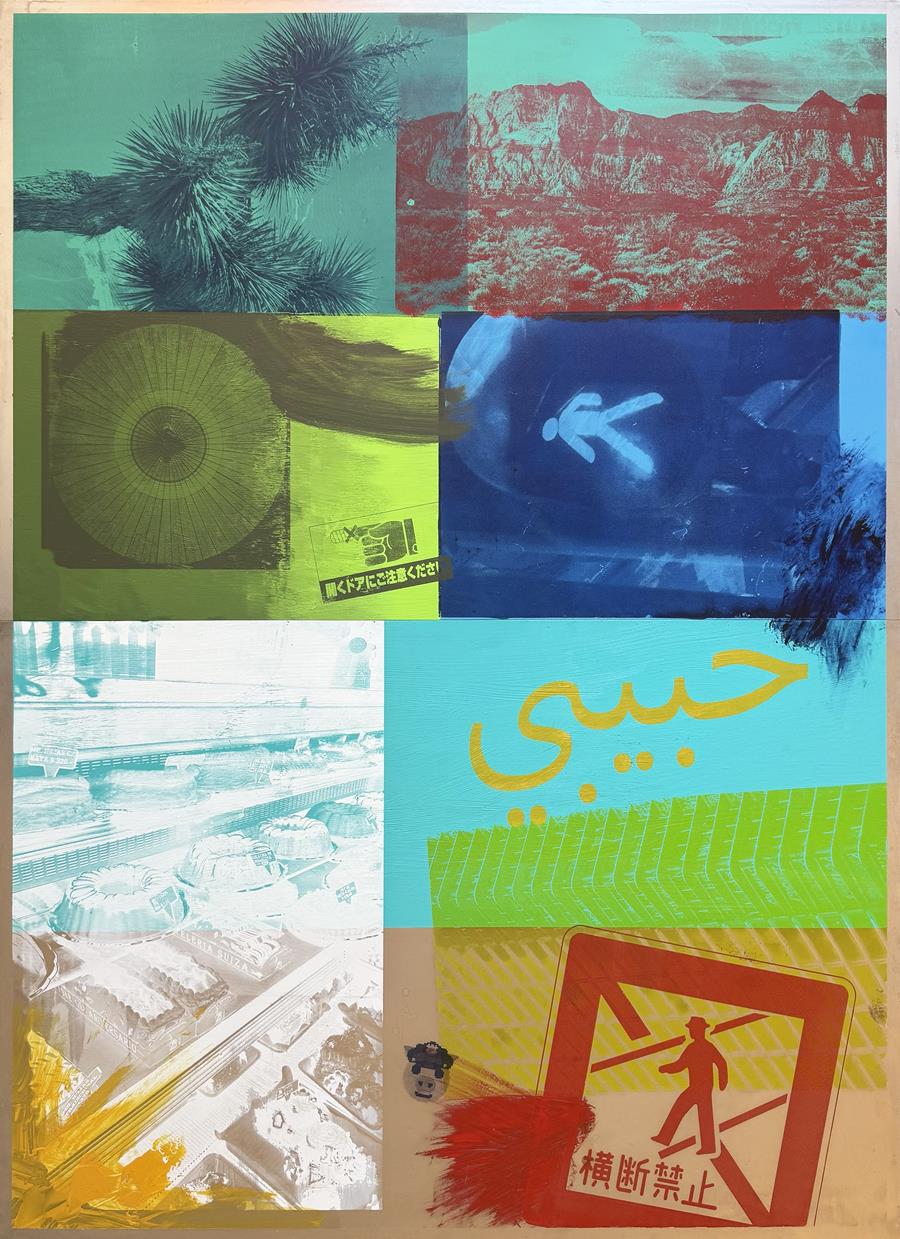
Acrylic and serigraphy on steel
36 x 48 in.

Acrylic, serigraphy, and paper on steel
24 x 36 in.
I think there was an initial impetus for me to rely on imagery that I’d photographed myself when I was in a naive state of creating new work, as if it made the pieces more “authentic,” but I’m now thinking much of this idea is simply bullshit and steeped in some antiquated fears about others’ perception of the work rather than my own. Sometimes a photo I’ve taken represents a concept as good as a stock or historic image can, so I use my own photo, and I think viewers are sometimes drawn to the fact that I took the photo, but for me personally, it’s beginning to matter less and less.
That hasn’t stopped me from taking photos - I sometimes think of photography as a form of disembodied cognition - there’s even lines of research that have discussed this, how experts “offload” cognition onto their environments, I use photography as a tool in the same way, sometimes to capture a mood or feeling, only to refer back to it later to recapture that fleeting mental state, rather than using the image directly in a work.
Drawing from the public zeitgeist is a powerful tool; semiotics has demonstrated the value of symbols, and sometimes appropriating directly from widely understood sources is the best way. Last year I made some silkscreens out of the drawings of Ramón y Cajal, an early neuroscientist from the 19th century - he was one of the first to draw neurons after looking at them under a microscope - I wanted to find a way to represent the nebulous connection between thoughts and the physical substrate that manifests them - quite literally the cells in our head - so I borrowed his work.
In the past couple months, I keep coming across his drawings in galleries. I’d used these images when I was teaching undergraduate cognition courses for years, and now I’m finding them referenced in artistic contexts - Cajal’s drawings are now back in the zeitgeist, circulating a bit more. I think what I’m saying is, sometimes there’s value in just deriving source material from found or borrowed imagery because it touches upon something in the public zeitgeist of our shared visual language that the audience might more easily interpret.
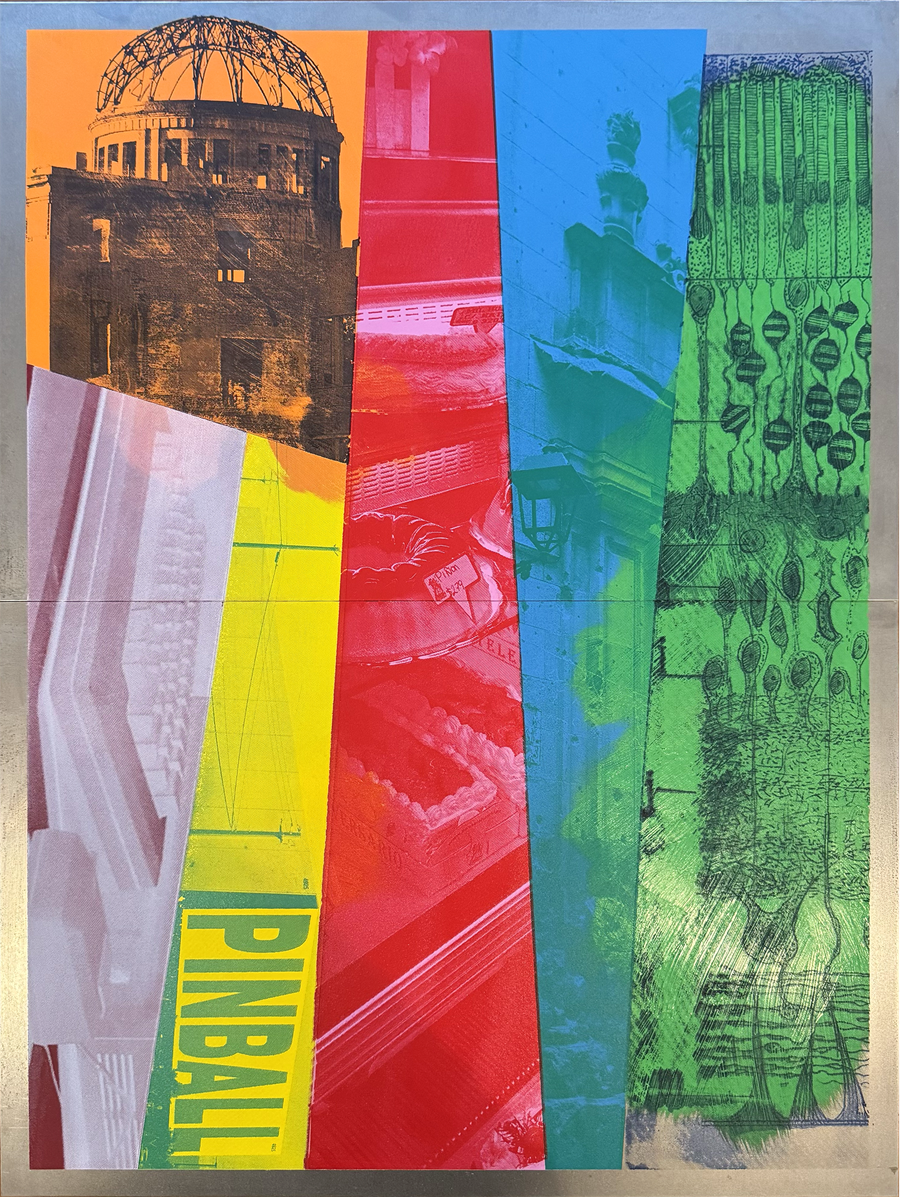
Acrylic and serigraphy on steel
18 x 24 in.
I’d always stress to my students how so much of what we deal with in behavioral research are just constructs (concepts) and not real: working memory, attention, motivation. They’re not “real” in the directly observable sense, but things we operationalize for the purpose of study, and measure through inferential means. So how do we operationalize the boundaries of collage?
Perhaps I’d operationalize it like this: collage is a technique involving one or more mediums to produce a composition consisting of often disparate forms, consisting of two or more elements. But this is a very, very reductive way to operationalize it, and to operationalize something for the purpose of study can be a really diminishing (but useful) exercise.
When it comes to drawing a line as to where collage begins or ends, I think it’s a bit nebulous, and perhaps that’s why I’m drawn to art more after coming from training as a behavioral researcher - there is a rigidity to empirical research. Art is less rigid in constraints, but requires the same rigor in exploration and inquiry… You can blur the lines, dispense with formalism. Collage can be figurative or purely abstract: it can be about medium specificity or about surpassing the limitations of the mediums.
Collage, like so many other terms used in the arts, is wildly elastic, but still fundamentally serves as a conceptual bridge between parties talking about a work. I’m not sure that it’s so elastic that it loses meaning, but the term itself can also be reductive because, in the minds of many, it can sometimes imply a particularly narrow definition of collage in those less familiar with the varied history of the technique.
I’ll end with an anecdote… I am forever enamoured with the minute design elements that we find in cities; the textures created by brick, stucco, paint, plaster, rock, torn advertising; the variations in color and value created by artificial light, digital signage, the changing weather of the day; all of this sometimes coalesces into visual compositions of elements on walls that can feel complete. Occasionally, a wall on a street corner can feel as pleasing as a painting in a gallery. But do I dare call the wall a collage? I don’t think so, because there isn’t necessarily human intention involved. So I think one boundary I would place is human intent.

Acrylic and serigraphy on steel
24 x 18 in.

About the Artist
Gabriel Allred, Ph.D., is a multidisciplinary artist and former behavioral researcher. His recent work explores autobiographical themes and contemporary issues (e.g., immigration, late-stage capitalism, identity, class). His collage work is heavily grounded in silkscreen printing. Growing up in Las Vegas, Nevada, he spent much of his formative years as a satellite in his father's sculpture studio.
Gabriel studied psychology, earning a Ph.D. with a specialization in human cognition. Possessing a rather nuanced understanding of human cognition alongside sensation and perception, he uses this knowledge in his own artistic practice - utilizing his imagery to conjure implicit themes and concepts. He has also created a number of digital media projects alongside artist and collaborator Keil Corcoran of the band STRFKR. Zinemaking is also a part of Gabriel's practice, an extension of his photography.
For Your Viewing Pleasure
What to watch, read, and experience, as curated by the Collé team.

NICHOLAS D'ORNELLAS is a Guyanese-born artist and educator based in Jersey City, NJ. His practice centers on printmaking as a means to create screenprinted and handwoven textiles that explore domestic immigrant narratives.

RADEK SZLAGA (b. 1979, Gliwice, Poland) is a painter working between Brussels and Detroit. A Poznań graduate and Penerstwo co-founder, he recycles found and archival imagery—cutting, pasting, and transferring fragments between canvases—colliding Eastern European memory with American visual culture in densely layered, self-referencing compositions.

GHADO FASHO is a Canadian artist based in the Greater Toronto Area who specializes in abstract oil and acrylic paintings, pastels, and ink drawings. [1, 2]

RACHEL YOUN (b. 1994) rescues secondhand electric massagers and fastens artificial plants to them, creating kinetic sculptures: clumsy, erotic, and absurd. Haunted by their immigrant father's American Dream, Youn identifies with the replica earnestly desiring to be real.

JOSÉ LUIS ANZIZAR (b. 1962, Buenos Aires) is a self-taught Argentine artist working in cut paper, collage, and thread. His large-format works map imagined cities—tangled, luminous metropolises poised between observation and invention.
Out and About
What to watch, read, and experience, as curated by the Collé team.

▼ VISIT
Positive Fragmentation at Long Beach Museum of Art
LBMA presents Positive Fragmentation: From the Collection of Jordan D. Schnitzer, running June 26 – Sept 27. The exhibition gathers more than 180 prints by contemporary artists working with fragmentation in distinct ways. Artists in the show include Louise Bourgeois, Ellen Gallagher, Jenny Holzer, Julie Mehretu, Wangechi Mutu, Lorna Simpson, and Kara Walker.
▼ VISIT
Making Meaning: A Collage Symposium
Making Meaning: A Collage Symposium is a three-day convening exploring how collage constructs, disrupts, and reimagines meaning across time, media, and community. Featuring presentations, workshops, exhibitions, and a book fair, the symposium takes place July 22–24, 2026 at the Vassar Institute for the Liberal Arts in Poughkeepsie, NY.

▼ LISTEN
In A Beautiful Place Out In The Country by Boards of Canada
This 2000 EP is the duo's most concentrated mood piece. Four tracks of warped tape and woozy synth, its title lifted from a Heaven's Gate recruitment video.
