
Collage on paper
30 x 21 cm
Sharon Etgar
Sharon Etgar’s collages occupy a place where painting and sculpture are integrated. A universe, as Max Ernst would say, that exists ‘beyond painting’. She uses carefully selected papers and dyes them by hand, formulating a playful and eloquent visual dialect that relies on weight, balance, rhythm and contrast. A formal inquiry is the leading principle in her practice, giving her permission to experiment with two and three dimensional formats, including cut canvas and wood compositions as well as large wooden composite sculptures.
In the Words of the Artist
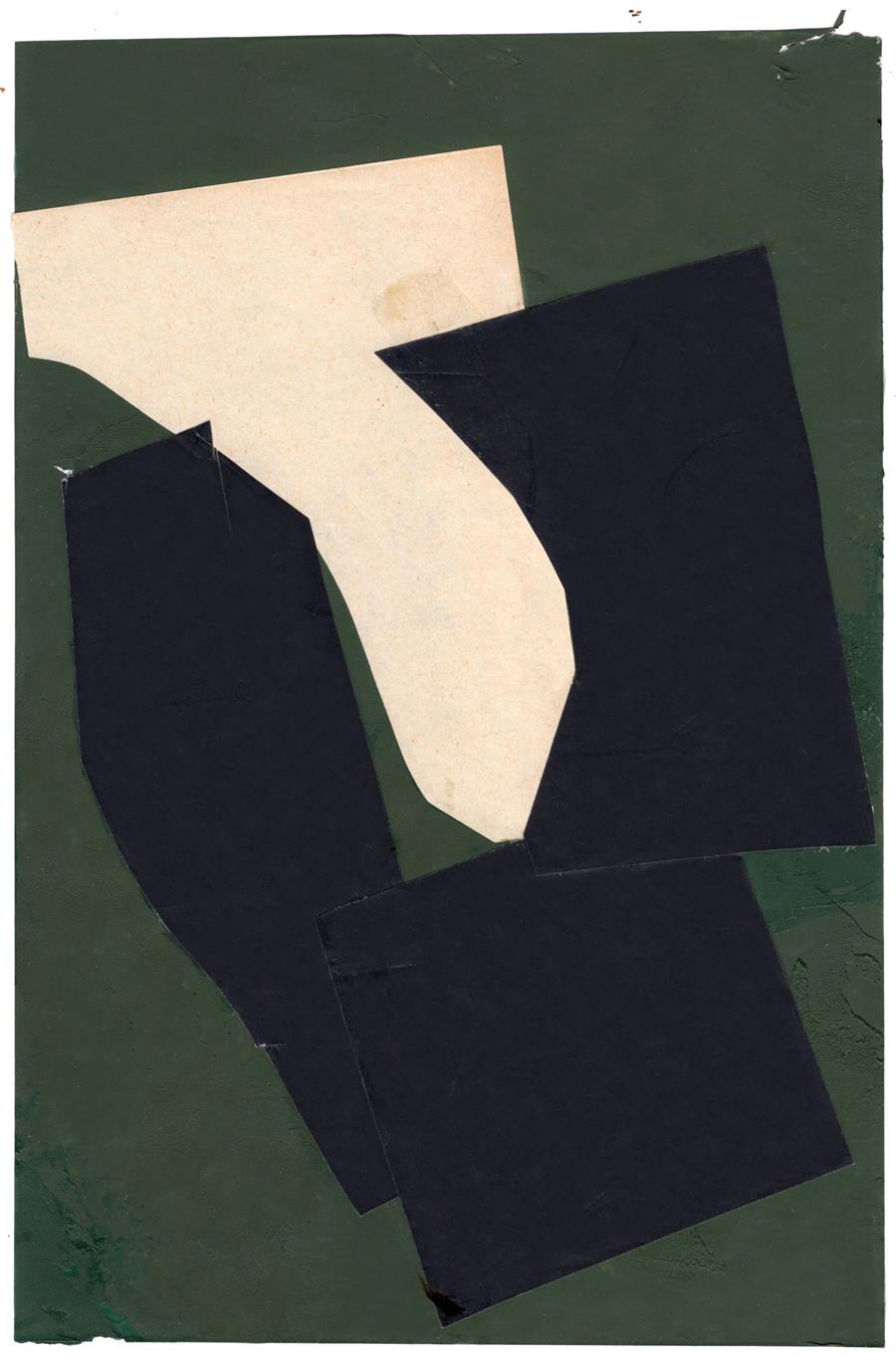
Collage on paper
29 x 19 cm
‘You know, in the Scriptures it says, “In the beginning was the word.” No! In the beginning was emotion. The Word came later, replacing emotion like trot replaced gallop’
- Julia Kristeva, Powers of Horror: An Essay on Abjection, 1982.
Observation and insight into relationships are the unconscious impulses that set me in motion. When the dialogue between forms takes place, they tell their own stories—attraction, repulsion, separation, dependency, boundaries, or containment. Material, by contrast—paper, paint, wood, fabric—is the conscious stimulus. I choose it for the physical possibilities it offers and, more than that, out of a bodily need to experience something through it.

Collage on paper
30 x 21.5 cm
My first collages, made in 2008, were copies of paintings by Gwen John (1876-1939). Through this process of observation, I repeatedly practiced the familiar transition from mixing colors to working with paper: from a patch of color to a defined shape, from the stroke of a brush to a cut, and, in a still partial way, from figuration to abstraction. I mixed quantities of paint drawn from her pastel palette and used them to color more and more sheets of paper. I sorted them by hue and found myself surrounded by them—and by her.
Today, the papers I find or those I make myself are accumulated in boxes and drawers in my studio. I am surrounded by possibilities. I stopped sorting my source materials long ago. This often allows me to rediscover, with a sense of surprise, a piece of paper I had already forgotten or that had hidden itself away somewhere.

Collage on paper
30 x 21 cm
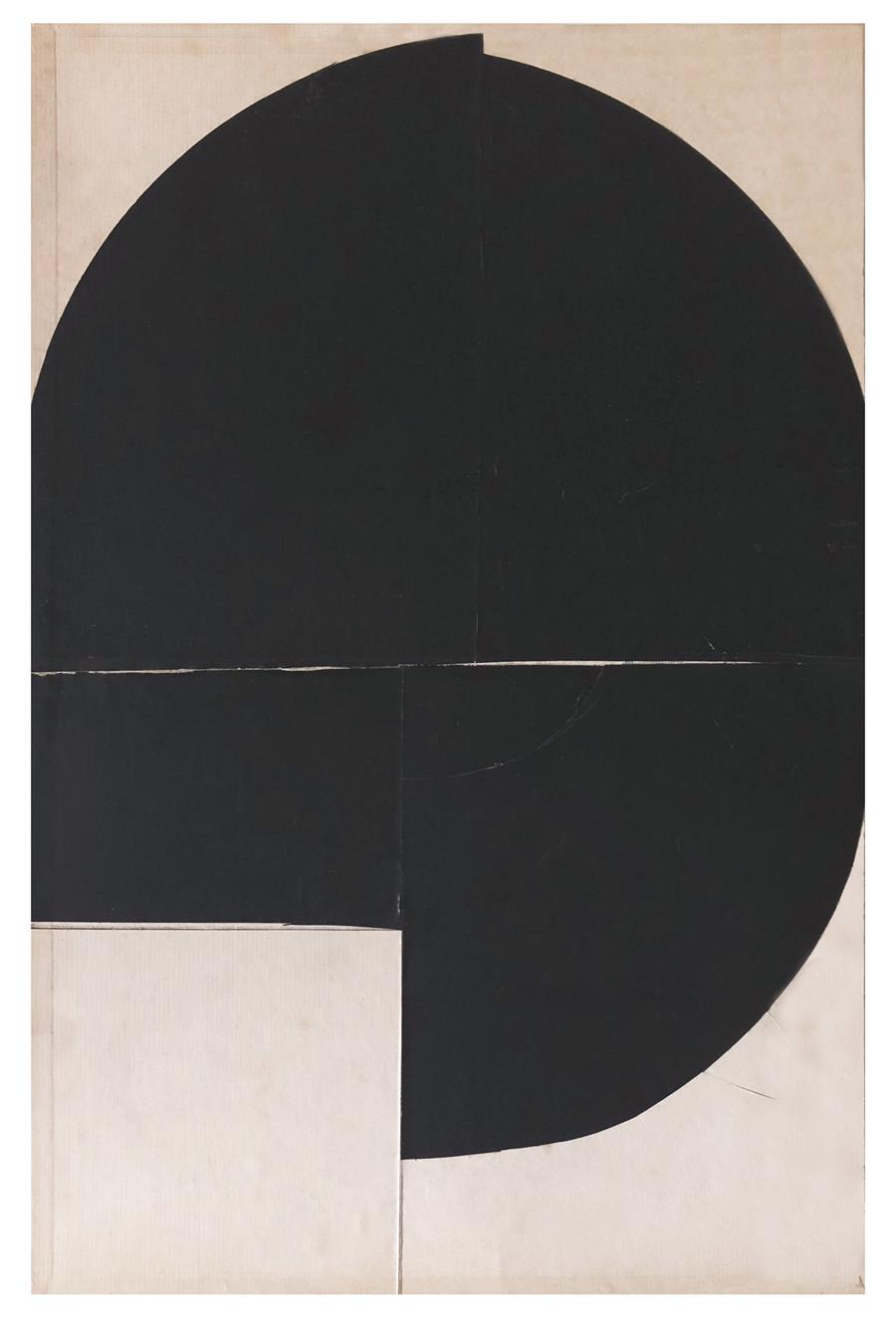
Collage on paper
48.5 x 32 cm
I do not work with sketches or a grid, because the act of collage demands disassembly and reassembly, playfulness, and experimentation. This is true whether I am working in two dimensions or creating my sculptures, which are also composed of various three-dimensional forms. These are cut without a precise assembly plan, and I take the risk that I may not succeed in joining them into a complete, three-dimensional collage. Mistakes usually reveal themselves as openings toward a solution, while any advance plan will, in any case, change along the way, taking its own surprising course toward the final composition.
Recently, and naturally, out of a need for movement and space, my formats have grown larger and new materials have entered the studio. Recent collages are made with wood, cut intuitively and through a process of free exploration despite the seemingly deliberate impression created by their formal geometry. My observations of nature, people, and art over the years—and the forms I discover in them, the grid, the tensions, the relationships, and the possibility of practicing the inner grammar of language—are the driving force that carries me away from narrative storytelling and toward abstraction.
Formal collage is an open door through which I can realize and experience an inner process of stillness and reduction, one that feels necessary and right for me amid the overload of information, consumption, and endless sharing that characterize the reality around us. Through this door, I enter the studio and withdraw for a few hours into the privilege of stepping away from imagery and conceptual narrative.

Collage on paper
29.5 x 21 cm

Collage on cardboard
30 x 21 cm

About the Artist

Sharon Etgar (b. 1975, Jerusalem) is an artist whose practice encompasses a wide range of media, including oil painting, paper and fabric collage, textile works, and sculpture. She received her B.Des. in Visual Communication from the Bezalel Academy of Arts and Design, Jerusalem, and subsequently studied painting and drawing at the Jerusalem Studio School. She has taught at Bezalel since 2013 and currently works in Kibbutz Ein Shemer.
Her solo exhibitions include If Your Heart Runs Lead It Back to a Place, Inga Gallery, Tel Aviv (2024); Elements, Hansen House, Jerusalem (2021); Recent Works, Davis & Langdale Gallery, New York (2015); Thread Drawings, Davis & Langdale Gallery, New York (2013); and Sharon Etgar: Collage, Davis & Langdale Gallery, New York (2011). Her work has also been exhibited at the Tel Aviv Museum of Art, the Petah Tikva Museum of Art, and internationally in New York, Dublin, Paris, and Philadelphia. Her works are held in collections including the National Gallery of Art, Washington, D.C.; the Zimmerli Art Museum at Rutgers University; and the Werner and Sarah-Ann Kramarsky Collection.
Etgar’s work is currently on view at Gordon Gallery, 139 Norfolk Street, New York, NY 10002 (through November 15th).
For Your Viewing Pleasure
What to watch, read, and experience, as curated by the Collé team.

ANNE RYAN (1889–1954) was an American painter and printmaker who turned to collage after seeing Kurt Schwitters’ work in 1948. In her final years she made hundreds of small abstract compositions from paper and fabric.

ESTEBAN VICENTE (1903–2001) was a Spanish-born American painter and a member of the first generation of New York School artists. He painted his own papers for collage, tearing and arranging them into luminous abstract compositions.

LEE KRASNER (1908–1984) was an American Abstract Expressionist painter. In the early 1950s she cut up her own discarded paintings and drawings and reassembled them into collages, a body of work that redirected her practice.

LEONORE TAWNEY (1907–2007) was an American artist who helped move weaving from craft toward sculpture. Alongside her suspended woven forms, she made collages and assemblages throughout her life, often combining found paper, thread, and text.

SARAH CROWNER (b. 1974) is an American artist based in Brooklyn. She cuts and sews painted canvas into hard-edged abstract compositions, and extends the work into ceramic tile installations and stage sets for dance companies.
Out and About
What to watch, read, and experience, as curated by the Collé team.

▼ READ
Dayanita Singh Dreams of Archives
Singh skipped the sponsors and the Biennale hype, set up shop in Venice’s state archive with students as docents, and talked with Sarah Meister about why she’s really an archivist, not a photographer, and why art should circulate.

▼ RESOURCE
An Incomplete* Listing of Los Angeles Libraries, Reading Rooms, and Archives
This is the second edition of a growing directory of freely accessible reading spaces in LA County. Beyond the collections and knowledge they house, these spaces provide essential services to LA County’s 10+ million residents.

▼ LISTEN
Eastern Soul by Tsvia Abarbanel
Yemenite folk run through funk and jazz, with Albert Piamenta’s band backing her. She privately pressed it in 1970 after Israeli labels called it too strange. Fortuna Records from Tel Aviv finally reissued it in 2018.
