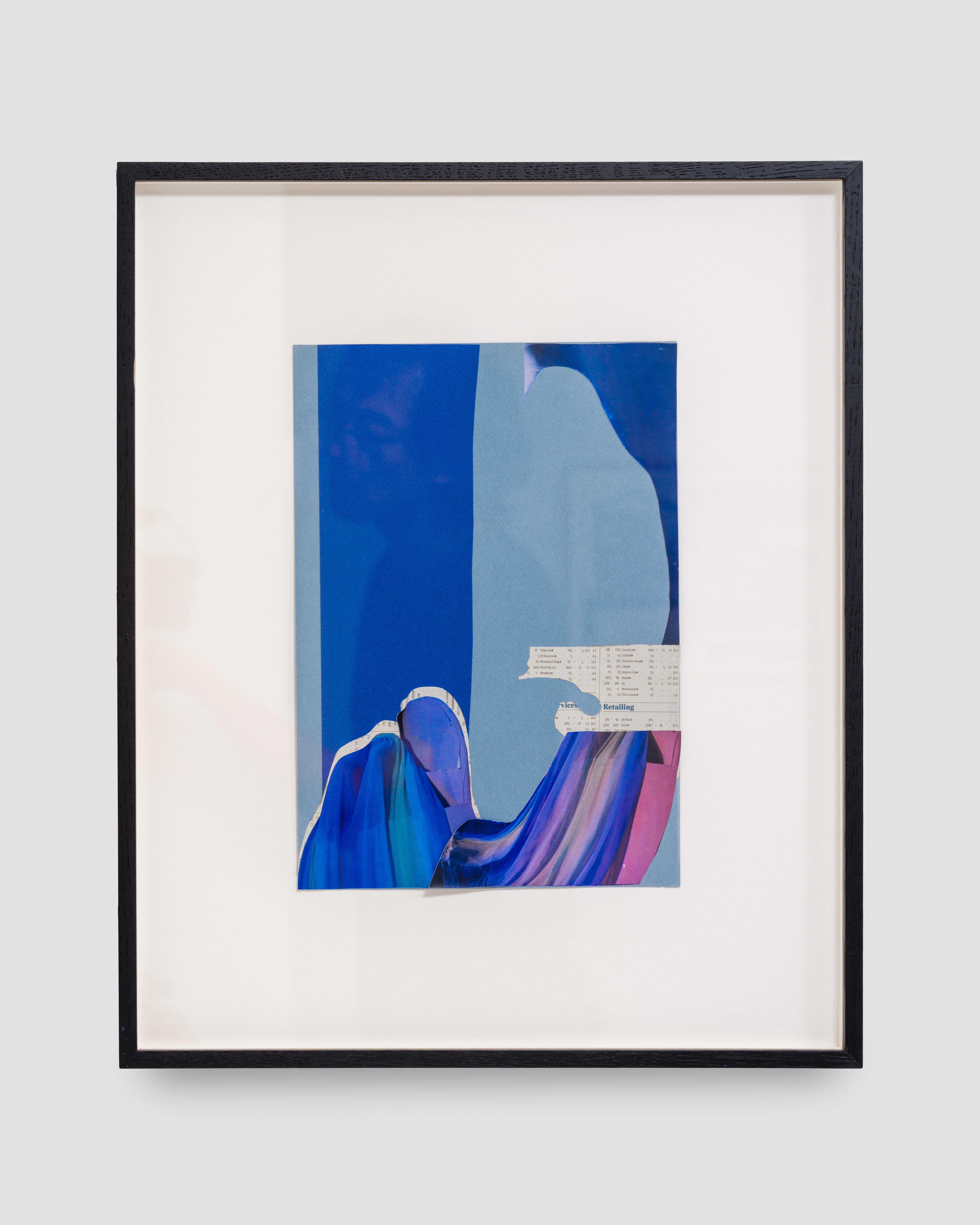
Melanie Smith, whose work moves fluidly between painting, film, sculpture, and performance, says something that stops you short: “I think all of my work is some kind of collage. Not collage as a category — as a medium listed alongside the others — but collage as a fundamental orientation, a way of holding fragments in productive tension. A state of mind.” The sentiment echoes across contemporary practice: Njideka Akunyili Crosby, who embeds collaged photographic imagery into her painted canvases, layering memory and migration onto domestic scenes; John Stezaker, who works almost exclusively in found photographs, making precise incisions that reveal meanings the originals never intended to carry. What these practices share, across their considerable differences, is a single conviction: collage is not a technique. It is a way of thinking.

It also occupies a particular position in the wider history of making — simultaneously one of the oldest human impulses (to gather, to juxtapose, to find resonance in the adjacency of things) and one of the most persistently misunderstood. Too often perceived as craft, too rarely recognized as the sophisticated cognitive act it actually is.
What collage demands is a particular quality of attention. Not the linear attention of writing a sentence or laying down a brushstroke, but something more lateral and associative: the attention of someone genuinely looking at what is in front of them and asking what else it might become. Ellen Langer, the Harvard psychologist whose research on present-moment awareness has reframed how we understand creative engagement, argues that this quality — what she calls mindful creativity — is among the most cognitively valuable states a person can access. Open-ended making, where there is no predetermined correct outcome, produces a presence genuinely difficult to achieve by other means.

Neuroscience is arriving at similar conclusions from a different direction. The emerging field of neuroaesthetics — the scientific study of how aesthetic experience shapes the brain — has found that deep aesthetic engagement transforms the brain's rumination circuitry into something more integrated and coherent. The mind that won't quiet down turns out to have another gear. Cortisol levels measurably drop during art-making, and the effect holds regardless of prior experience or skill. What artists have long understood intuitively — that making is a form of thinking, and thinking through material is a form of care — turns out to be legible to the body as well.
But the health argument, compelling as it is, tells only part of the story. Collage has long served as a thinking tool, a private laboratory, for artists whose primary practice lies elsewhere. Matisse, immobilized in his late years and unable to paint, turned to cut paper and discovered what he called drawing with scissors: a late body of work that many consider his most radical. The painter Amy Sillman, whose practice is rooted in gestural abstraction, has spoken of collage as indispensable to her process — a way of working through pictorial problems that painting alone resists. Writers, too, have found in it a structural thinking tool: a way of assembling fragments — images, clippings, found language — into patterns of meaning that linear drafting tends to obscure. There is something about placing two things on the same plane, as Smith observes, that clarifies their relationship in ways that words, for a time, cannot.
This is the quality that makes collage both accessible and inexhaustible. You do not need a studio, a decade of training, or a clear idea of what you are making. You need fragments, and a willingness to see what they do to each other. Any new gesture, Smith says, switches up the meaning.
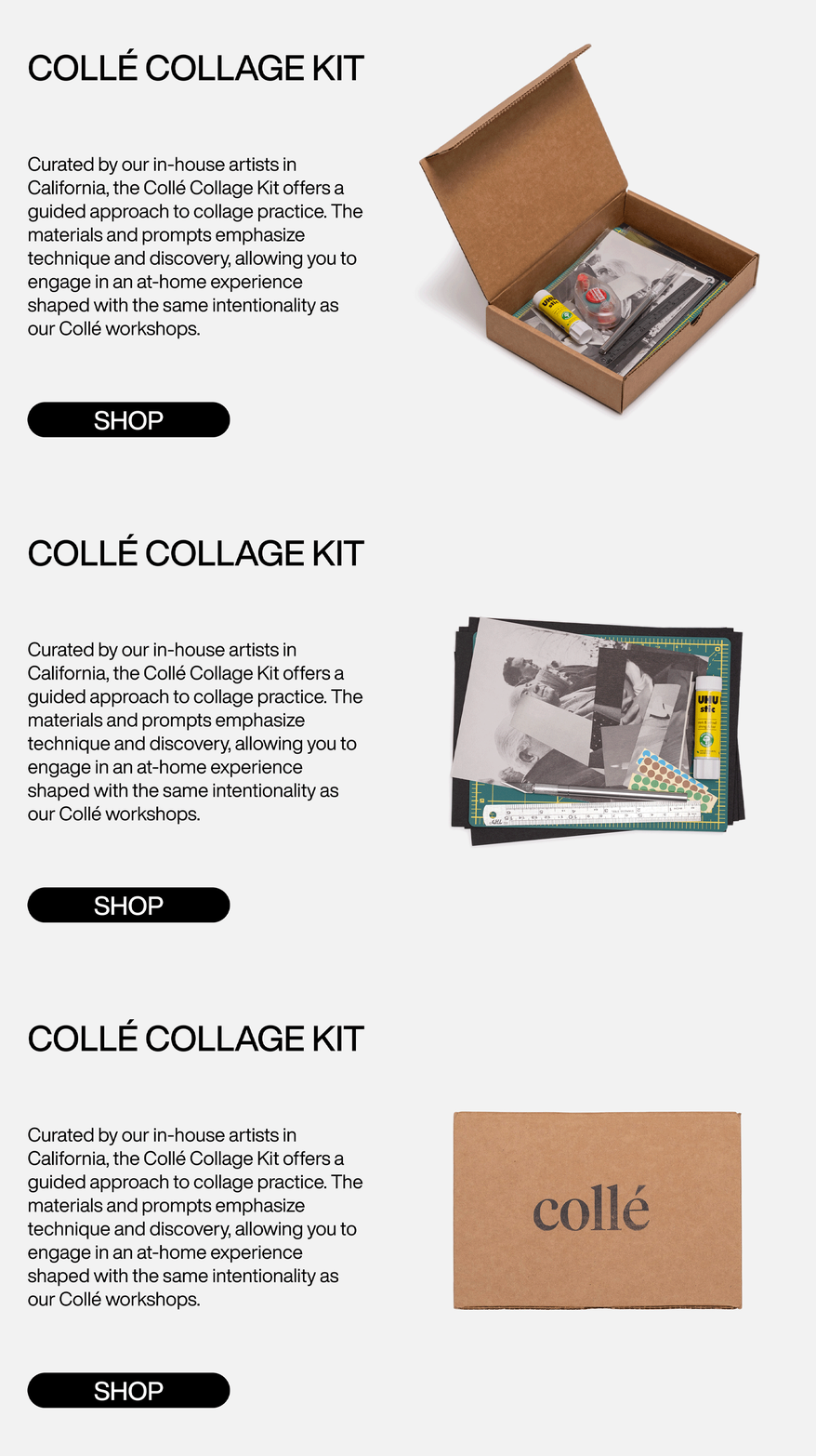
For those new to the practice — or returning to it after years away — the Collé Collage Kit offers a considered place to begin: materials selected for their quality and range, with enough structure to start and enough openness to go wherever the work leads. Buy the kit here.