The first thing you notice is the edges.
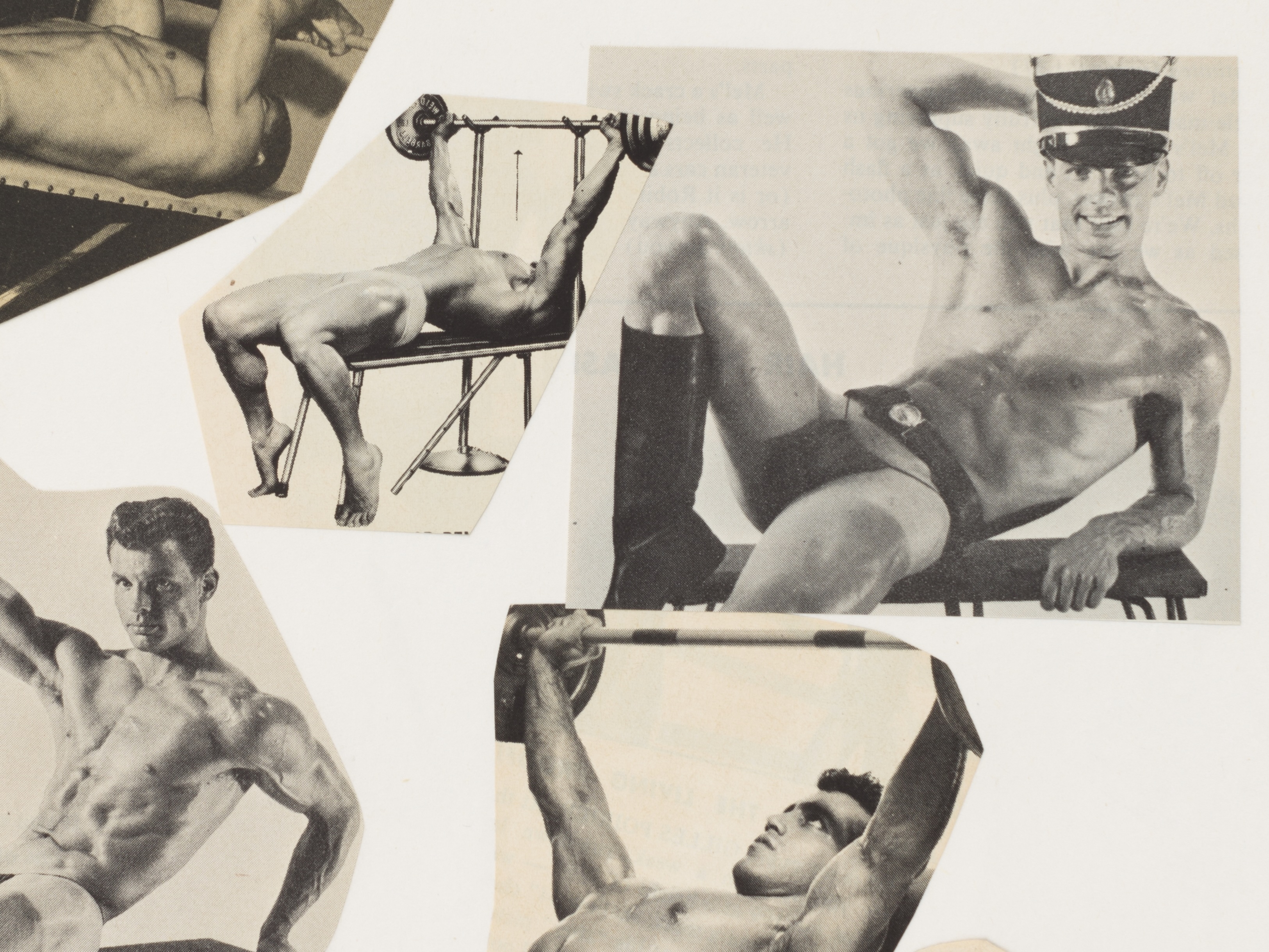
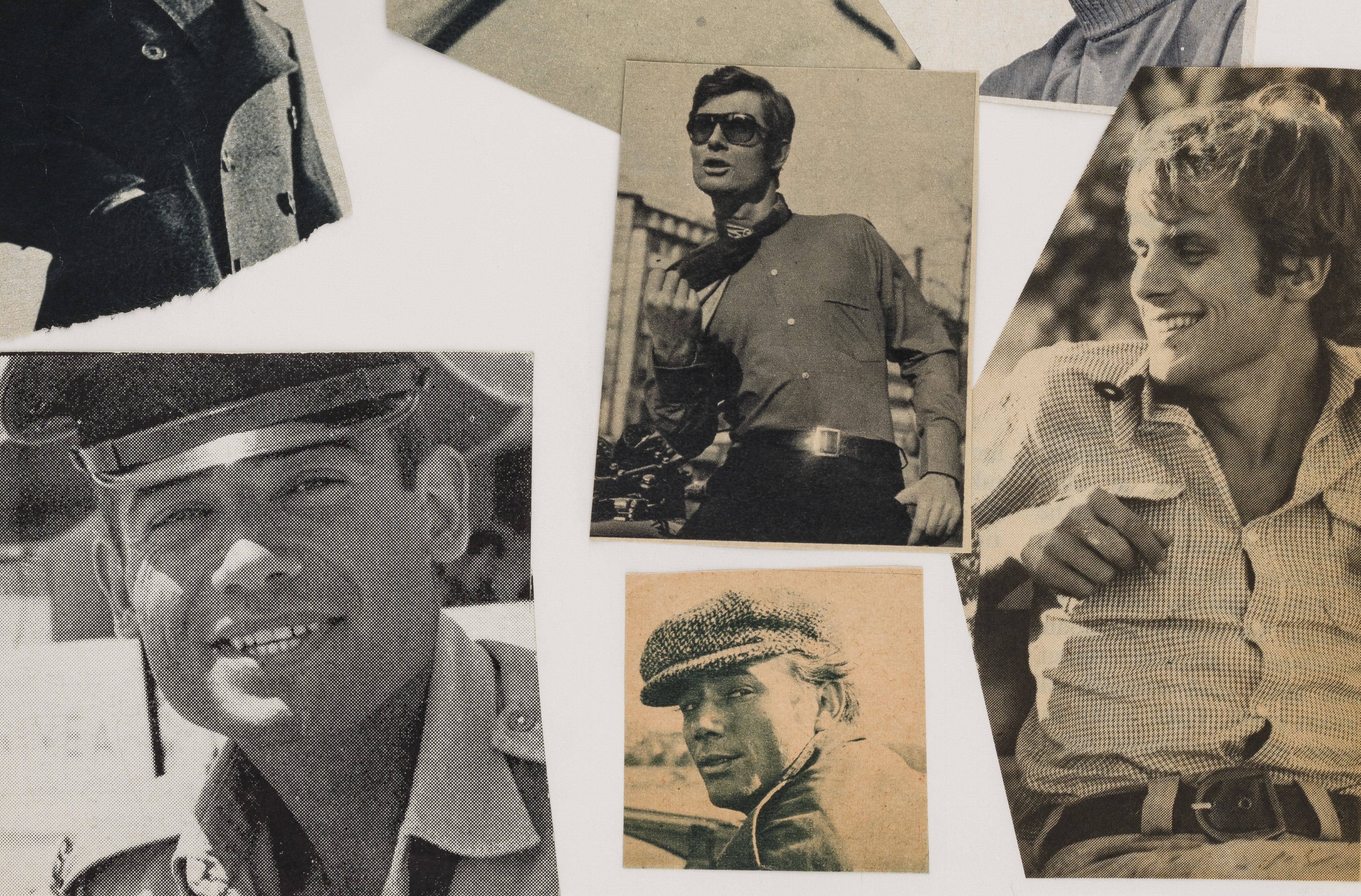
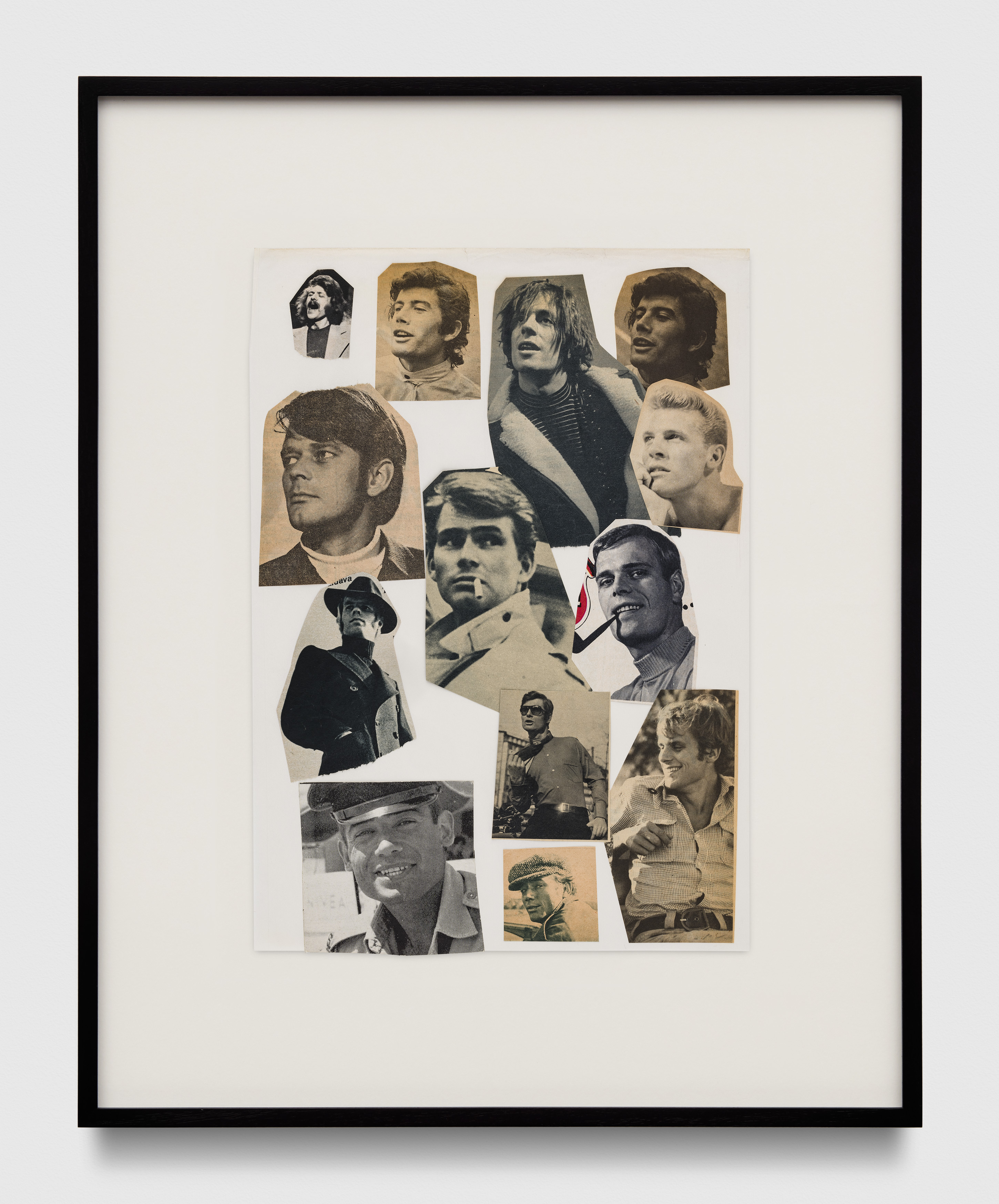
Not the figures themselves, not yet, but the cuts. Hard, decisive, and unapologetic. Yellowed, pulpy fragments of newsprint are set against crisp white mounting boards, the seams left visible, insisting on their own construction. In one collage, bodies arch in stacked fragments. Outstretched torsos with tight waists are arranged into a vertical thrust that feels almost architectural, if one were inclined to keep things polite. In the other, the frame tightens. Faces come closer together, cheek to cheek, tightly cropped and arranged into something quieter, more varied and searching. Together, the two works establish a tension that runs through Tom of Finland’s practice—between monument and intimacy, spectacle and scrutiny, the body as icon and the face as site of serial differentiation.
These are not finished images. They are not resolved. And yet, they feel complete in another way, dense with intention, already carrying the charge that would later define his drawings. What emerges here is not just a style, but a system. A way of building desire from fragments, from images not intended for you. These collages are structured by a logic in which limitation becomes generative, where what is possible emerges not in spite of constraint but through it.

Courtesy of David Kordansky Gallery and the Tom of Finland Foundation
The first collage operates at the scale of myth. Cut-out figures—muscular, idealized, unmistakably drawn from mid-century physique magazines—are stacked in an angular, scaffolded tower; their forms never fully merge but connect through their repeating curves and embodied tension of a vacuumed waist and expanded ribcage. While physique magazines of the period frequently invoked Grecian aesthetics and idealized poses, in the collages these references register less as explicit citations than as ambient influence. Before arriving at his own exaggerated ideal, Tom appears subject to the pull of an already established visual language, one he studies, extracts, and gradually transforms. The eye then moves across these strained anatomies, reconciling similarities that fall short and discontinuities that never quite settle. And yet, the overall effect is one of solidity. The body, though fragmented, becomes monumental and formidable.
This is the paradox at the center of the work: the image gains force not in spite of its seams, but through them.

Courtesy of David Kordansky Gallery and the Tom of Finland Foundation
These source images were never neutral. Produced within a culture that simultaneously commodified and censored the male body, physique magazines offered a coded visibility ostensibly about fitness, but legible to those who knew how to find what they were looking for. Within José Esteban Muñoz’s framework of disidentification, such images are neither simply accepted nor rejected but actively reworked from within, becoming a strategy of survival for subjects who cannot fully align with or wholly refuse dominant culture. By cutting and reassembling these images, Tom does not simply appropriate them; he intensifies them. He displaces their intended function, draws out their latent charge, and reorganizes it into something more explicit, more controlled. The body here is not discovered, it is engineered, though not without a certain pleasure in the process.
Seen this way, the collage is not exclusively preparatory. It is generative. It stages the emergence of the iconic Tom of Finland figure not as an invention ex nihilo, but as an accumulation: an image built through careful repetition, variation, and deft selection.

Courtesy of David Kordansky Gallery and the Tom of Finland Foundation
If the first work reaches outward, the second turns inward.
Here, the scale contracts. Faces replace bodies, or rather, bodies are snipped from attention and left on the studio floor. Cropped from magazines and gathered more closely on the page, these faces do not declare themselves in the same way. They begin to register against one another, inviting comparison. Their expressions are ranging and ambiguous—some direct, some averted, some caught mid-glance with a cigarette hanging from parted lips, all in three-quarter view. The composition feels less like a public image and more like a private one, a page from a notebook or a wall of references that was never meant to be seen.
The shift is subtle but significant. Where the first collage constructs a type and a consistency, the second suggests a relation through difference. These are not interchangeable parts of an idealized whole; they are specific, even if anonymous and clipped from their original context. The act of looking changes. It slows down. It becomes less about recognition and more about attention. It shifts from looking at something to looking for someone.

Courtesy of David Kordansky Gallery and the Tom of Finland Foundation
Together, the two works map a spectrum of desire: from the monumental to the intimate, from the public fantasy to the private archive. And it is within this spectrum that collage reveals itself as more than a technique. It becomes a method, a way of thinking, a way of assembling not just images but identities, symbols, and networks of meaning. This double register of commercial competence redirected toward private need is nowhere more visible than in the collages themselves.
By the late 1950s, working by day as an advertising executive, Tom had access to a wide range of printed material: mainstream magazines, commercial imagery, and emergent, internationally circulated forms of visual and consumer culture. These collages—what he referred to as ‘reference pages’—were built from a stream of imagery he both contributed to and was excluded from, producing visuals for a public that did not include him. In this sense, the collages register this split most clearly: the same technical and compositional skills that sustained his work in commercial advertising were repurposed, underwriting a queer visual vocabulary that both draws on and departs from those conventions.
Courtesy of David Kordansky Gallery and the Tom of Finland Foundation
According to Tom of Finland Foundation, these materials formed part of a larger archive through which the artist developed his now-iconic visual language. Cuttings were organized into categories, annotated, sometimes drawn over and reworked. Some photographs he had taken himself. They functioned as working documents, but also as repositories of desire. Seen in this light, the collages are not ancillary to the drawings; they are their infrastructure. They show how the image is made before it appears fully formed, how fantasy is constructed through selection, repetition, and recombination.
This matters, especially now when images arrive already resolved, already decided for us.
We are accustomed to encountering images of the body and the identities they suggest or establish as seamless, finished, and optimized. The labor of their construction is hidden, or at least smoothed over. Tom’s collages refuse that illusion. They make visible the process by which an ideal is assembled, and in doing so, they open that process up to scrutiny.
To consider these works today is also to situate them within a longer history of queer image-making under scrutiny. At a time when explicit representation was heavily policed, collage offered a way to work indirectly, to assemble what could not yet be shown outright from methods and materials that were available. It allowed for a kind of coded production, where meaning could accumulate across fragments and was legible to only those attuned to its subtle signals.
But there is nothing tentative about these works. Even in their intimacy, they are assertive. They do not ask to be decoded so much as inhabited.
Courtesy of David Kordansky Gallery and the Tom of Finland Foundation
What they offer is not just a glimpse into process, but a proposition: that identity, like the image, is something constructed. Not artificially, but materially—through contact, through accumulation, through the negotiation of what is available and what is desired. Potential within constraint.
In this sense, the collages feel strikingly contemporary. Not because they anticipate the present, but because they make visible a queer logic that has only become more generalised: that identity is assembled rather than given, composed through selection, repetition, and recombination. In an era saturated with images, where bodies circulate as data and identity is simultaneously hyper-visible and algorithmically managed, this logic takes on renewed urgency. Tom’s work reminds us that it is not new—but it also suggests that it can be done otherwise, with intention, with awareness, with a kind of erotic intelligence.
But this logic is unevenly distributed: not everyone has equal access to the tools of self-making. Some forms are chosen, while others are imposed; not all fragmentation is creative, and in many cases, the cuts are made by others.
Returning to the two collages, what lingers is not just their imagery, but their structure. The cuts remain visible. The joins hold. Nothing fully resolves. Nor does it seem particularly interested in doing so.
And that may be their most enduring quality.
They do not present the body or self as whole. They show them in the act of becoming.

Courtesy of David Kordansky Gallery and the Tom of Finland Foundation
Nicolo Gentile is an artist and educator based in Philadelphia, PA. He holds an MFA in Sculpture from the Tyler School of Art and Architecture at Temple University and a BFA in General Fine Arts from the Pacific Northwest College of Art.
Gentile’s work has been exhibited nationally and internationally at venues including The Athenaeum, Commonweal Gallery, BLAH BLAH, Temple Contemporary, and Automat (Philadelphia); Fragment Gallery and Trestle Gallery (New York); The Vault (Denver); LVL3 (Chicago); Portland Contemporary and Carnation Contemporary (Portland, OR); SOIL and The Vestibule (Seattle); FAUN, TSA LA, Cannery Village Gallery, and Last Projects (Los Angeles); as well as exhibitions in Paris and Melbourne.
He is a recent recipient of the Association of Public Art’s Art on the Parkway Competition and the Velocity Fund, supported by The Andy Warhol Foundation for the Visual Arts, and is an upcoming Artist-in-Residence at the Tom of Finland Foundation. Gentile teaches at the Tyler School of Art and Architecture and has served as a guest lecturer at the Pacific Northwest College of Art, Portland State University, and Nazareth College.
Tom of Finland (Touko Laaksonen, b. 1920, d. 1991) is widely regarded as one of the twentieth century’s most influential artists for his groundbreaking representation of the male figure. In his youth, Tom trained at an advertising school, but what he would come to call his “dirty drawings,” which he first began developing as a teenager, were the true focus of his attention, both during this formative period and throughout the entirety of his life. These masterful renderings of virile men engrossed in acts of homoerotic desire can be approached along several interpretative lines—art historical, social, technical—but each of them points to the revolutionary nature of his project. A master draftsman, whose passion for both his medium and his subject matter enabled him to become a powerful cultural force, Tom gave form to an imaginative universe that in turn helped fuel real-world liberation movements and enabled gay men to access their strength in new ways. Tom’s drawings reaffirm the centrality of sexuality, joy, and the body in all areas of human endeavor.

Tom of Finland Foundation (ToFF) is dedicated to protect, preserve, document and educate the public about erotic art and erotic artists. ToFF shall continue to encourage the work of erotic visual artists regardless of race, creed, religion, gender, sexual identity, medium of expression or any other censoring criteria.
Tom’s Stretch, a group exhibition engaging with Tom of Finland’s radical ability to imagine a physique—and a world—that did not yet exist in popular culture, opens at David Kordansky Gallery Los Angeles on July 10, 2026.