
E’wao Kagoshima Interview
Interviewed by Dr. Reiko Tomii with Takako Tanabe in Japanese
Interview translated and edited by Dr. Reiko Tomii
E’wao Kagoshima (b. 1945) is a Japanese-born, New York-based artist whose practice encompasses painting, sculpture, and collage. He has presented solo exhibitions at Ulterior Gallery, New York (2026); Greenspon Gallery, New York (2018); The Box, Los Angeles (2018); Galerie Gregor Staiger, Zurich (2016); Mitchell Algus Gallery, New York (1997, 2008); the New Museum, New York (1983) and Nagai Gallery, Tokyo (1976). His works have been featured in exhibitions at MoMA PS1, New York (2021); the Baltic Triennial at the Contemporary Art Centre, Vilnius (2018 ); the Jewish Museum, New York (2014); SculptureCenter, New York (2013); White Columns, New York (2011); and the Institute of Contemporary Arts, London (1982). Most recently, in 2025, he was given a retrospective at the Center for Art, Research and Alliances (CARA), New York. His works are in the collections of the Asian American Art Centre, New York; the Japanese American Cultural & Community Center, Los Angeles; the Princeton University Art Museum, New Jersey; and the Zuzeum Art Centre, Riga. Kagoshima will present a selection of his collage works in The Fifth Island, an exhibition opening in spring 2027 at KINOSAITO in the Hudson Valley, New York. Ulterior Gallery represents E’wao Kagoshima.

Mixed media on paper, 12 x 9 in (30.5 x 22.9 cm)
KAGew-131
Reiko Tomii: We would like to know what initially inspired you to make collages. So, let me begin with a three-part question. Did you make collages when you were in Japan before you came to New York? When did you find out about the collage technique? When did you start making collages yourself?
E’wao Kagoshima: When I was a student, I didn’t do that kind of art. In my case, I didn’t start out doing “art” as such. I initially studied metal casting at the crafts department, not painting or fine arts. I wasn’t making collage then. After graduating from art school, it became urgent to earn a living. So I made jewelry and such, because I had a skill in metalworking.
I began making collages after I came to New York. Definitely not in Japan. In Japan, I read about Schwitters in books, or maybe I owned a small monograph of his works. That’s probably because I saw it at an antiquarian shop. I like bookstores.
In New York, Strand was very interesting to me. I would walk from home [in the Village] to Strand, such a huge bookstore, and I loved outdoor carts. They were old books and magazines, 50 cents apiece. That’s cheap. That’s how I started to collect, accumulate [materials for collage]. It wasn’t about good or bad; I just collected them.
New publications, such as monthly magazines, were too current. So Strand was a great source of information.
Even this, I think I [used what I] bought at Strand.
Collage on paper, 11 x 8 1/2 in (27.9 x 21.6 cm)
© E’wao Kagoshima; photo courtesy of Ulterior Gallery, New York.
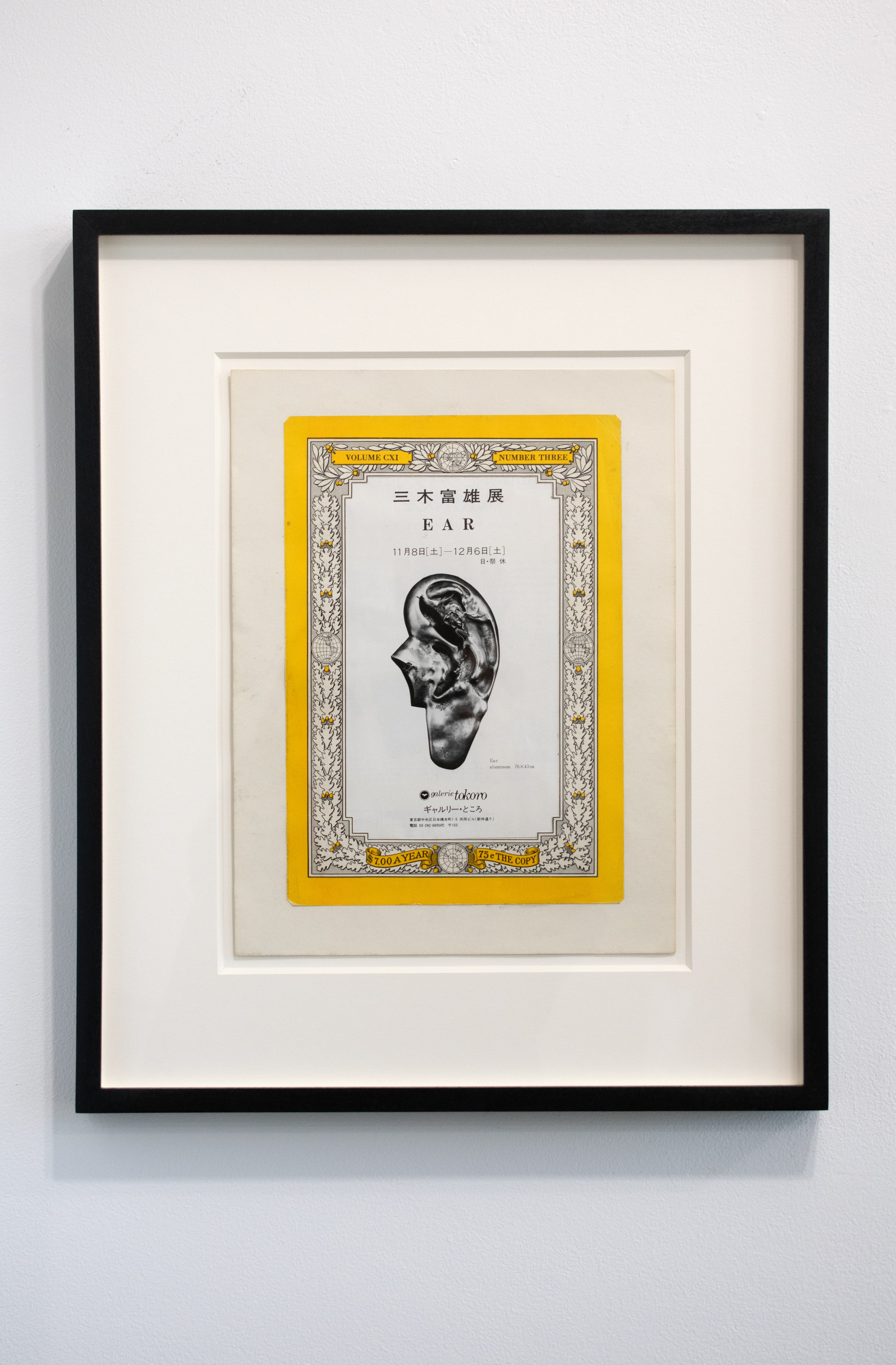
RT: I think Strand had a lot of National Geographic magazines.
EK: You see, this work has a material related to Tomio Miki [postwar Japanese artist known for the theme of ears], so I thought maybe this came from Japan. Wait, huh, would Tomio Miki really appear in a place like [National Geographic], I wonder. Ah! I pasted it on. To be honest, I didn’t think I pasted this myself.
RT: Look, it says Galerie Tokoro. A gallery in Nihonbashi in Tokyo.
EK: Tomio Miki was famous when I was in Japan. So maybe I bought this old [brochure]. So the stuff here is all picked up like that.
When I buy magazines and such, the criteria was “Ah, I like this.” But when I started making collages, I thought, “I got a lot now, maybe I’ll add them.” Then I would mix my own ideas.
Something like this is probably stuff I picked up, I believe, from the street. Then, I wiped it a little, and added it. I attached the string later. After all, with collage, I could get materials for free. I could pick up interesting things lying around, for free. That makes collaging very interesting. Many things were on the streets, like a spoon. “Ah, a spoon. If I wash it a little and clean it.” People here [in New York] throw many away. “Oh, what’s that? Maybe, I can use it.”
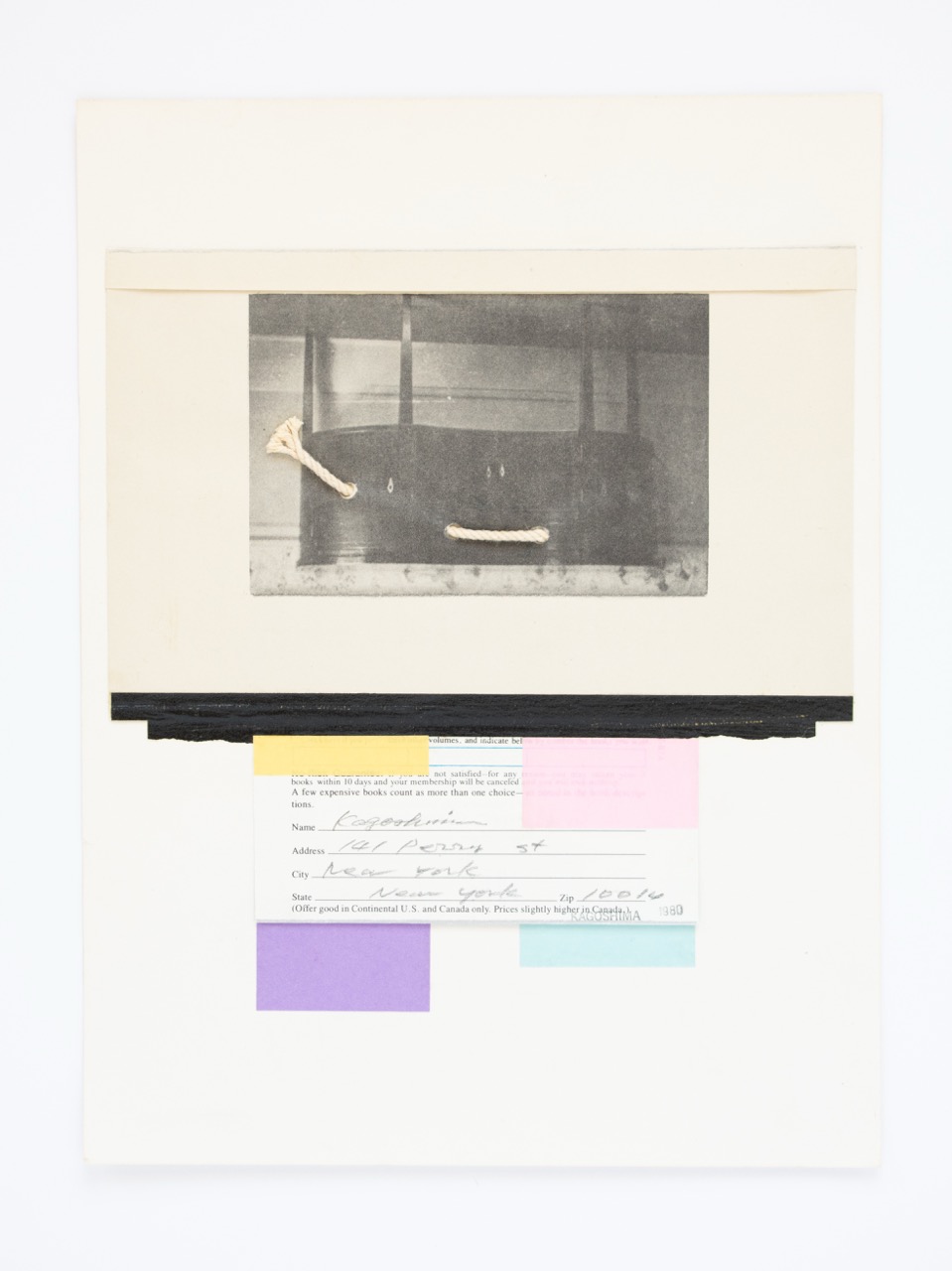
Collage on paper, 11 x 8 1/2 in (27.9 x 21.6 cm)
© E’wao Kagoshima; photo courtesy of Ulterior Gallery, New York.
RT: So, these discarded things inspire you.
EK: Collectors just collect, probably. Say, when they buy a book, that’s that. Then, perhaps they throw it away, and I find it, and think, “Ah, I’ll take this home and do something with it.” [Finding it on the street] can be my motivation.
RT: How did you discover gay materials?
EK: I found magazines and such thrown around on Christopher Street. I picked them up and used [inside pages].
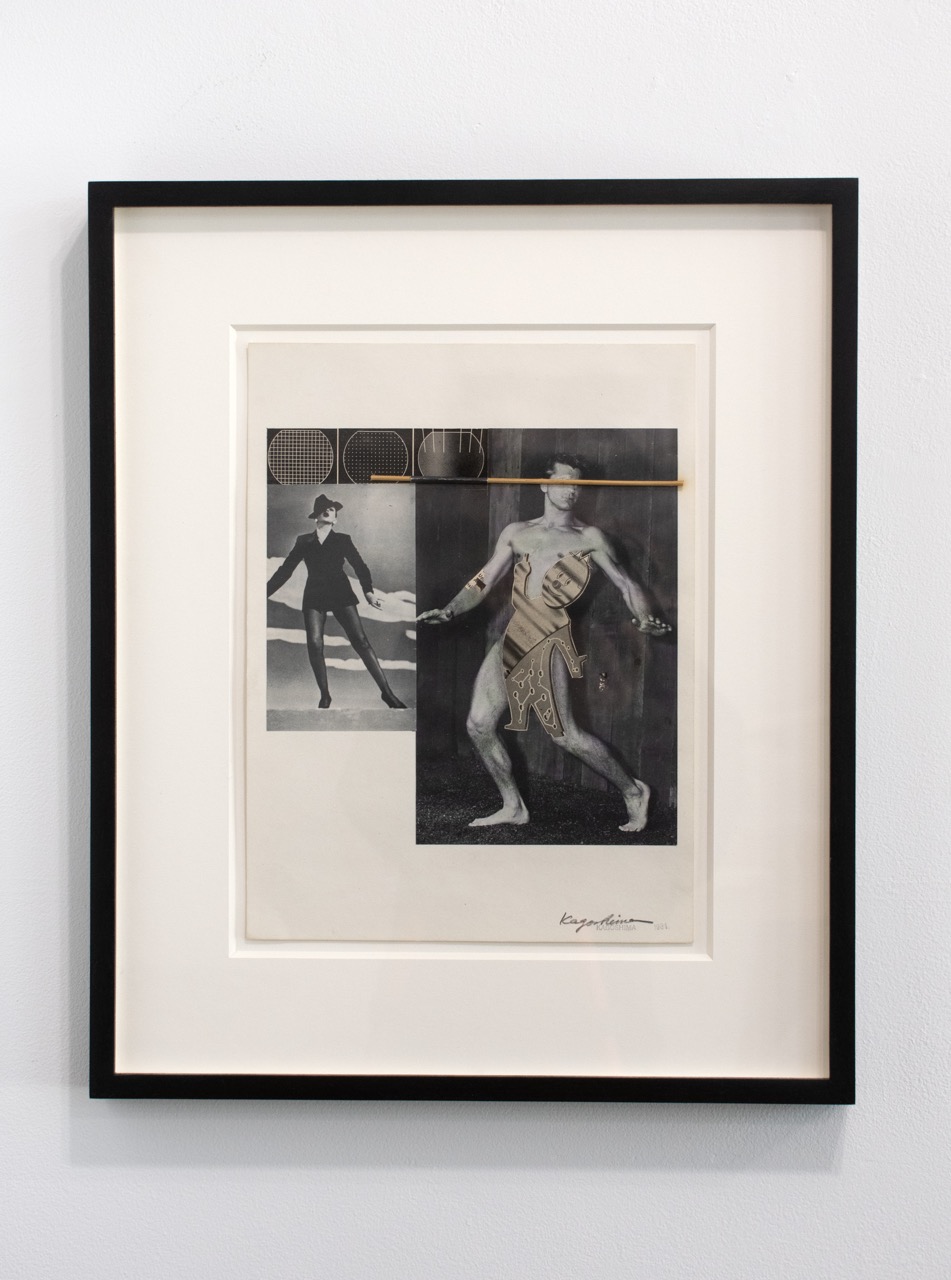
Collage on paper, 11 x 8 1/2 in (27.9 x 21.6 cm)
© E’wao Kagoshima; photo courtesy of Ulterior Gallery, New York.
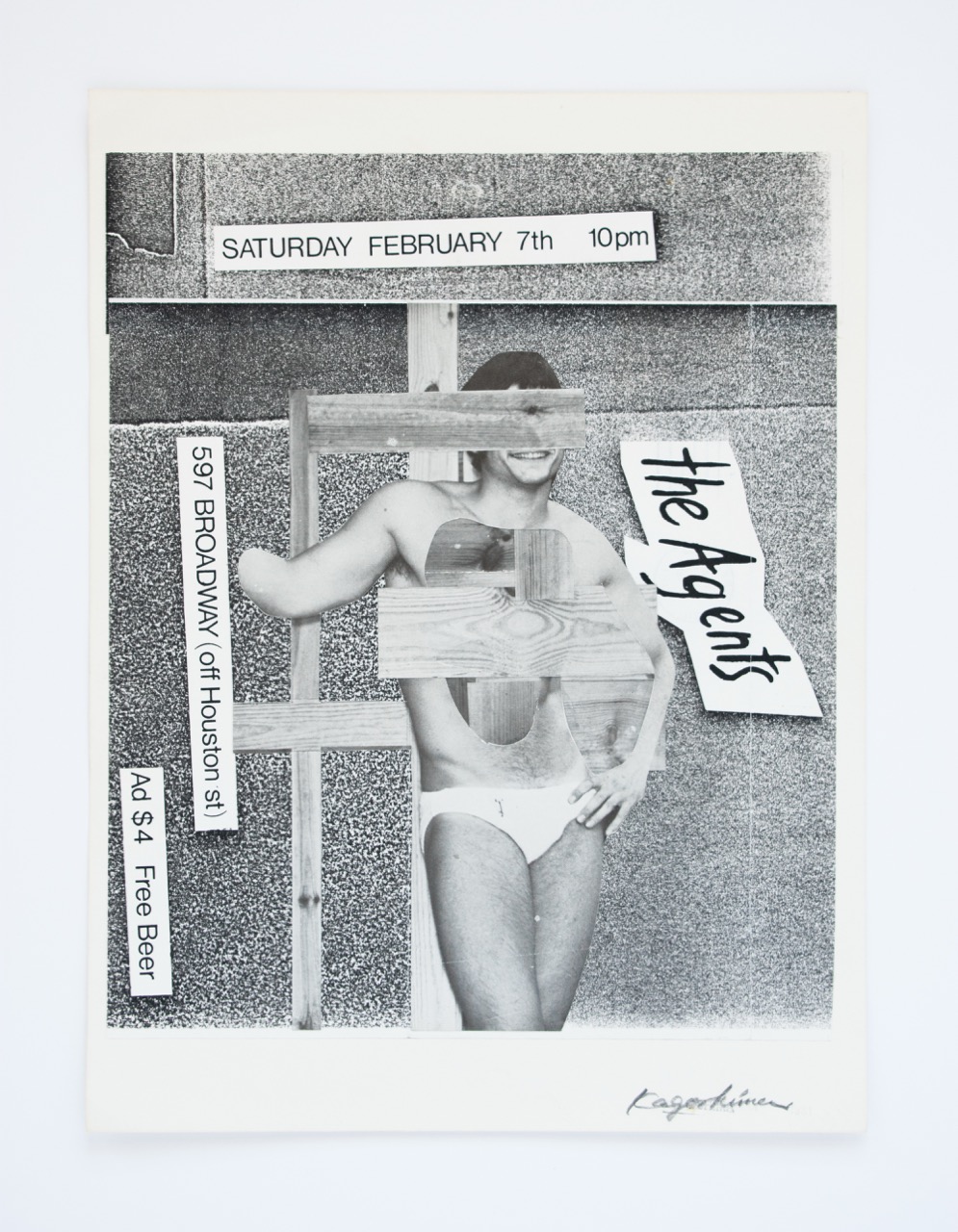
Collage on paper, 11 x 8 1/2 in (27.9 x 21.6 cm)
© E’wao Kagoshima; photo courtesy of Ulterior Gallery, New York.
Gay stuff, well, I must have also bought them at a used bookstore. No way I would find them at a regular bookstore. There were lots of shops selling those things on Christopher Street. Maybe they are gone by now. When I first lived on Perry Street [around the late 1970s and early 1980s], to be honest, the area was run down.
[Materials with] Chinese words were from Chinatown. Ah, 風俗 (fūzoku), that could be Japanese, I clipped it out of a newspaper. Doesn’t it look pretty?
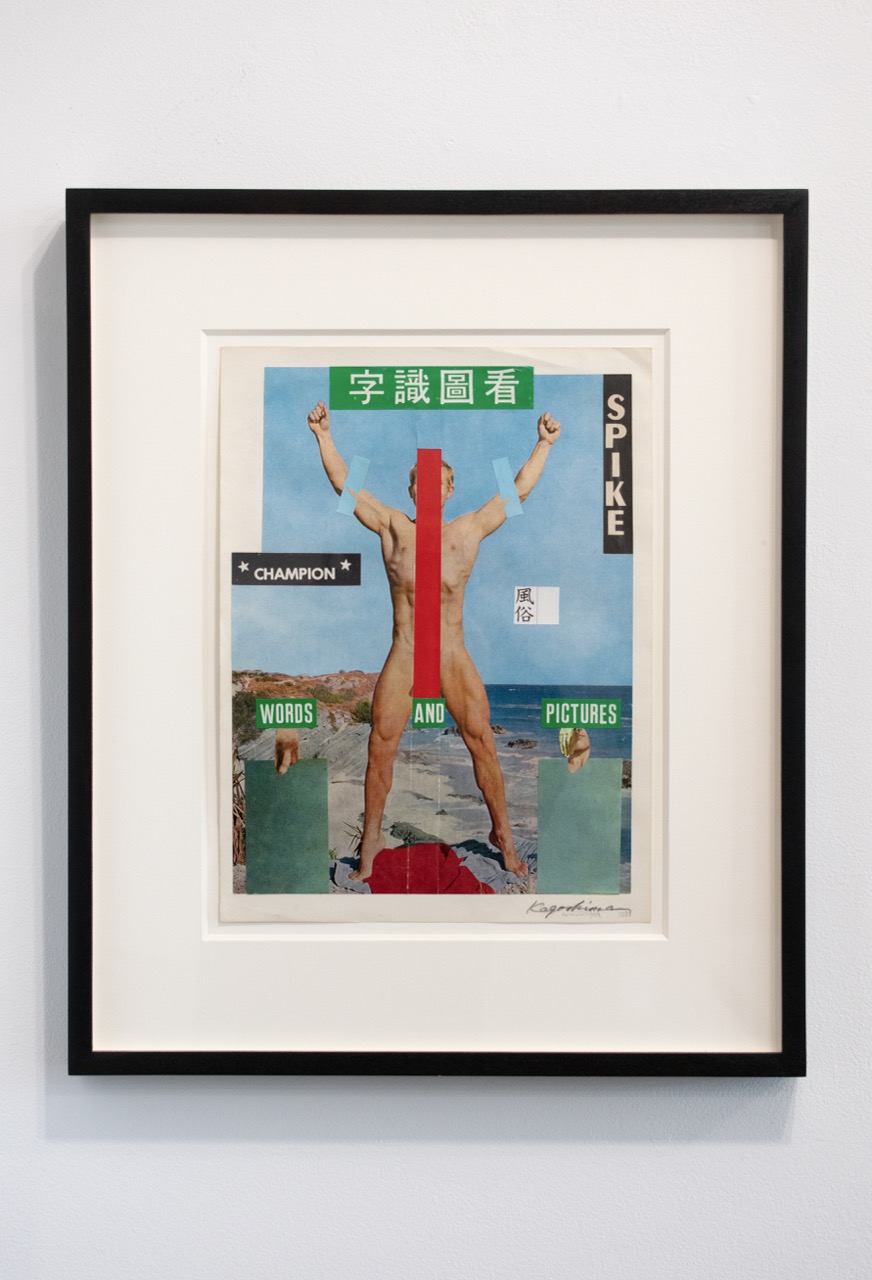
Collage on paper, 11 x 8 1/2 in (27.9 x 21.6 cm)
© E’wao Kagoshima; photo courtesy of Ulterior Gallery, New York.
In the past, there was a variety store called West Ribbon [in the West Village]. Looking at these collages now, I can tell I used to go to these [cheap] places a lot. Buying these things at full price is boring. So I liked collecting them and thinking about what I could do with them. When I wasn’t making collages, I would save them up, thinking, “This looks interesting.” I think this one [with the moon] was like that. It looked interesting.
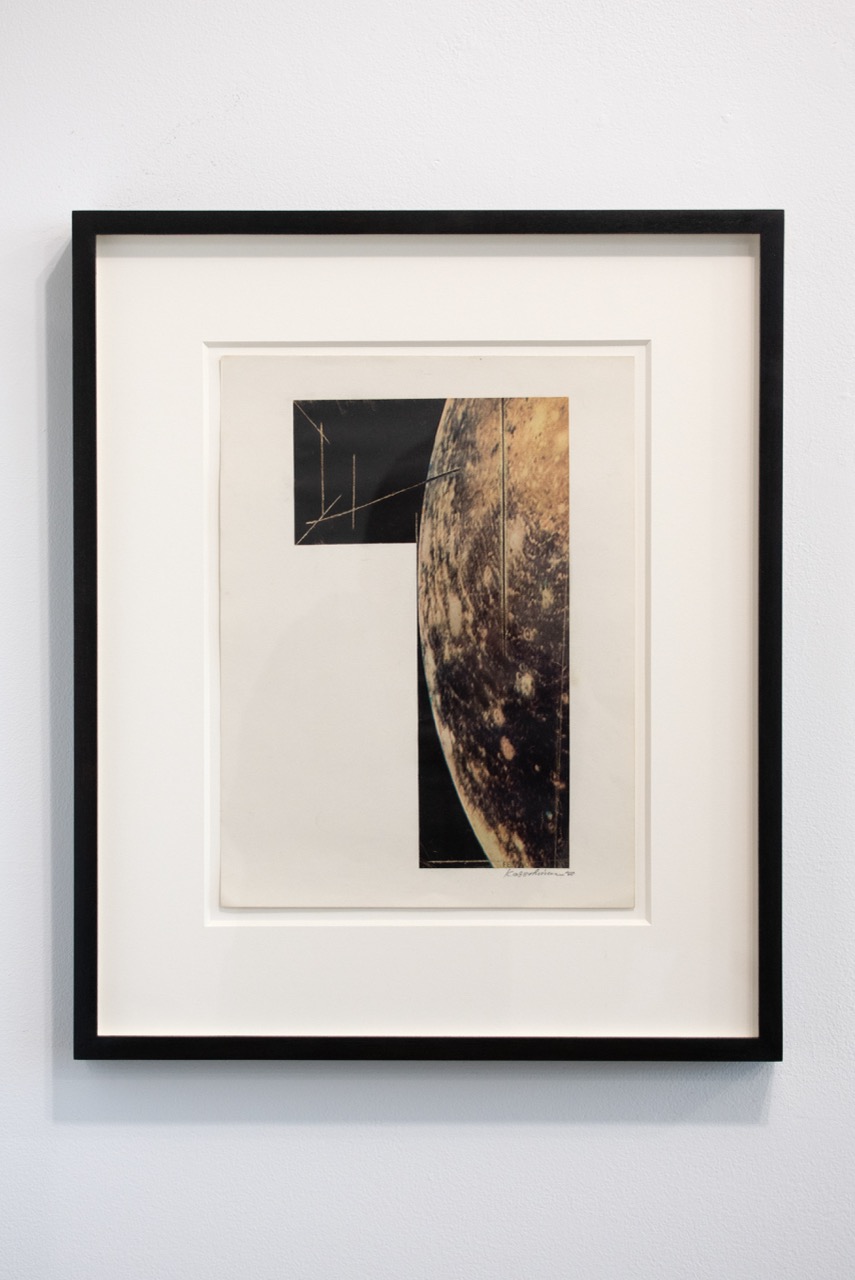
Mixed media and collage on paper, 11 x 8 1/2 in (27.9 x 21.6 cm)
© E’wao Kagoshima; photo courtesy of Ulterior Gallery, New York.
I think it’s the real moon. I must have first thought where to cut, how to manipulate it, and make it into a work. The US already went to the moon.
When I first started collage, which I felt you can easily do with glue and stuff. You don’t have to draw. But I did not know whether it would make a work of art, my own work, because this might just make an abstraction. I had never done abstract art on canvas. In America, most contemporary artists made abstraction. I felt it was overdone with that concept. Suppose you cannot have a new concept in abstraction any longer; but figuration has a long history. You cannot overdo it. After all, what is left to you is figuration. It is just that. Think about Warhol: he suddenly became a big figure in the art market, with Pop. I saw Warhol frequently walking in my neighborhood around Christopher Street. He must have had his friends around there. But when I saw him, he was always alone.
But you are too interested in my materials. Setting aside these technical issues, the key is to have everything ready so you can just jump right in and do it the moment the mood strikes. Every time you make something, you need that sense of flow, a kind of “vibe” to kick in. That’s what matters. It’s my belief that professionals operate on the mindset that it has to work that way. You can’t be sitting around and thinking about “art.” You must train yourself so your hands move instinctively without overthinking it. If you start thinking too much, you end up getting philosophical. Worse, you might begin to wonder, “Do I actually have talent?”
I still make collage-like constructions today. Sometimes, I get stuck, unable to figure out what to do with one spot or another beyond a certain point. It may be interesting, but if that’s all there is to it, that’s boring. I am afraid somebody else might have done it already. Then, I realize it’s more fun to cut some material, paste them with hand, and do it with your hands. That kind of thought comes to me suddenly and I would make some additions. [Although I don’t remember how I made this collage], that must be my thinking back then. Although having brought this work to this form, I still don’t know whether others might have done something similar or not.
TT: I think this is really interesting. See, a part of the figure is cut out. Now the body is lounging on a couch but the cut-out part, which looks like an apron, is pasted below.
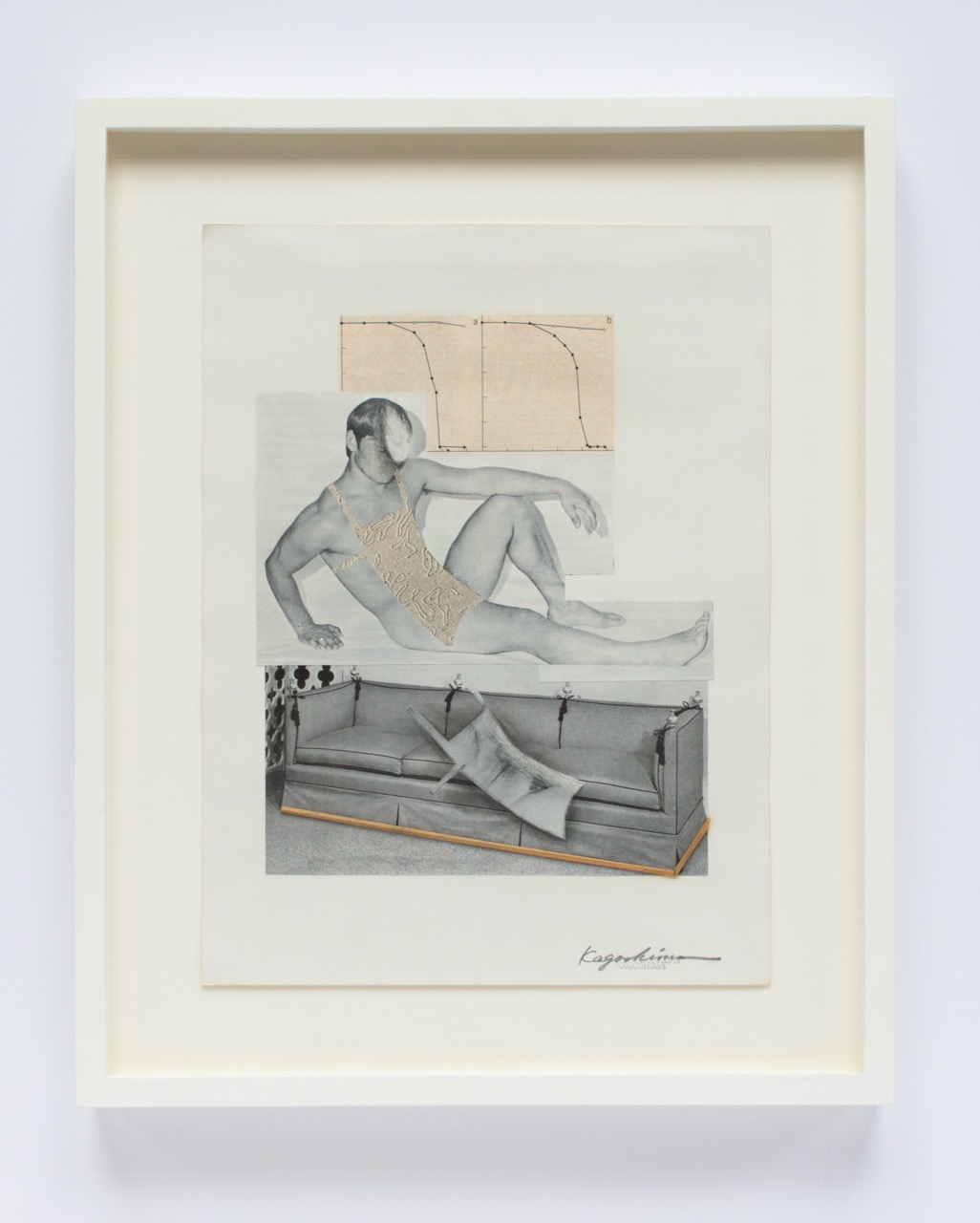
Mixed media on paper, 11 7/8 x 9 1/8 in (30.2 x 23.2 cm)
© E’wao Kagoshima; photo courtesy of Ulterior Gallery, New York.
EK: Look, this person can lie down right here. It’s positioned exactly like that. Theoretically, that’s how you can think. I don’t know about other artists, but I have to do it on the spur of the moment, otherwise, the idea will fall apart. You know how we talk about an idea “strikes” you, like a sudden flash. Fireworks make a good explanation. If a firework goes off, Boom!, and you only hear the sound and miss seeing it, then you can’t really say you saw the fireworks. Sometimes, when I’m at home, I hear the loud sounds of fireworks, but by the time I step outside, they’re already gone. Meanwhile, the people down below who set them off are all cheering, Ooh!, experiencing a joy. But for me, “Darn, I missed it. What a letdown.” Complete opposite.
So the inspiration comes like a flash of gunpowder explosion. Boom! Shooting up into the sky and exploding. But imagine if that were aimed at my window; the glass would shatter and it would be total chaos. We might even be evicted if a fire started. Reality is always around the corner. We’re here, living in this space where we nurture our dreams. But the moment you step outside, you will be surrounded by people; you could clash with someone, get into a fight, and end up dead. “Now” can suddenly turn into a dangerous place where accidents can happen in an instant. But if you decide it’s not dangerous, it isn’t at all. Looking at the scenery from here, for instance, I don’t feel any danger at all. But then, if you look down, it’s a completely different world down there. When you have that kind of spark, a flash of inspiration, you start to think, “Hey, that’s an interesting idea.”
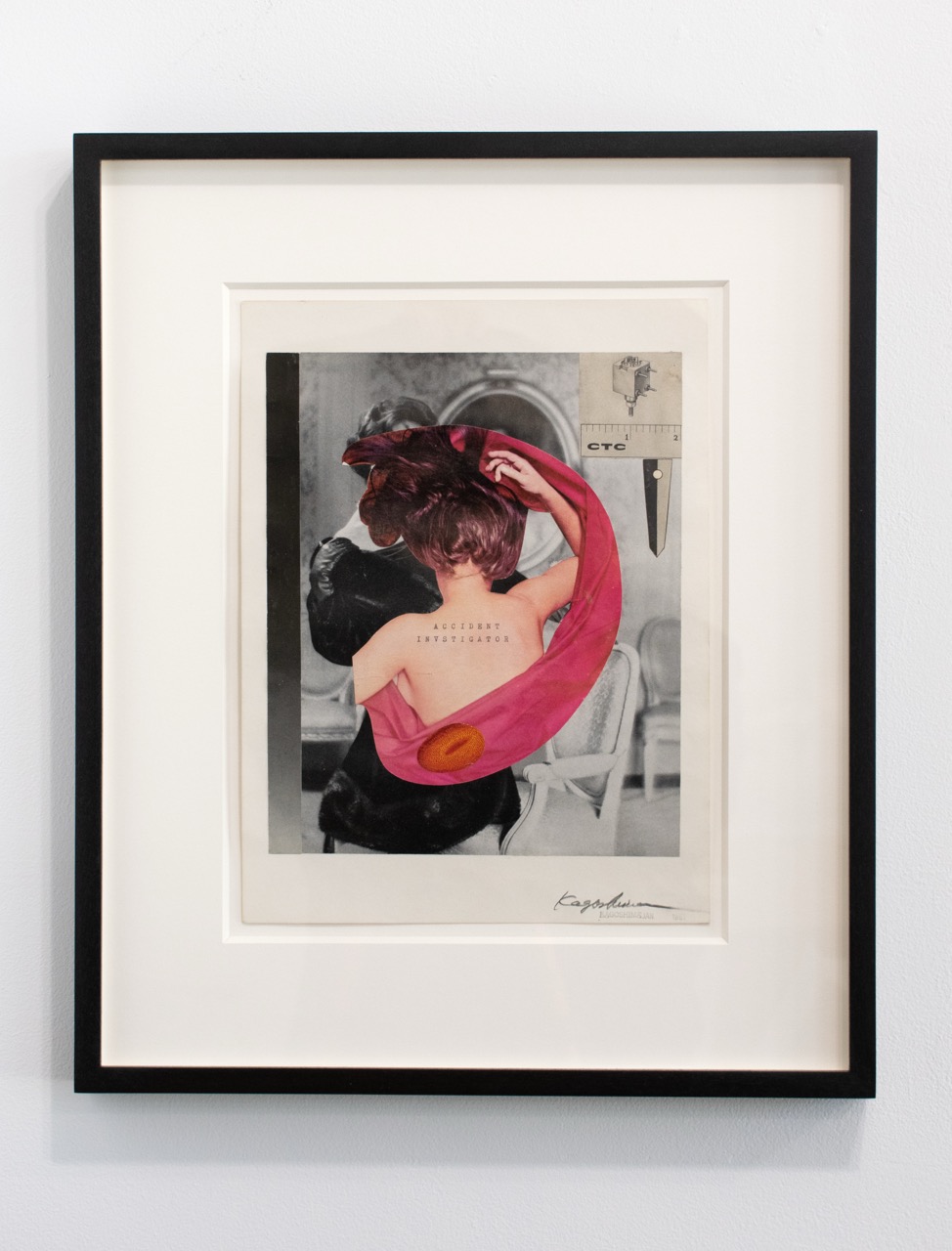
Mixed media on paper, 11 7/8 x 9 1/8 in (30.2 x 23.2 cm)
© E’wao Kagoshima; photo courtesy of Ulterior Gallery, New York.
RT: So, do you feel negative about abstraction?
EK: I think abstraction is something you think is popular nowadays to hang in a guest room. Since few people understand it, much less so than figuration, there is no issue of racial discrimination. If a picture shows a Japanese or a Vietnamese, people may think “they look a bit dangerous,” or something like that. Don’t you feel so? I certainly do.
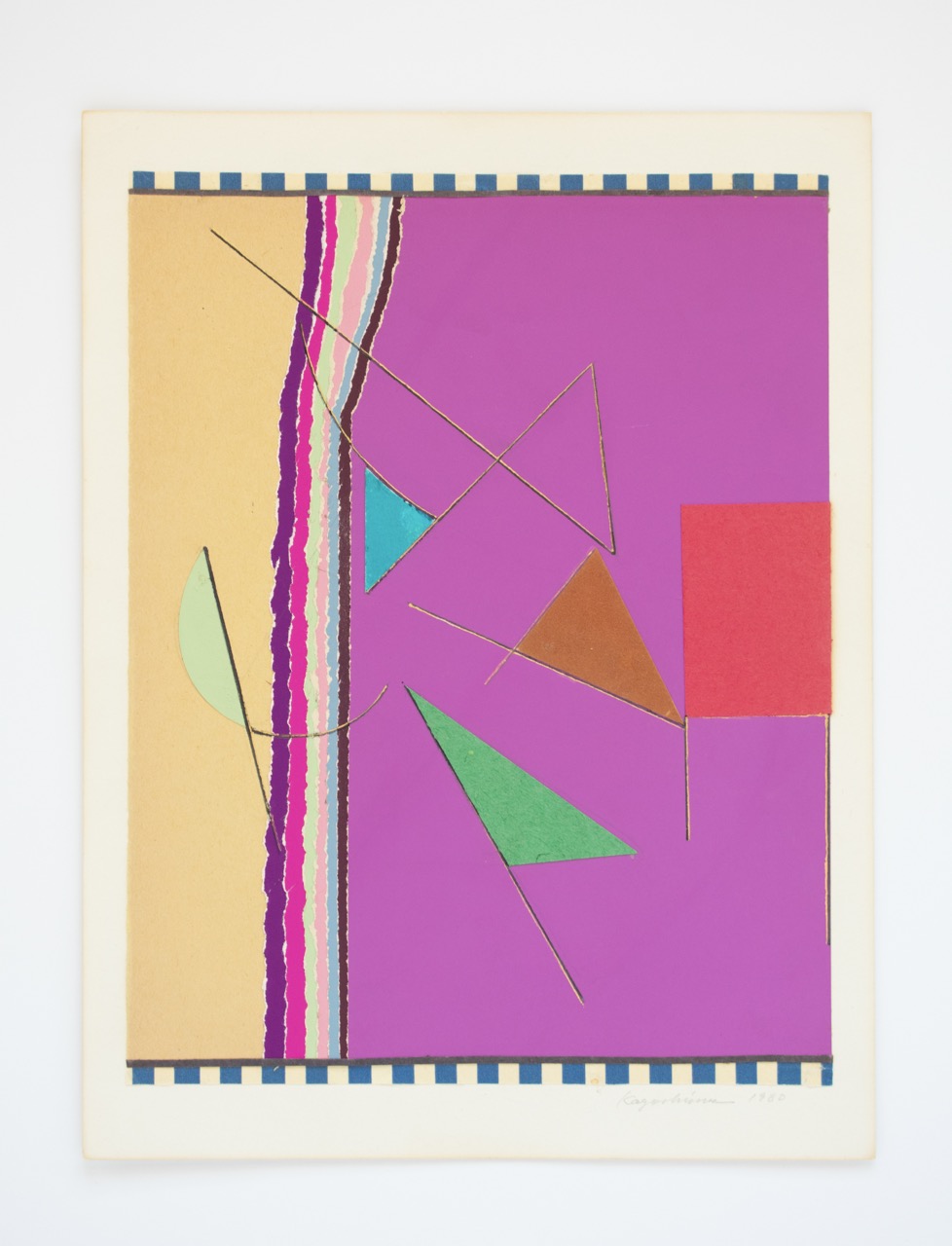
Mixed media on paper, 11 7/8 x 9 1/8 in (30.2 x 23.2 cm)
© E’wao Kagoshima; photo courtesy of Ulterior Gallery, New York.
RT: In your collages, you mixed abstraction and figuration. You also did “almost pure abstractions” as well as “more Dadaist figurative kinds.” In a sense, you don’t have one single style.
EK: You see, with Marcia Tucker … Ah, no, let me put it this way. [In postwar American art], the prevailing wisdom, as I understood it, was that in order to become famous, you had to establish a singular style, popularize it, and stick with it until you became a millionaire. Anything else just wasn’t accepted. In Western art, it was about establishing a signature style, like Jackson Pollock or de Kooning. The moment you see their works, you would instantly recognize it: “That’s a Pollock! That’s a de Kooning!” It was about building a brand name. That’s what it really boiled down to: establishing a brand. With Jackson Pollock, it was all about that wild, frenetic, dancing-while-painting. With de Kooning, it was more of a heavy, thumping feel, sort of a Dutch style, you could say.
RT: What about E’wao Kagoshima?
EK: Well, I decided to just tear it all down. Basically, the opposite approach is to get involved in absolutely everything, any sort of style.
RT: In this collage, you drew on pasted papers. Usually a collagist doesn’t do collage and drawing like this. Why did you decide to draw on these collages?
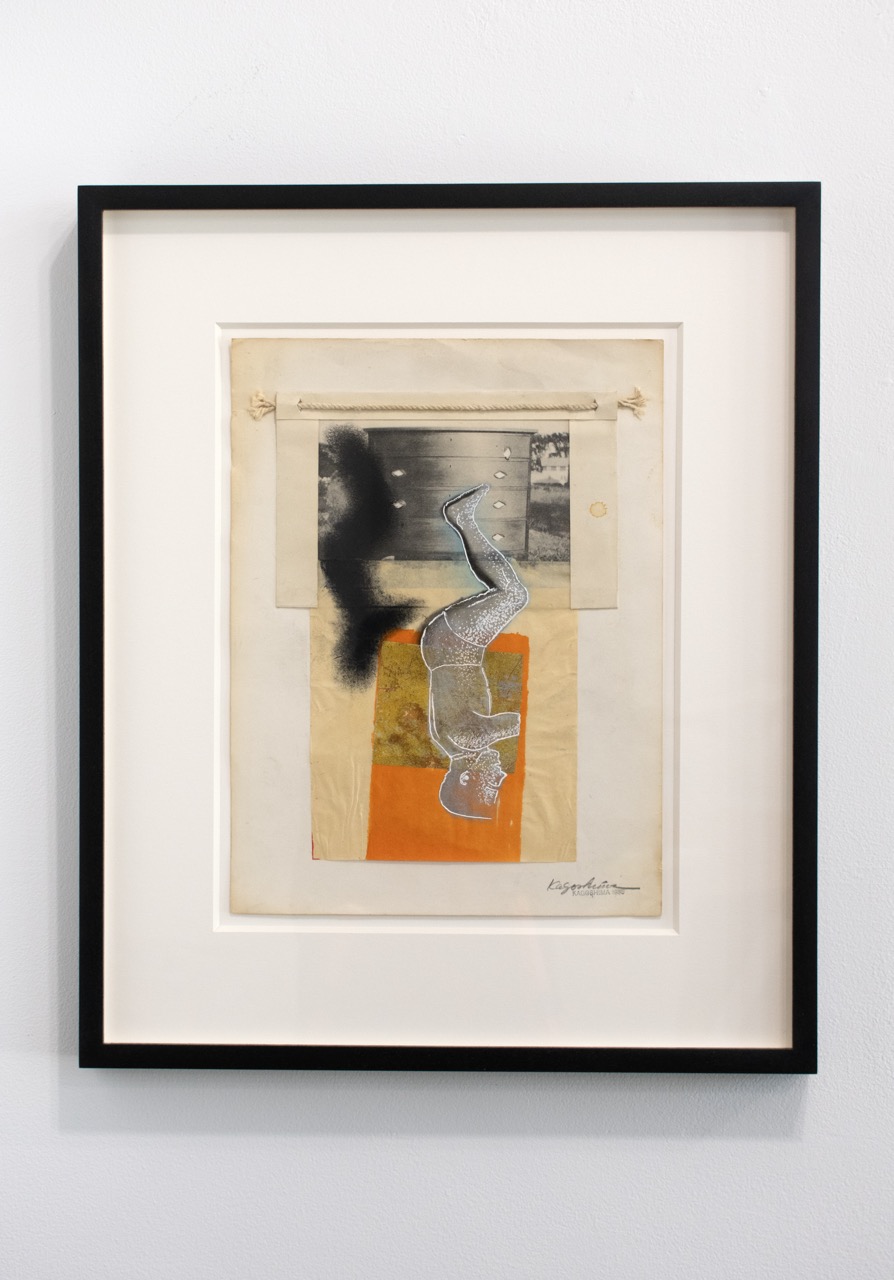
Mixed media and collage on paper, 11 x 8 1/2 in (27.9 x 21.6 cm)
© E’wao Kagoshima; photo courtesy of Ulterior Gallery, New York.

Mixed media and collage on paper, 11 x 8 1/2 in (27.9 x 21.6 cm)
© E’wao Kagoshima; photo courtesy of Ulterior Gallery, New York.
EK: I don’t know, but I must have thought the mixture of abstraction and figuration was more interesting. In American art, abstract artists are famous. There have been plenty of figurative artists. I imagine I thought this was one place I could show my drawing. It’s ultimately a part of it, not the whole. Looking at the whole, which is very colorful, let me insert a crouching figure. I must have thought in a flash.
RT: In all of these collages, figuration and abstraction are mixed.
EK: In the way I see it, collage is ultimately an all-inclusive medium. In short, it is not painting. Yet, since it involves photography, it uses cutouts and clippings, images taken from magazines, that is, existing materials. I wonder: if you do this, what happens when the person who originally took the photograph sees it? They might think, “Oh, that’s my work,” or rather, “That actress I photographed for the magazine is being used here.” This raised the issue of copyright, specifically, the question of who owns the rights, which became a legal matter in the U.S. Take Andy Warhol, for instance; he used other people’s work.
Debuted with Campbell’s soup cans. In my opinion, Campbell profited from Warhol’s works because it “promotes soup.” Does the company still exist? If I were a Campbell employee, I would say, “Good publicity.”
Then you can declare, “This is what I call Pop Art.” You can tell them, “What’s wrong with incorporating current trends into Pop Art? It’s publicity for your company.” Then the company president might say, “Oh, I see. So you’re claiming it’s your work? Well, that means it’s a valuable Andy Warhol piece; we should buy it at auction.” The situation flips completely. The person who initially felt exploited starts thinking, “If it becomes such high-value art, it’ll actually serve as publicity for us.” They will start seeing it the other way around. Everything can get turned upside down. You claim, “I created this.”
But if you don’t make it into your art, the person who took the original photo [will be forgotten]. It would be buried. Even if you ask who took it, nobody knows who the photographer was. So, my collage is the same kind of case. A photographer probably said, “Oh, that’s great!” and snapped what he saw. But now, no one remembers it. It ended up being thrown away. You know how printed materials all get burned or tossed out eventually.
EK: It is my belief that an artist doesn’t need theory or philosophy. I once read a book by a psychologist, which said the more intellectual an artist becomes, the fewer works he makes. I don’t remember which book that was, but I kind of agree. When I am making something, all I want is to avoid making boring art.

Dr. Reiko Tomii is an independent art historian and curator specializing in post-1945 Japanese art history. She co-founded PoNJA-GenKon, a scholarly listserv ( www.ponja-genkon.net ), in 2003 and currently serves as Co-Director. She has worked closely with numerous artists including Yayoi Kusama, Cai Guo-Qiang, Ushio Shinohara, Xu Bing, Mariko Mori, and Yukinori Yanagi. She was a guest curator of E’wao Kagoshima’s mid-career retrospective, Deconstructed Bodies, at the Center for Art Research and Alliances (CARA) in New York in 2025. A prolific author of scholarly articles and exhibition essays, she published her first English monograph, Radicalism in the Wilderness: International Contemporaneity and 1960s Art inJapan in 2016 from MIT Press and received the 2017 Robert Motherwell Book Award. It was turned into an exhibition Radicalism in the Wilderness: Japanese Artists in the Global 1960s at Japan Society Gallery in New York in 2019. In 2020, she received the Commissioner for Cultural Affairs Award from the Japanese government. She is currently preparing her second English monograph, Defying the Curse: Japanese-Type Modernism and Belatedness.