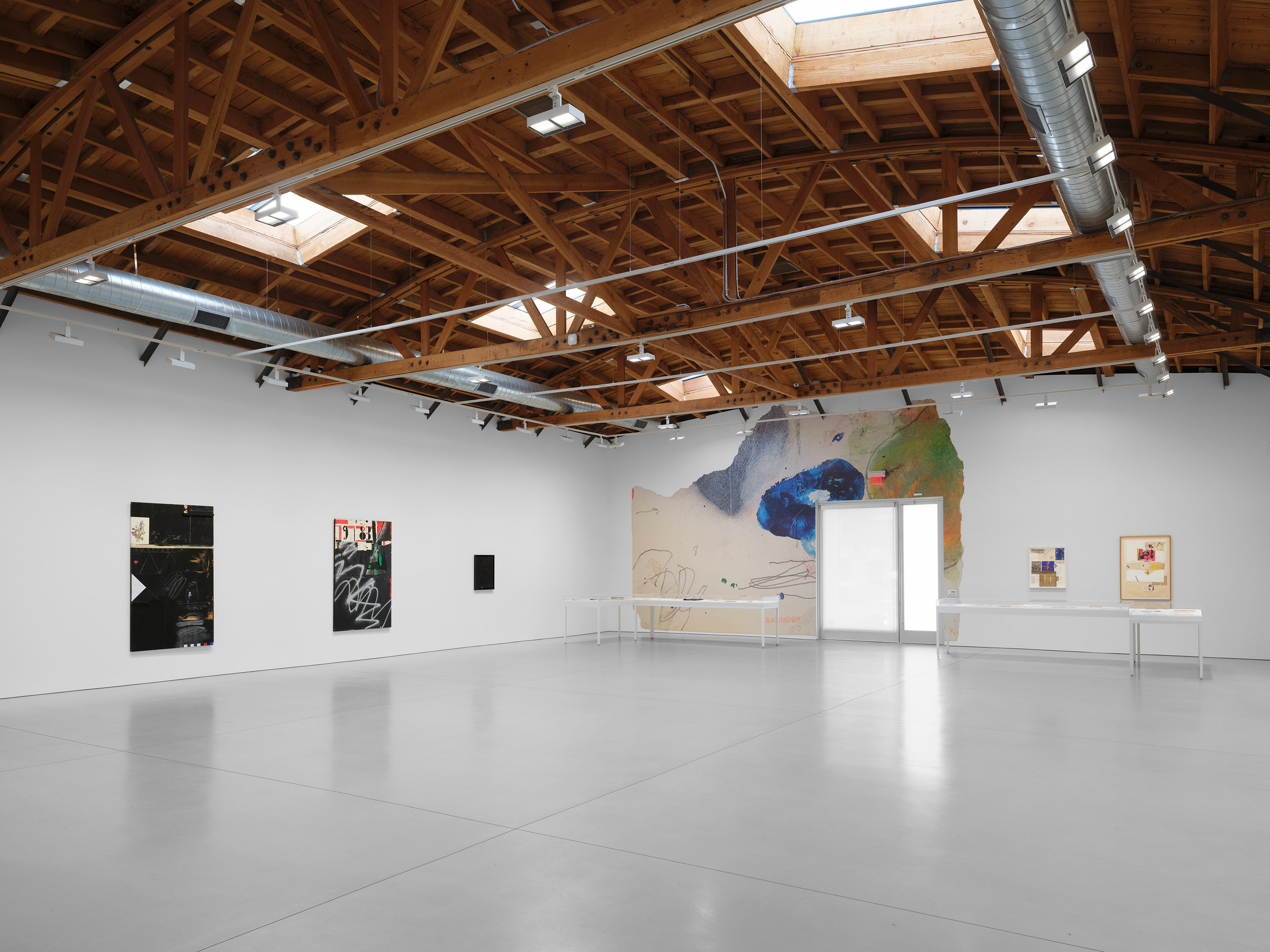
Entering the David Zwirner gallery on Western Avenue in Los Angeles is to step into what Toni Morrison described as an “outrageous bounty.” The retrospective Notes from LA, curated by Ebony L. Haynes, presents the late Raymond Saunders (1934–2025) as a permanent and preeminent focal point for the medium of contemporary collage.
Amidst the shorthand chalk marks, weathered metal, and found ephemera, the show reiterates that Saunders’s practice was never just about aesthetics, never solely regarding one singular aim. Instead, for Saunders, a lifelong educator, it was a profound pedagogical technology, a system of knowledge and survival rooted in the Greek techne (craft) and logos (discourse).
Saunders’s technical foundation was laid in Pittsburgh under Joseph C. Fitzpatrick, the same mentor who taught Andy Warhol and Mel Bochner, before studies at the Pennsylvania Academy of the Fine Arts, the Barnes Foundation, and a BFA from the Carnegie Institute of Technology (1960). A move to Oakland the following year to complete an MFA at the California College of Arts and Crafts proved transformative. There, teaching and artmaking became equal, reciprocal pursuits, and his decades as a professor at California State University, Hayward (now Cal State East Bay), shaped a nonhierarchical approach to pedagogy. He was committed to broadening access for working-class communities, treating the classroom as a vital site for the exchange of ways of seeing the world. Having trained in a traditional and rigorous academy, Saunders refashioned himself, forging a more democratic pedagogical practice, his academic career a live-action version of his assemblages, a constant accumulation of notes and shared knowledge.
As Morrison wrote of Saunders’s ability to bridge the physical and the psychological, his “emotion fused by a rapier intelligence forces us to see clearly what we only guess at: the shape of language, the speed of color, the massy weight of space.” Saunders’s works translate the ineffable into the evident. What a gift we are able to witness.

That Haynes, known for her commitment to innovation and creating space for artists to take risks, chose to organize this retrospective speaks directly to the nature of Saunders’s practice. Her curation of Notes from LA mirrors his own pedagogical ethos: both are acts of deliberate, nonhierarchical exchange. The selection of tactile works, studio ephemera, and intimate vitrines filled with postcards and stamps from his Oakland studio does not simply display Saunders’s output; it reconstructs his process, inviting viewers into the shorthand logic of a lifelong archivist.
Saunders’s work illustrates the long arc of the blackboard as a universal interface. This history begins in the 11th century with smooth sheets of dark gray slate, the original reusable writing surface, and extends into the present day, where digital platforms like Blackboard Learn now host materials and facilitate the exchange of knowledge. Saunders, who lived and worked through this technological transformation, stands at the center of this arc, his canvases anticipating the logic of the Learning Management System decades before it existed.
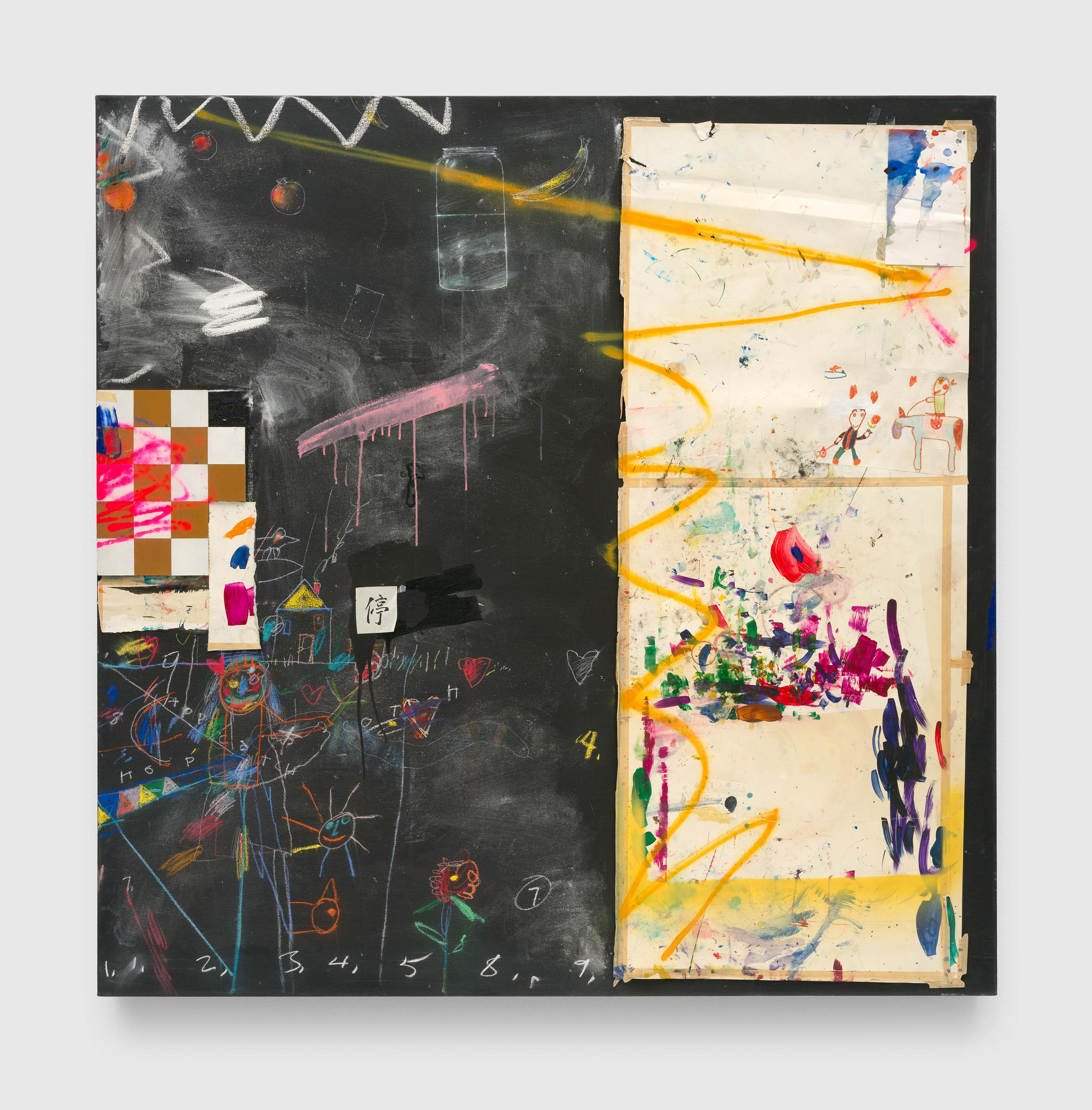
His “black-ground” compositions, a term Saunders used to describe his use of black as an active, generative ground rather than a neutral backdrop, are nowhere more alive than in We Try (1985). A whimsical and nostalgic primer to his blackboard practice, the work presents a square black void whose continuity is interrupted by a long tan rectangle, reminiscent of a manila folder, stretching from the top to the bottom of the canvas and creating two distinct planes for his mark-making. Measuring 73 x 73 1/8 inches and comprised of acrylic, spray paint, chalk, collage, and mixed media on canvas, the work lays bare the breadth and range of Saunders’s manipulation of material.
His hand is everywhere here: multicolored chalk drawings of the sun, hearts, and a timeline ranging from 1 to 9 (with 4 appearing twice, as if the sequence continued before being collaged over with tape and paper), a beautifully sketched outline of a cylindrical object, and various fruits. A layered strip of roughly taped paper is adorned with gestural marks that appear to be finger-painted, and above it, an elementarily drawn figure presents a flower to a companion on horseback. Working over these dark expanses with white chalk, Saunders enacted a pointed reversal of the traditional figure-ground relationship, where the expected roles of an object (figure) and its background (ground) are deliberately swapped, challenged, or made ambiguous. In doing so, he transformed the canvas into a palimpsest, a site where knowledge is constantly layered and preserved, annotated and rewritten. This is an alchemy that creates something from nothing, keeping everything. As Haynes notes, the chalkboard works “signify a mode of pedagogy where information is transmitted, edited, and continually reworked live and in action” — a conceptual foundation she identifies across all of Saunders’s output, in which “everything is in process and prone to change, both physically and psychically.”
This spirit of accumulation and accretion is central to understanding Saunders as an archivist. He gathered what he referred to as urban debris, found objects, signs, and doors, assembling unexpected visual resonances and forging works of art from fragments. The vitrines at David Zwirner offered a window into this impulse: visitors could encounter postcards and stamps from his Oakland studio, ephemera that illustrate how his life was a continuous impulse to annotate, keep in touch, and accumulate. Haynes explains that for Saunders, these postcards “were meant to be used and shared with students, friends, colleagues, and loved ones” — at times didactic, at times simply connective, reflecting a nonhierarchical approach to teaching where students were treated akin to friends, all sharing and exchanging experiences and knowledge.
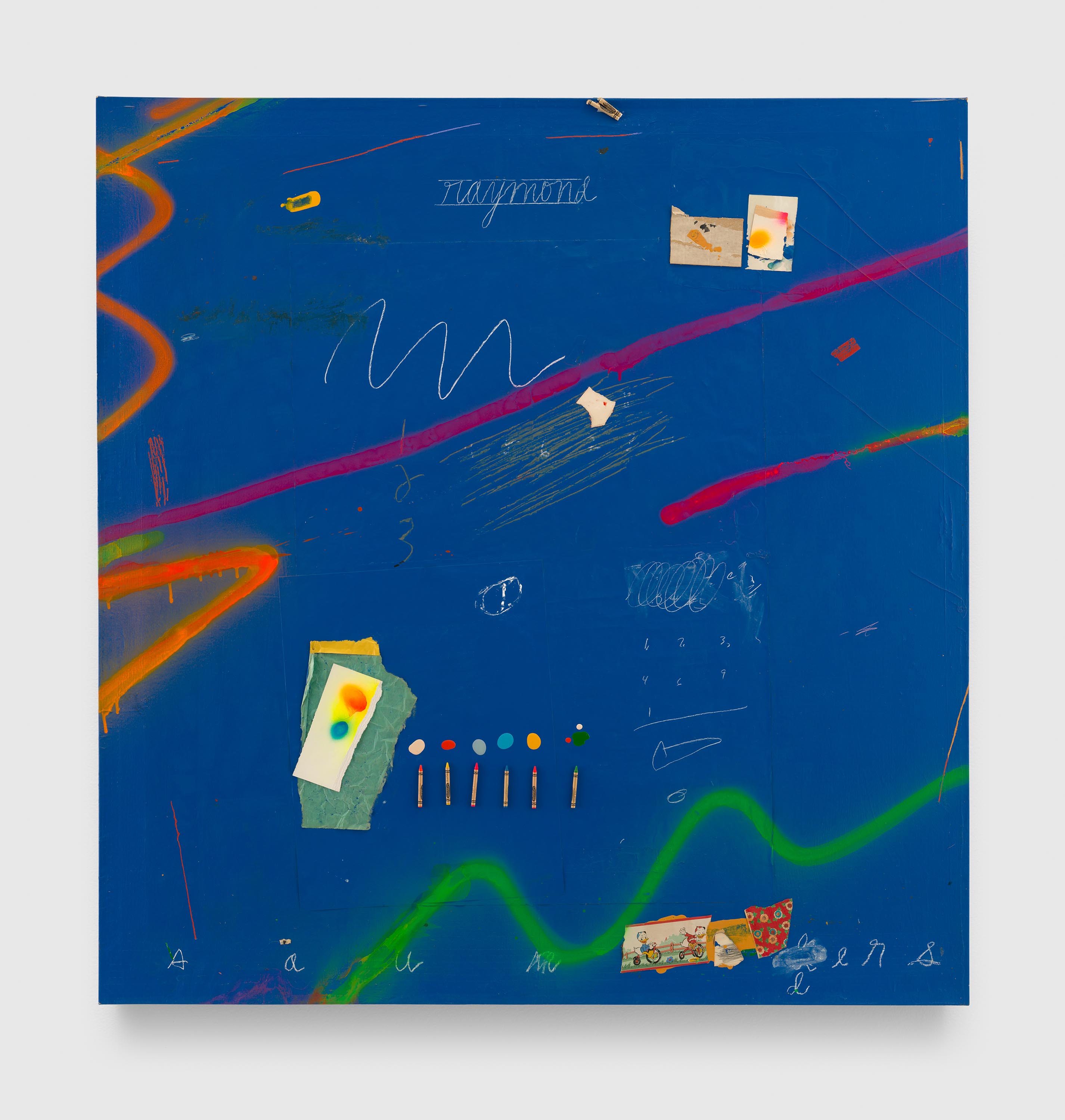
To see Saunders’s work is to witness what Fred Moten describes as the “necessity of paying attention to our history,” to navigate the unforeseen, an improvisation inherent to Black life, that Moten argues becomes both a method of survival and an object of study. Nowhere is this more apparent than in the striking royal blue expanse of It Wasn’t Easy Being a First Grader (1979/1984). This work operates through a ‘shorthand’ logic, much like the method of rapid writing that communicates through abbreviations and symbols. Saunders substitutes paint, crayons, and found imagery for letters, building a visual vocabulary that accumulates meaning rather than narrating it linearly, affixing crayons, fragments of drawings, and book illustrations to the canvas as if assembling a personal lexicon of memory and experience.
In It Wasn’t Easy Being a First Grader, the bold cobalt blue work, measuring 77 3/8 x 74 inches, is comprised of acrylic, spray paint, and chalk. Six primary-colored crayons are affixed to the bottom of the canvas, amid pasted cartoons, blobs of paint, and spray-painted gestures that span the work. Including a number table and his own name, “Raymond,” written in neat cursive and centered in the composition, Saunders invites us into a nostalgic site of exchange: an expansive tableau that rewards careful and sustained engagement, allowing a multiplicity of meanings to emerge through its syncopated layers.
The intellectual foundation of Saunders’s pedagogy is anchored in his 1967 pamphlet, Black Is a Color. Published as a rebuttal to the perceived narrowness of the Black Arts Movement, the text argued that siloing Black artists fails to capture the vastness of their expression. Saunders’s imperative was to “recognize the wider reality of art, where color is the means, not the end.” Haynes, whose own practice has long resisted the flattening of Black artistic identity, whose 52 Walker gallery launched with an all-Black staff and a mission to challenge traditional commercial gallery models, is a natural heir to this philosophy.
As she observes, Saunders’s visual shorthand is “a transmission of information and a set-up of an emotional and psychic dialectic between the viewer and the work” — his artistic sovereignty expressed not through closure, but through a practice that remains, in her words, “dialogous and interminably fluid.” In bringing Notes from LA to California, she extends Saunders’s argument into the present: that Black artists cannot and should not be confined to a single story, a single market, or a single mode of seeing.
By positioning himself as responsible only for being “as fully myself, as man and artist, as I possibly can be,” Saunders created a blueprint for the modern collagist. He taught us that the gesture of collage, as a way of making meaning and material, is inherent to Black life on this planet. This is what I refer to as a “technology of the sacred,” a term I developed in my research on Black collage artists, a system of making passed down through an ancestral lineage of Black artistic resourcefulness and imagination. From the improvisational assemblages of Romare Bearden, the found-object sculptures of Betye Saar, and the material-rich installations of Rashid Johnson, Black artists have long developed analog systems for gathering, preserving, and transmitting knowledge in the face of erasure.
Saunders’s black-ground canvases are a vital node in this lineage. What he enacted in paint, crayon, and urban debris, layering memory and meaning onto a dark expanse, the digital LMS now performs in code and servers: hosting, organizing, and transmitting knowledge to those who seek it. The technology changed; the impulse did not. To use Blackboard Learn today is, in some sense, to inherit a logic that Black artists like Saunders had already perfected, that accumulation is survival, and that to gather and share knowledge is itself a sacred act.
In Notes from LA, Saunders’s pedagogy of assemblage remains an open book, an archive that is alive. His work and this show operate as a vehicle and a site of exchange, facilitating the translation of meaning from artist to viewer. Saunders was a wayfinder with a way of seeing that transforms urban debris and pigment into what Morrison famously called a “kind of trembling tenderness touched with menace, exhilaration, relief, and the outrageous bounty at our disposal.”
Through his shorthand mode of expression, his marks, the delicate flowers, the cardboard, the accretion, the aggregation, fueled by his lifelong impulse to annotate, the late artist illustrated that Black collage and assemblage, as a gesture and act, becomes a preeminent form of creative expression for Black artists navigating the unforeseen. As Haynes observes, a globalized art market tends to shift artists toward a more cosmopolitan direction, making it all the more essential to “showcase someone so woven through and through by a certain place” — Saunders’s practice, which spanned studios, ateliers, and classrooms from New York to Paris to Venice, California, is in her view “a revelation of what can arise from the specificity of location.” Saunders's first solo West Coast exhibition and first major museum presentation was at the San Francisco Museum of Modern Art in 1971. Haynes's tender and brilliant curation marks the first solo exhibition of Saunders's work in Los Angeles in over a decade.
Raymond Saunders himself remains a permanent reference point for any artist seeking to make something from nothing. For Black artists, the lesson of his life and his use of assemblage as technology and vernacular language is that our history is not just a burden of survival, but an endless possibility for beauty and hope.
References & Source Notes
Morrison, Toni. “Introduction.” In Raymond Saunders. Exhibition catalogue. San Francisco: Stephen Wirtz Gallery, 1993, p. 5.
Saunders, Raymond. Black Is a Color. Self-published pamphlet, 1967.
Saunders, Raymond. Quote from Artists Observed by Harvey Stein, Cornell Capa, and Elaine A. King. New York: Abrams, 1986, p. 86.
David Zwirner Press Release. “Raymond Saunders: Notes from LA.” Curated by Ebony L. Haynes. February 24–April 25, 2026.
Moten, Fred. (Research notes on the necessity and method of improvisation as a tool for Black survival).
Haynes, Ebony L. Written responses to interview questions. March 2026.